

Hydroponic farming in Mexico and across Latin America has moved from niche greenhouse trial to commercial pipeline in less than a decade. Berries from Jalisco and Michoacán, tomatoes from Sinaloa, leafy greens around Mexico City, and the rise of hydroponic blueberry nurseries in Peru and Chile have turned the region into one of the fastest-growing controlled-environment agriculture markets. For a B2B buyer evaluating where to place the next greenhouse, the opportunity is real — and so are the climate zones, the customs paperwork, and the language gap. This guide walks a buyer through what makes a hydroponic project in Mexico or LATAM different from a US or European project, and where the engineering decisions have to change.
Why Latin America Is Now the Fastest-Growing Region
Three forces are stacking on top of each other. Fresh-produce export into the United States and Canada has tightened around food-safety and traceability rules, which favors growers who can document inputs and harvest dates — exactly what a hydroponic system records by default. Water scarcity in central Mexico, northern Chile, and coastal Peru has pushed growers off open-field production and into closed-loop systems where every liter of nutrient solution is reused. The counter-seasonal window — when North America is frozen, LATAM is in peak harvest — gives greenhouse operators a pricing advantage soil-based farms cannot match.
The buyer landscape now spans family-owned berry exporters in Jalisco buying their first Dutch bucket system, mid-sized operators in Peru scaling blueberry substrate from 5 ha to 50 ha, and Chilean salad processors switching growers from NFT to vertical towers. Each profile wants a different mix of equipment, but they share three constraints: import logistics, local certification, and after-sales support in Spanish.
Climate Zones: Altitude, Humidity, and Aridity in the Same Region
A single shipment to Latin America can land in three different climate envelopes. That is the first thing we flag with any new buyer, because the same NFT channel and the same shade screen do not perform in all three zones.
| LATAM zone | Example sites | Day/night °C | Humidity | Grower implications |
|---|---|---|---|---|
| High-altitude temperate | Mexico City, Guadalajara, Bogotá | 22–28 / 8–14 | 50–70% | Wide day-night swing; venting and anti-condensate film matter; high UV at altitude |
| Humid tropical lowland | Veracruz, Cartagena | 28–34 / 22–26 | 80–95% | Pythium and downy mildew pressure; dehumidification drives yield more than heating |
| Arid coastal / desert | Sinaloa, northern Chile, Piura | 26–35 / 12–18 | 30–55% | High transpiration; desalination water is common — EC and sodium must be measured weekly |
| Mild Mediterranean | Central Chile, Uruguay | 20–28 / 6–12 | 55–75% | Excellent for cool-season greens; mild winters reduce heating capex |
The practical effect on equipment choice: an arid-coast buyer typically needs dutch bucket systems with high-frequency drip and shade screens, while a high-altitude buyer needs more venting, double poly cover, and stronger UV-stabilized resin. We have shipped both from the same Ningbo production line, but they leave the factory with different resin batches and different accessory lists. Skipping the climate-zone conversation usually ends in a retrofit bill in year two.
Import Logistics: Manzanillo, Callao, Cartagena, and Valparaíso
Container logistics into Latin America are workable but unforgiving. The four ports that handle most of our hydroponic equipment shipments are Manzanillo (Mexico), Callao (Peru), Cartagena (Colombia), and Valparaíso (Chile). Each one has its own paperwork rhythm, and the most expensive line item on a LATAM project is almost always demurrage.
- Manzanillo, Mexico. Pacific gateway for central and western Mexico. Importers need a Mexican RFC tax ID, NOM paperwork for any electrical component, and an import pedimento from a registered agent. Typical clearance runs 5–10 working days on a clean file.
- Callao, Peru. Principal port for Peru and western Bolivia. SENASA inspection applies to anything that has touched soil or organic matter, so equipment must be packaged away from untreated wood. Allow 7–14 working days for first-time importers.
- Cartagena, Colombia. Handles most container traffic for Colombia and Ecuador. INVIMA paperwork applies to NFT channels and Dutch buckets — anything in contact with nutrient solution.
- Valparaíso, Chile. Reliable and fast, with SAG biosecurity inspections. Chile has the cleanest port process in the region and the strictest biosecurity checks.
The single biggest mistake we see on first LATAM shipments: wooden pallets and untreated crating. A pallet stamped with the wrong IPPC mark can hold a container at the port for weeks. We ship all hydroponic equipment on heat-treated pallets with ISPM 15 stamps, and we wrap foam and cardboard in plastic — the same rule applies across the four ports.
For buyers new to importing from China, the importing hydroponic equipment from China guide walks through the document set, and the container loading for hydroponic orders page covers how we pack to reduce in-transit damage.
Local Certifications: NOM, SENASA, INVIMA, and SAG
Compliance in Latin America is country-specific, and what passes in Mexico can still be held at a Chilean border. The four marks that come up on almost every project:
| Authority | Country | Scope | What a buyer should expect |
|---|---|---|---|
| NOM (Norma Oficial Mexicana) | Mexico | Electrical safety, food contact | Pumps and panels need a NOM certificate or a NOM-recognized equivalent (UL, CSA) plus a local test report |
| SENASA | Peru | Phytosanitary + agricultural inputs | Required for any equipment touching edible produce; also governs irrigation water analysis |
| INVIMA | Colombia | Food-contact and sanitary registration | Applies to NFT channels, Dutch buckets, reservoirs, and any piping in contact with nutrient solution |
| SAG | Chile | Biosecurity and agricultural inputs | Strict on biosecurity; clean equipment and documented origin are non-negotiable |
The certification conversation needs to happen before the pro forma invoice. If a buyer needs NOM for a Mexican install, we build that into the order form at quote time. If equipment is being sent to Peru and Colombia for the same client, we separate the documents so each country’s inspection clears independently. Skipping that conversation at quote time is how buyers end up paying twice — once for the equipment and once for a local re-test.
Spanish-Language Support, Spare Parts, and After-Sales
Most Latin American operators run their greenhouse in Spanish — engineering team and harvest crew included. English manuals stay on the shelf. We supply every LATAM shipment with a Spanish-language install manual, Spanish sub-menus on the climate controller, and a Spanish-speaking project coordinator. When a pump fails in Jalisco on a Sunday afternoon, the grower needs a WhatsApp number that answers in Spanish, not a ticket in a global CRM queue.
Spare-parts stocking is the second after-sales gap we close. For a multi-hectare install, we ship a 5–8% spare-parts kit in the same container — bulkhead gaskets, drip emitters, pump seals, controller fuses, shade-screen clips. The cost is small relative to a container; the cost of not having them is a multi-day harvest delay.
Project Snapshots: Mexico Tomatoes and Peru Blueberries
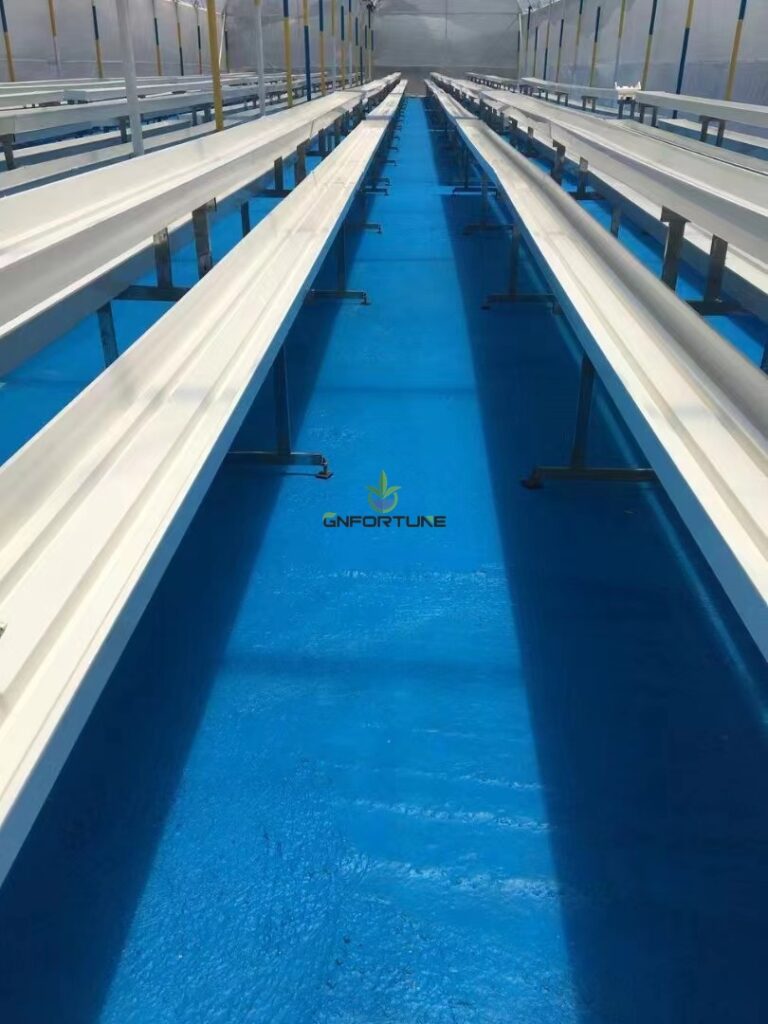
Venezuelan client greenhouse with white grow troughs in double rows over a blue floor, representing warm-climate Latin American hydroponicsThe two projects that recur most often in our LATAM pipeline are Dutch-bucket tomatoes in central Mexico and substrate blueberry nurseries in Peru.
The Mexican tomato project — a multi-hectare greenhouse in the Bajío region on a Dutch bucket drip system — needed higher pump capacity than the original spec, because inlet water carried 1.4 mS/cm baseline EC and the recipe required higher dosing. We sized the pump and reservoir for that, and the facility has run without major retrofit for several cycles. The Peruvian blueberry project on the desert coast near Piura went the other way — the well water was already close to the final recipe, so the system runs on lower-pressure drip with tight EC control; the engineering challenge there is heat load and screen management. The Dutch bucket tomato guide and the substrate berry guide cover the crop-side engineering in more depth.
For a buyer still at planning stage, the how to build a commercial hydroponic system resource walks through the engineering inputs, and the commercial hydroponic system cost page offers a baseline USD-per-square-meter budget.
Frequently Asked Questions
Which Latin American country is the easiest place to start a hydroponic project?
A: Mexico offers the most developed greenhouse supply chain; Chile has the cleanest port process and strictest biosecurity; Peru and Colombia are growing fast but reward buyers who line up their customs broker and certification paperwork before the container sails.
Do hydroponic channels and buckets need a local food-contact certificate?
A: In Colombia (INVIMA) and Peru (SENASA), yes — both treat NFT channels, Dutch buckets, and reservoirs as food-contact equipment. In Mexico and Chile, a documented food-safe material declaration is usually sufficient, but an inspector can still request test reports.
Can a buyer in Mexico import hydroponic equipment without a local partner?
A: Yes, but you need a Mexican RFC tax ID and a customs agent to issue the import pedimento. Most first-time LATAM buyers hire a local broker for the first container and bring customs in-house after the second or third shipment.
What is the typical lead time for a system shipped to Manzanillo or Callao?
A: Production runs 25–35 working days from order confirmation; ocean transit to Manzanillo is 18–22 days from Ningbo, to Callao 25–30 days, to Cartagena 28–35 days, to Valparaíso 30–38 days. Total door-to-door is usually 6–9 weeks.
Does the equipment need to arrive on heat-treated pallets?
A: Yes. All four major ports enforce ISPM 15; untreated pallets or crates with straw can be rejected. We ship only on IPPC-stamped heat-treated pallets.
Plan Your LATAM Project
Send your country, climate zone, crop, and target hectares through the quote form, and our team will return an engineered layout with port choice, certification list, and per-square-meter pricing in USD. We have shipped complete hydroponic systems to Mexico, Peru, Chile, Colombia, and Ecuador. The wholesale and shipping FAQ answers the most common cross-border questions.