
A greenhouse irrigation supplies list reads best in two columns: items bought once, and items bought every season. That split decides how the first purchase order looks, and it is where new projects lose money. Capital hardware gets over-ordered because the site wants to look complete on commissioning day; consumables get ordered to the exact count, so a torn filter screen or a missing end cap stops planting. The list below follows that split, with indicative quantities per 1,000 m² of growing area so the first order covers commissioning without a second freight charge.
Greenhouse Irrigation Supplies: Buy Once vs Consumables
Classify every line before a supplier sees the enquiry. Capital items are sized once and depreciated over the life of the structure. Consumables are re-ordered every crop turn, and the first delivery should arrive with a margin rather than an exact count, because the failures that delay a planting schedule are almost always small parts.
- Capital hardware — pump set, filter bodies, injector, controller, mainline, manifolds, zone valves. Specified against peak simultaneous demand.
- Emission hardware — drip line, emitters, spray stakes. Replaced every few seasons, ordered 5 to 10 percent over the count.
- Filtration consumables — screens, disc stacks, sand media. Replaced on differential pressure, one spare set held from day one.
- Control consumables — EC and pH probes, seals, dosing tubes, calibration fluids. Probes drift before they fail, so budget a spare.
- Small parts — end caps, gaskets, unions, clamps. Ordered by box, never by piece.
The test for any line item: if a failed part would stop the crop within a week and no local supplier stocks it, order it twice. Filters, end caps, and calibration fluid always pass that test.
Head Assembly: Pump, Filter and Dosing
The head assembly is the one part of a greenhouse irrigation supplies package that should never be value-engineered. Every downstream symptom — dry blocks at the far end, drifting EC, blocked emitters in month three — traces back to a pump, filter, or injector sized for average conditions rather than peak demand.
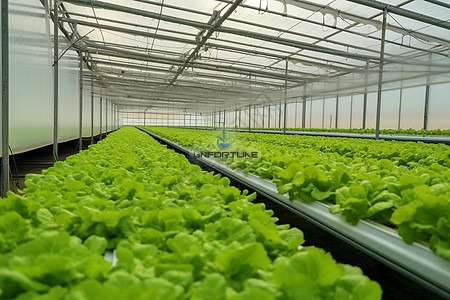
Size in a fixed order: the pump against the largest set of zones that can run at once plus backwash volume, the filter against the smallest emitter passage, then the injector against the concentrate strength the recipe uses.
| Head assembly item | Spec to confirm | Typical range | What goes wrong |
|---|---|---|---|
| Duty pump flow | Peak simultaneous zone demand plus backwash | Sized per zone; commonly 5 to 30 m³ per hour on a 1,000 m² house | Average-flow sizing leaves the last zone short every cycle |
| Pump head | Static lift plus filter loss plus friction plus emitter pressure | 2 to 4 bar at the manifold | Under 1 bar at the emitter, non-compensating emitters lose uniformity |
| Filtration grade | Final stage finer than the emitter passage | 120 to 200 mesh, two stages on surface water | Single-stage screen on a well spends its life being cleaned |
| Filter bodies | Two in parallel, isolation valves each side | One duty, one standby | One body means irrigation stops whenever cleaning is due |
| Injector ratio | Matched to concentrate strength | 1:100 nominal, adjustable 1:50 to 1:200 | Ratio fixed too low forces over-concentrated stock tanks |
| EC and pH control | Setpoint, deadband, alarm output | EC 1.2 to 2.4 mS/cm by crop; pH 5.5 to 6.5 | Control without alarms only works when someone is watching |
| Standby pump | Auto-changeover on houses above roughly 2,000 m² | Duty plus standby | A single pump makes the whole crop dependent on one motor |
Tank volume belongs to the same decision, since storage sets how forgiving the system is to a pump fault; see the reservoir sizing guide and the pump redundancy guide. Injection ratio is treated separately in the fertilizer injector buying guide.
Zone Layout: How Many Zones per Greenhouse
Zone count is a uniformity and labour decision. More zones give shorter cycles, better control across mixed crops, and the ability to flush one block while the rest of the house keeps running. Fewer zones cost less in valves and controllers but force longer runs and wider pressure spread.
- Break zones by crop and by planting date first. A block planted three weeks after its neighbour needs a different schedule and often a different EC.
- Keep run lengths inside the uniformity limit. Beyond roughly 30 m, or on any sloped site, pressure-compensating emission stops being optional.
- Put a valve and a flow meter on every zone, and leave one spare channel in the controller.
Row-level layout follows from this: see the commercial drip irrigation guide for substrate rows and the bucket row drip layout for bucket houses.
Per 1,000 m² Quantity Estimate
Planning figures for a first order on a substrate house at commercial spacing; not a substitute for a take-off from the layout drawing.
| Line item | Indicative quantity per 1,000 m² | Ordering note |
|---|---|---|
| Mainline (PE or PVC, PN6 to PN10) | 60 to 120 m | Keep two spare lengths |
| Sub-main and manifold pipe | 80 to 150 m | Sized to peak zone flow |
| Drip line or lateral | 1,500 to 3,000 m | Set by row spacing |
| Emitters or spray stakes | 2,000 to 6,000 points | Order 5 to 10 percent over |
| Zone valves | 4 to 12 | One per block plus one spare |
| Filter bodies | 2 in parallel, plus spare set | Final stage 120 to 200 mesh |
| Pressure gauges | 4 to 6 | One each side of filters |
| Flow meters | One per zone, plus one spare | Cheapest diagnostic on site |
| Injector or dosing skid | 1, plus seal kit | Match mainline flow range |
| End caps, unions, gaskets, clamps | By box, 10 percent over count | Cause most start-up delays |
Consumables to Stock From Day One
Commissioning week is when consumables run out, because flushing, pressure testing, and balancing use more of them than steady operation ever will. A starter store should hold the following before the first plant goes in:
- One full spare filter element set — screens or disc stacks for every body on site.
- Two spare pressure gauges and at least one spare flow meter.
- EC and pH calibration fluids plus one spare probe of each type.
- Acid and oxidising treatment chemicals, kept segregated and never mixed, for scale and biofilm control.
- End caps, gaskets, unions, and clamps in boxes, not in counted quantities, plus injector seal kits and spare emitters.
Budget Shape for the Irrigation Package
The irrigation package is a modest band of total greenhouse build cost, with the head assembly and control carrying a disproportionate share. Filtration, dosing, and instrumentation are where money should concentrate; pipe and fittings are commodities. Cost per irrigated hectare spans a wide range with filtration level and return design, and figures vary by region and season, so compare quotations on specification rather than on the bottom line.
The advisory line we repeat to new greenhouse owners: a first order should be judged on whether commissioning runs without an emergency shipment, not on whether the total looks low. Buy the filtration grade the water needs, meter every zone, and double the count on every part that ships in a bag rather than a box.
Two lines deserve explicit approval. The first is standby capacity: a second pump and filter body cost a fraction of one lost crop cycle. The second is instrumentation, because a zone without a flow meter is a zone nobody can diagnose. Owners who cut both usually buy them in year two, at air freight prices.
FAQ
How many irrigation zones does 1,000 m² need?
A: Commonly 4 to 12, set by crop blocks, planting dates, and run length rather than area alone. Leave a spare channel in the controller.
Should the first order include a standby pump?
A: Yes above roughly 2,000 m² of growing area, or wherever a single pump failure would stop irrigation for the whole house. Below that, a stored spare is acceptable.
What filtration grade should a starter package specify?
A: A final stage at 120 to 200 mesh, finer than the smallest emitter passage, with two bodies in parallel. Surface or well water needs a second stage ahead of it.
How much spare emitter and fitting quantity is sensible?
A: Around 5 to 10 percent over the counted number for emitters, and box quantities for small parts. Commissioning and first-season repairs consume far more than steady operation.
Does drain-water collection belong in a first order?
A: Only where water cost or discharge rules justify it. Collection adds a tank, treatment, and a monitoring obligation, so drain-to-waste is often the better decision on a first house.
Request a Greenhouse Irrigation Starter Quote
The fastest way to a reliable greenhouse irrigation supplies list is to send growing area, crop plan, water source, and target cycle count, then let the specification come back line by line. Use the request a greenhouse irrigation starter quote form with those four inputs and the engineering team will return pump sizing, filtration train, zone layout, and a per-1,000 m² quantity take-off.


