
Water Meters and Leak Detection on Hydroponic Farms
An irrigation water meter on the main line tells a farm what it used. The same meter on each branch tells it where the water went, and that is the difference between a utility bill and a leak-detection system. On a recirculating farm the numbers worth logging are make-up volume per zone and night flow while nothing is running. This guide covers which meter suits which line, where to install it, and the night-flow method that finds a leak without digging.
Why Meter Every Branch, Not Just the Main
One meter on the main gives a total that cannot be attributed. A leak of 0.5 m³ per day is invisible inside a 60 m³ daily demand, and by the time it shows at the main it has usually run for weeks. Meter each zone that can be isolated and the same loss becomes a line in a table you can sort.
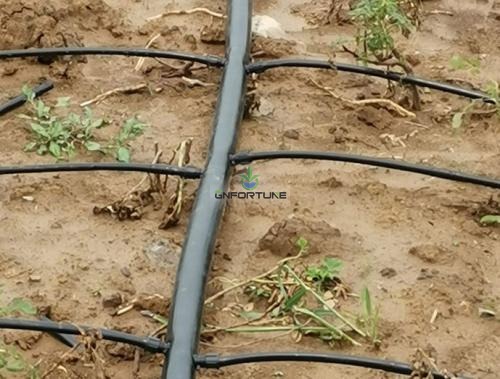
The second reason is calibration drift rather than leaks. Dosing pumps, injectors and float valves all drift, and a zone meter is often the first place it shows, as make-up volume rising while EC falls. The practical rule: meter wherever you can isolate. A metered zone with no valve cannot be tested, and a valved zone with no meter cannot be measured. The pipework and manifold layout rules set where those isolation points belong.
Meter Types: Mechanical, Electromagnetic, Ultrasonic
Choose by the fluid, whether the pipe can be cut, and the accuracy the decision needs. Nutrient solution is conductive, which opens options raw-water metering does not have.
| Type | Typical accuracy | Install notes | Fit |
|---|---|---|---|
| Mechanical turbine or propeller | ±2 to 5% | Cut the line, 5 to 10 pipe diameters straight upstream, moving parts wear | Cheap branch meters, clean water, low budget |
| Electromagnetic (mag meter) | ±0.5 to 1% | Cut the line, needs full pipe and conductive fluid, mains power | Fertigated lines, mains, dosing verification |
| Ultrasonic clamp-on | ±1 to 2% | No cut, sensitive to pipe wall, liner and coupling | Retrofits, temporary surveys, large mains |
Mechanical meters remain the default for branch metering because the unit cost allows one per zone. Their weakness is wear: bearings and rotors pick up grit and fertilizer salt, and accuracy falls long before the meter stops turning.
Mag meters suit fertigated water because nutrient solution is far above the minimum conductivity most designs need, and nothing in the bore fouls. They cost more, need power, and must run full — an air pocket after a filter change reads nonsense until it clears.
Ultrasonic clamp-on units are the retrofit answer, and accuracy depends on the pipe: wall thickness, material, liner and coupling all move the reading, so treat the number as a trend rather than a billing figure.
Where the Meter Goes in the Line
Put the zone meter downstream of the isolation valve and upstream of the filter, so it counts everything entering the zone, and keep it away from the turbulence of an elbow or pump discharge. On a recirculating system two meters matter: a return-line meter for circulation and a make-up meter for consumption. The ratio tells you whether a rising bill is crop demand or loss, since circulation stays flat while make-up climbs when something leaks.
The Night-Flow Method
With irrigation off, pumps down and valves closed, flow should be zero. Anything above the meter’s resolution is a leak, an overflow, or a valve that has not fully shut. That one number finds most losses without anyone walking the rows.
Procedure: record the zone meter index and tank level after the last irrigation cycle, then read both before the first cycle next morning. The meter difference is night loss in m³; the tank difference, corrected for any make-up that ran, confirms it.
Thresholds are relative. On a well-sealed recirculating zone, night loss under about 1 to 2% of daily make-up volume is noise: thermal expansion, a weeping air release, tank evaporation. Above that, isolate zone by zone. A zone using 8 m³ per day that loses 0.25 m³ overnight is losing roughly 3% and is worth chasing; at 0.02 m³ it is not.
Cross-check the pump before chasing the pipe, since a pump off its duty point changes both flow and pressure. The pump sizing and duty-point method is the reference. A loss that appears at the meter but not at the tank is usually a meter or a siphon, not a leak.
Pressure Zones and Isolation Valves
Divide the farm into zones that can each be shut without stopping production, and give each a valve, a gauge and, where budget allows, a meter. Smaller zones localise a loss faster; larger zones cost less.
The companion test is pressure decay. Bring the zone to working pressure, commonly 2 to 3 bar on drip and spray lines, shut the isolation valve, then watch the gauge for 15 to 30 minutes. A drop beyond roughly 0.2 to 0.5 bar over 30 minutes with stable temperature points to a leak rather than contraction. Check solenoid valves are not weeping back through a bypass first.
What to Record and Review Weekly
A log is only useful if the same person reads the same fields the same way every week. Keep it short and numeric, and normalise by crop area so a change in planted area does not look like a change in losses.
| Field | Frequency | Why it is logged |
|---|---|---|
| Zone meter index, m³ | Daily, same hour | Trend, and the base for night-loss maths |
| Night loss, m³ | Daily | The leak indicator |
| Zone pressure, bar | Daily | Separates a leak from a pump or filter problem |
| Filter differential pressure | Daily | Rising ΔP mimics falling flow at the meter |
| Pump current or kWh | Weekly | Catches drift off the duty point |
Normalise to litres per m² per day and compare week to week rather than against a published figure. Recirculating leafy systems commonly run roughly 1 to 3 L per m² per day of make-up in temperate conditions and more in hot, dry climates; figures vary by region and season, so your own trend is the standard. Where a controller network already exists, feed the meter data into it rather than onto paper; the IoT and remote monitoring overview sets out what is worth automating.
A meter nobody reads is a fitting with a dial on it. The failure mode we keep meeting is a farm that bought branch meters, then logged nothing because no one owned the round. Assign the reading to a named task at a fixed hour and the log starts catching losses within a fortnight.
Leak Modes: Fittings, Emitters, Tank Overflows
Most losses come from four places, worth checking in this order because the largest is the least noticed.
- Tank overflow and fill valves: a stuck float or a fill valve that fails open empties the header tank to drain, usually overnight. It is the biggest single-loss event and leaves no wet floor.
- Compression fittings on PE: creep and seasonal temperature swing produce the classic weep that appears at dawn and dries by midday. Re-torque after the first week and after the first temperature change.
- Emitters, barbs and spaghetti lines: cracked barbs, punched laterals and UV-embrittled tubing. Blockage sends flow elsewhere, so a clogged zone leaks at the next weakest joint. Filtration practice in the drip emitter clogging guide applies.
- Solvent-welded joints and filter housings: poor primer or cure, unsupported spans under stress, O-rings seated dry. The pipe fittings types and sizing guide covers what to specify.
One more that surprises people: a return line that siphons when the pump stops, emptying the tank into the floor while the meter reads it as consumption. Fit an anti-siphon break or an air gap at the return discharge.
Frequently Asked Questions
Where should an irrigation water meter be installed?
A: Downstream of the zone isolation valve and upstream of the filter, in a full pipe with straight runs either side. Avoid immediately after an elbow or pump discharge.
Which meter type suits nutrient solution?
A: Electromagnetic meters work well because nutrient solution is conductive and nothing in the bore fouls. Mechanical meters suit clean water and cost far less per zone.
How do I tell a leak from normal crop use?
A: Run the night-flow test: with irrigation off and pumps down, flow should be zero. Sustained night loss above about 1 to 2% of daily make-up volume is worth isolating.
What is a normal make-up water figure?
A: Recirculating leafy systems commonly run roughly 1 to 3 L per m² per day in temperate conditions, more in hot climates. Figures vary by region and season.
How many meters does a farm need?
A: One per isolation zone, plus one on the make-up line and one on the return. A zone with a valve but no meter cannot be measured.
Request a Metered Irrigation Layout Quote
Water leak detection on a farm is mostly a design question: zone boundaries, isolation points and meter positions decided on the drawing decide whether a loss is found in an hour or a season. An irrigation water meter per zone costs a fraction of one crop cycle’s labour, and it is the instrument that finds a leak before it becomes a yield problem.
Send the zone layout, pipe sizes and pump duty point, and the engineering team will return a metering schedule with types and positions. To request a metered irrigation layout quote, include how many zones you can shut without stopping production.


