
Microgreens vs Baby Leaf: Which Fits Your Farm
Microgreens vs baby leaf looks like a crop question and is really a customer question. Both are young leafy crops grown at high density without a transplant, both run in trays or beds, and both can be produced in the same building with much of the same sowing and watering kit. What separates them is who buys the result and how the week is staffed. Microgreens sell at a high price per kilogram into a narrow, relationship-driven market and are harvested every day of the week. Baby leaf sells at a far lower price per kilogram into salad processors and bagged retail, and is harvested in blocks. Pick the wrong one for your customer list and the equipment is the least of your problems.
Definitions and the Overlap Zone
Microgreens are harvested at the cotyledon or first true leaf stage, typically 7 to 21 days from sowing, and are sold as cut product or as living trays. Baby leaf is harvested later, at roughly 5 to 12 cm and 21 to 40 days depending on species and season, and is sold loose or bagged.
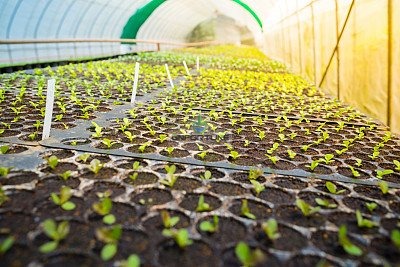
The overlap is the first week. Both start as dense surface sowings at high seed rates, in shallow trays or beds, under humidity management that keeps the seed moist until germination. That is why a farm can legitimately run both: the front end of the process is close to identical, and a sowing line, germination space and water system bought for one will serve the other. The divergence is at harvest, and it is decisive. Microgreens are cut by hand or with a light cutter, packed immediately, and sold within days. Baby leaf is cut mechanically, washed, dried and packed, and enters a cold chain with food safety documentation.
Cycle Length and Turnover
Turnover per square metre per year differs by a factor of several, and so does the yield per harvest.
| Factor | Microgreens | Baby leaf |
|---|---|---|
| Days from sowing to cut | 7 to 21 | 21 to 40 |
| Crop height at harvest | 2 to 8 cm | 5 to 12 cm |
| Yield per harvest | Hundreds of grams per tray | Kilograms per square metre |
| Regrowth | Rarely; resow | Possible on some species, quality varies |
| Shelf life | Roughly 5 to 10 days chilled | Roughly 7 to 14 days washed and chilled |
| Price per kilogram | High | Modest |
Read the table as a pair of columns, not as a scoreboard. High price per kilogram means nothing if the harvest is measured in hundreds of grams, and a modest price per kilogram looks very different when the bed produces kilograms per square metre. What usually decides the comparison is annual output per square metre of growing space multiplied by the price you can actually hold, and then minus the labour to get it cut and packed.
Equipment: Trays, Racks, Lighting and Washing
Microgreens buy racks; baby leaf buys washing and cold chain. The capital profiles are different enough that a farm rarely converts between them cheaply.
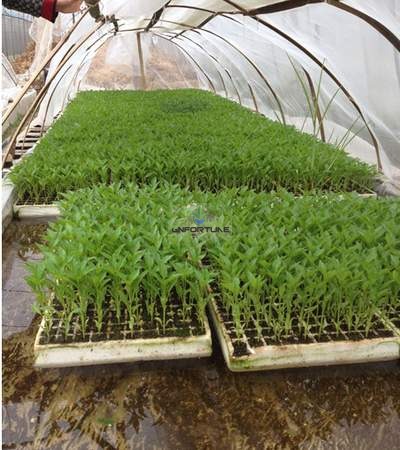
- Sowing and germination: common to both. A sowing line, a germination or blackout stage, and misting or gentle overhead watering until the seed has taken.
- Microgreens addition: multi-tier racks, lighting sized to the rack footprint, and air movement tight enough to keep a dense canopy from damping off.
- Baby leaf addition: beds or channels at floor level, plus a cut system, wash line, dryer or spinner, and chilled packing space.
- Cold chain: microgreens need a cold room and fast dispatch. Baby leaf needs a wash-pack line that is auditable.
- Space efficiency: racks give microgreens a large growing area per square metre of floor, which is the main reason the format works in expensive buildings.
A nursery built for transplant production, as described in the propagation room setup guide, can often start microgreens with little new capital. That is the cheapest way to test the market before committing to racks.
Labour Shape: Daily Sowing vs Block Harvest
This is the difference owners feel most, and the one that catches farms out.
Microgreens are a daily rhythm. Trays are sown every day because they are cut every day, and the workload is continuous: sowing, watering, blackout, uncovering, cutting, packing, cleaning trays. There is no quiet week, and the ratio of labour hours to kilograms produced is high. Baby leaf is a block rhythm: sow a bed, tend it, then cut the whole bed in one pass, with the peak concentrated at harvest and pack-out. The labour per kilogram is materially lower, and more of it can be mechanised.
For an operation that already has a crew on site every day, microgreens fill idle hours well. For one that is trying to reduce headcount per kilogram, baby leaf is the structure that supports it.
Yield and Price Reality
Treat both columns with caution: prices move with the season and the channel, and yields move with variety, light and temperature.
| Operating indicator | Microgreens | Baby leaf |
|---|---|---|
| Price level per kilogram | High, often several times baby leaf | Modest, contract-driven |
| Volume per square metre per year | Low per harvest, high turnover | Higher per harvest, slower turnover |
| Labour per kilogram | High | Lower, partly mechanisable |
| Waste and trim risk | High; unsold trays have days, not weeks | Moderate; washed product has a defined window |
| Contract structure | Short order cycles, relationship-based | Programme supply with specifications |
| Capital per square metre of growing area | Racks and lighting | Wash line and cold chain |
The honest summary is that neither format is automatically more profitable. Microgreens carry a higher gross margin per kilogram and a higher labour and waste cost; baby leaf carries a thinner margin and makes it up on volume and mechanisation. Figures vary by region and season, so model both against your own labour rate and your own delivered price before choosing. The hydroponic farm ROI breakdown gives a structure for doing that arithmetic on a per-square-metre basis.
Which Buyers Buy Which
Match the crop to the purchase order you already have, or to one you can realistically win.
- Microgreens buyers: restaurants and chef supply, specialty wholesalers, meal-kit producers and premium grocery. Orders are small, frequent, and specification-heavy on appearance and cut height.
- Baby leaf buyers: salad processors, bagged salad brands and wholesale markets. Orders are large, scheduled, and specification-heavy on wash quality, foreign material and shelf life.
- Audit load: baby leaf into retail will be audited on wash water, traceability and cold chain in a way most microgreen sales are not.
- Seasonality: microgreens demand is fairly flat with a hospitality skew; baby leaf demand follows retail promotion calendars and processing programmes.
Farms that grow both usually do it for a reason that has nothing to do with yield: the microgreen line absorbs surplus nursery capacity and keeps weekly cash flow moving while the baby leaf programme ramps. That is a sensible hedge, and the blended salad line guide covers how mixed leaf programmes are actually specified by processors.
Choose on the purchase order, then on the labour calendar. A high price per kilogram is the least useful number on the sheet when the harvest is measured in grams and the crew is needed seven days a week. Write down the buyer, the weekly volume they will take, and the hours it costs to deliver it. If the order is not there, capacity is not the constraint, and adding racks will not create demand.
Frequently Asked Questions
Are microgreens more profitable than baby leaf?
A: Per kilogram, yes; per square metre per year, it depends on labour and on how much volume your buyer takes. Model both against your own labour rate.
Can one nursery produce both?
A: Yes. Sowing, germination and watering are nearly identical up to the first week, so a propagation room can start either crop.
How long do microgreens take from sowing to cut?
A: Typically 7 to 21 days depending on species and temperature. Baby leaf runs longer, roughly 21 to 40 days.
Do microgreens need a wash line?
A: Usually not a full one, but they do need clean cutting, chilled holding and fast dispatch. Baby leaf into retail needs a documented wash, dry and chill line.
Which has a shorter shelf life?
A: Microgreens, at roughly 5 to 10 days chilled. Washed baby leaf typically holds 7 to 14 days under proper cold chain.
Request a Tray-System Quote
Microgreens vs baby leaf comes down to the customer you can hold and the crew you can staff. Trays, racks, germination space and watering are largely shared, so the capital decision is really about what sits after harvest: racks and lighting for continuous small cuts, or a wash, dry and chill line for block harvests.
Send the format you intend to run, weekly target volume, available floor area and whether a wash line already exists, and the team will return a tray and rack layout matched to that volume. To request a tray-system quote for your format, include the buyer specification you have to meet.


