

The Nursery Bottleneck
In most commercial hydroponic farms, the nursery sets the pace of the whole operation. Sowing is precise, repetitive, deadline-driven work — and when it is done by hand, it caps how many trays a day the farm can turn around. A grower hand-sowing 300 trays a day with two staff is running a production line made of wrists.
An automated seeder hydroponic nursery line changes the equation: 200–1,000+ trays per hour, one to three operators, and singulation accuracy that hand sowing cannot hold for eight hours. This guide compares the technologies and shows how to specify one that fits your trays, seeds and scale.
The Three Seeder Technologies
| Type | How it singulates | Best at | Watch-outs |
|---|---|---|---|
| Plate / template seeder | Holes in a plate sized to the seed | Round, uniform seed (lettuce, basil) | One plate per seed size; slow changeover |
| Drum / roller seeder | Vacuum holes on a rotating drum | High volume, few varieties | Setup time; needs matched trays |
| Needle seeder | Programmable vacuum nozzles pick individual seeds | Many varieties, irregular or coated seed | Slower per tray; higher cost |
| Inline full line | Seeder + filler + dibbler + vermiculite + watering | Operations past ~500 trays/day | Space, capital, single-point-of-failure |
The honest decision rule: few varieties at high volume favours a drum; many varieties at moderate volume favours a needle seeder; a plate seeder is the budget entry point for uniform seed only.
Singulation and Its Consequences
- Target: 95%+ single-seed cells at sowing for reliable germination counts
- Missed cells cost trays of gaps; doubled cells cost thinning labour
- Seed quality amplifies: a seeder cannot fix poor germination — it just plants it faster
- Coated/primed seed usually seeds cleaner than raw seed on all machine types
- Calibration discipline: 10 minutes of test-tray runs at each changeover repays itself in the first hour
Whatever the machine, keep an operator checking a sample tray every batch. Automation holds accuracy only under supervision.
The Line Around the Seeder
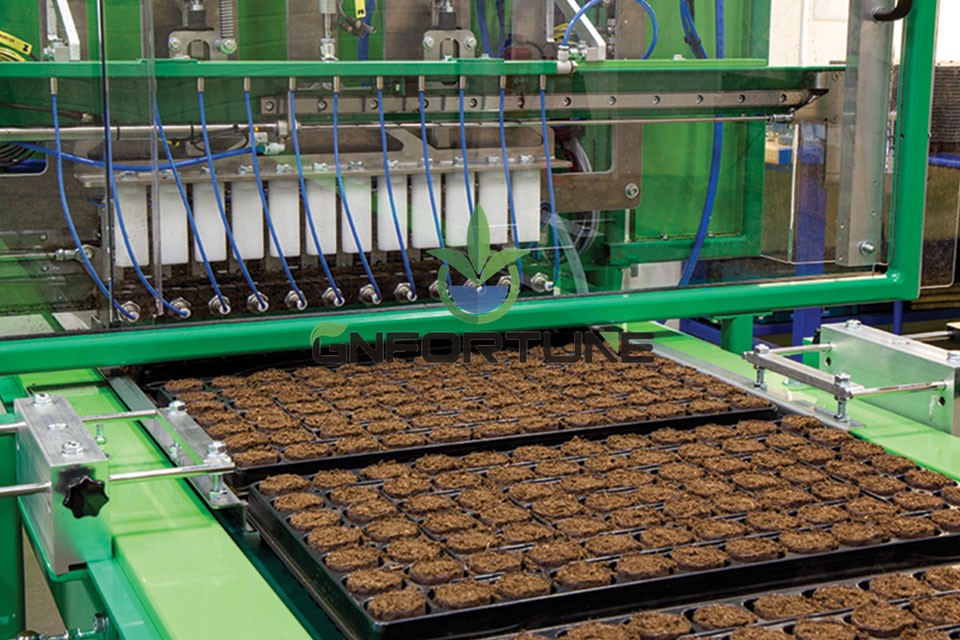
The seeder is the centrepiece, but throughput is set by the whole line:
- Tray denesting — automatic denester or a stack and a person
- Substrate filling and levelling — with a brush-off and, if your recipe needs it, pre-moistening
- Dibbling — consistent depth matters more than most growers expect for contact and germination
- Seeding — the machine itself
- Covering — vermiculite or none, matched to the crop’s light requirements
- Watering-in — fine, even misting; a heavy first watering displaces seed
- Stacking or conveyor to the germination chamber
Specify the line for the messy day, not the demo day: a half-filled pallet of substrate, a new seed lot, a trainee operator. Lines that only run with the supervisor present are not automated, they are relocated labour.
Specifying to Your Farm
- Tray compatibility: give the supplier your exact tray drawing; cell geometry drives singulation
- Realistic rate: quote at your mix of varieties, not the headline figure for one easy crop
- Changeover time between seed types — ask for it demonstrated, not quoted
- Cleanability: the machine gets wet and dusty daily; look for access to vacuum paths
- Spare parts: needles, plates, belts and vacuum filters on the shelf from day one
- Integration: will it later feed your existing conveyor or chamber doors?
Maintenance That Protects Singulation
Accuracy decays quietly on seeding lines. Vacuum paths gather dust and chaff, needles wear or clog, sensors drift out of alignment, and calibration props get moved during cleaning. The visible symptom arrives weeks later as a rising rate of missed cells — traced back to a machine nobody has cleaned properly for a month.
Put three routines in the calendar: a daily blow-out and sensor wipe at end of shift, a weekly needle and plate inspection with any worn part swapped from stock, and calibration verification at every seed lot or variety change. Keep a machine log next to the line showing date, operator, tray type and an observed 100-cell accuracy check. That single habit turns seeding accuracy from an opinion into a number, and it is also what the supplier will ask to see if you ever bring a warranty claim.
FAQ
What throughput justifies automation?
Rough guide: above 200–300 trays per day, a seeder plus filling line usually beats hand sowing on cost and consistency. Below that, better hand tools and bench layout often pay first.
Do automated seeders work with raw lettuce seed?
Well, with proper vacuum and calibration. Irregular or extremely fine seeds (some herbs) are where needle seeders show their advantage.
How much space does a line need?
A seeder with filling and watering typically needs 6–12 m of linear run plus operator and stack space both ends. Full lines with denesters and conveyors can double that.
What is the payback?
Mostly labour: a line replacing two to four full-time sowing roles, plus improved germination uniformity that compounds through the crop. On multi-hectare operations the payback is commonly 1–3 seasons.
Can it handle pelleted and naked seed on the same machine?
Needle seeders handle both with program changes. Plate and drum systems may need hardware swaps — confirm with your actual seed list before purchase.
How much maintenance does a seeder need?
Daily vacuum-path and sensor cleaning, weekly belt and needle checks, and calibration at every seed change. Budget 15–30 minutes a day; skipping it shows up in missed cells within a week.
Sow at the Speed of the Farm
Bring your tray drawing and seed list and we will match the seeder technology to the real mix — not the demo. Start with the quote form.
Related reading: the nursery works as a system — see commercial propagation and transplanting, variety and seed sourcing, seed and media incoming inspection, crop scheduling and harvest and packing automation.