

An aeroponic tower is a vertical growing system where plant roots hang in an enclosed column and receive nutrient solution as a timed mist from nozzles inside the tower. The roots are not submerged in water or substrate — they are suspended in air, wetted at intervals by a high-pressure pump. This is how an aeroponic tower works: pump pressurizes nutrient solution, nozzles atomize it into fine droplets, roots absorb water and nutrients during a brief on-cycle, then dry slightly between cycles to maximize oxygen uptake. The result is fast growth and high root-zone oxygen, but the system is more equipment-dependent and failure-sensitive than any other hydroponic method.
How an Aeroponic Tower Works in 60 Seconds
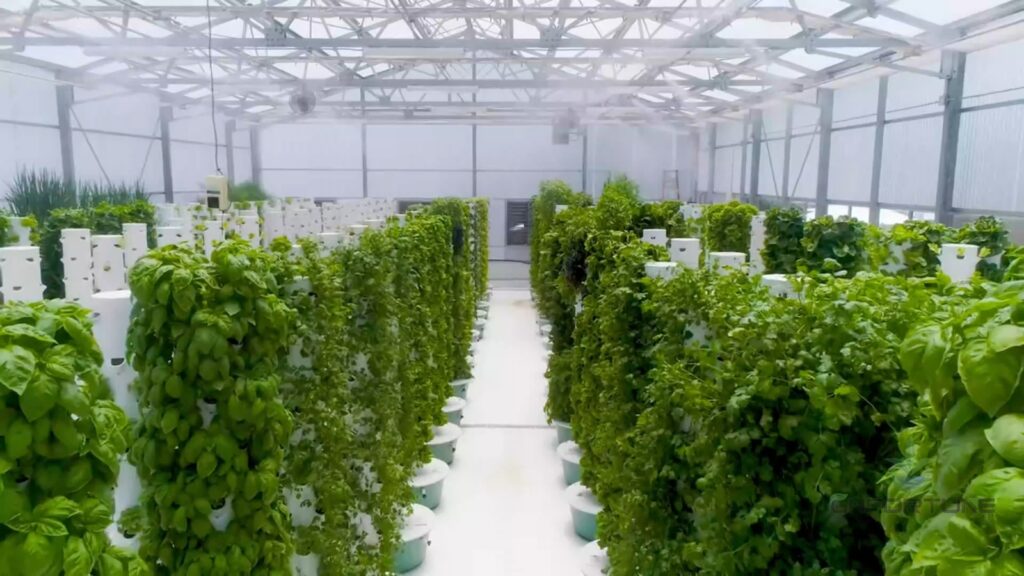
Rows of aeroponic towers with dense green plants in a greenhouseThe core components are a nutrient reservoir, a high-pressure pump, a timer or controller, a manifold of piping inside the tower, misting nozzles, and the tower column itself with plant sites cut into the walls. The cycle:
- Pump on: the pump pressurizes nutrient solution (typically 20–80 psi) and pushes it through the manifold to the nozzles.
- Mist: nozzles atomize the solution into droplets of 20–50 microns. The mist fills the column and wets all exposed root surfaces.
- Pump off: the timer cuts the pump. Residual mist settles onto roots, then roots begin to dry. The dry interval is when roots absorb oxygen directly from the air — the whole point of aeroponics.
- Drain-back: unabsorbed solution runs down the tower interior and returns to the reservoir for recirculation.
The root zone in an aeroponic tower has the highest oxygen availability of any hydroponic method — roots are never submerged, and the dry interval keeps the root surface exposed to air. The trade-off is almost no water buffer: if the pump stops, roots dry and wilt within minutes to hours, not days.
Mist Intervals: How Long, How Often
The mist cycle is the single most important operating parameter. Too long and roots stay wet and lose oxygen; too short and they dry between cycles and stress. The ranges below are starting points from operating tower systems:
| Parameter | Typical range | What it controls |
|---|---|---|
| Mist-on duration | 3–15 seconds | How much water and nutrient each cycle delivers |
| Mist-off interval | 3–15 minutes | Root drying time; oxygen uptake window |
| Pump pressure | 20–80 psi (1.5–5.5 bar) | Droplet size and mist distribution |
| Droplet size | 20–50 microns | Root absorption efficiency; finer mist = better coverage |
| Number of nozzles per tower | 4–12 (depending on height) | Mist coverage from top to bottom of column |
The correct cycle depends on crop stage, ambient humidity, and tower temperature. Young plants with small root masses need shorter off-intervals (3–5 minutes). Mature plants can handle longer off-intervals (8–15 minutes). In low humidity, roots dry faster and the off-interval must shorten. The timer should be adjustable in 1-second increments for on and 1-minute for off — a controller locked to fixed presets is a red flag.
Pump and Nozzle Sizing for a Tower Wall
A commercial aeroponic installation is a wall or array of towers sharing one pump and reservoir. Sizing the pump and nozzles to the number of towers is where most projects go wrong.
- Pump flow and pressure. Each misting nozzle needs roughly 0.5–1.0 L/min at 30–60 psi to produce fine droplets. A wall of 10 towers with 8 nozzles each (80 nozzles) needs a pump delivering 40–80 L/min at 40–60 psi — a substantial pump, not a fountain pump.
- Manifold sizing. Piping inside the tower and the supply manifold must be large enough that pressure does not drop from first to last nozzle. Undersized manifolds cause towers near the pump to mist well while the far end starves. Size the manifold so total nozzle flow is less than 50% of pipe capacity.
- Nozzle selection. Anti-drip nozzles are essential — a nozzle that drips between cycles keeps roots too wet. Choose nozzles rated for the pump pressure range and made from mineral-resistant materials (stainless steel or engineered polymer). Cheap brass nozzles corrode and clog faster.
- Filtration before nozzles. A 100–200 micron filter between reservoir and pump is mandatory. Without it, particulate blocks nozzles within days.
The field failure we see most: “We sized the pump for the nozzle count on the spec sheet, but the far towers were always under-misted.” The cause is almost always manifold pressure loss — the pump delivers rated flow at the outlet, but by the time water reaches the last tower in the line, pressure has dropped below the nozzle’s atomization threshold. The fix is to oversize the manifold pipe one or two sizes above the calculated minimum, or to split the wall into two independently pumped zones.
Why Towers Fail: Clogging, Power Loss, and Root Drying
Aeroponic towers are the most uptime-sensitive hydroponic system. The three failure modes that cause crop loss, in order of frequency:
- Nozzle clogging. The most common failure. Mineral deposits, biofilm, and particulate narrow nozzle orifices over time. A partially clogged nozzle produces coarse droplets or a stream, and roots in its zone go under-watered. Prevention: pre-filtration, weekly nozzle inspection (biweekly in soft water), and quarterly acid descaling. Keep spare nozzles on site.
- Power loss and pump failure. Roots have almost no water reserve. If the pump stops, roots dry within 15–30 minutes at normal greenhouse temperatures, and irreversible wilt can occur within 2–4 hours. Every commercial tower system needs a backup pump on a pressure switch and a generator or UPS for the controller.
- Root drying from uneven mist distribution. A partial clog or manifold pressure problem can leave sections under-misted. The crop looks fine until root mass is insufficient, then wilts on a warm day. The only reliable check is to open the tower inspection port weekly and verify all nozzle zones are misting during an on-cycle.
UV degradation of tower materials is a slower but real failure mode. Towers made from non-UV-stabilized plastics become brittle and crack after 2–3 seasons in a greenhouse. Specify UV-stabilized or opaque tower materials from the start — the cost difference per tower is small; the cost of replacing a wall of cracked towers is not.
Towers Versus NFT Channels for Commercial Leafies
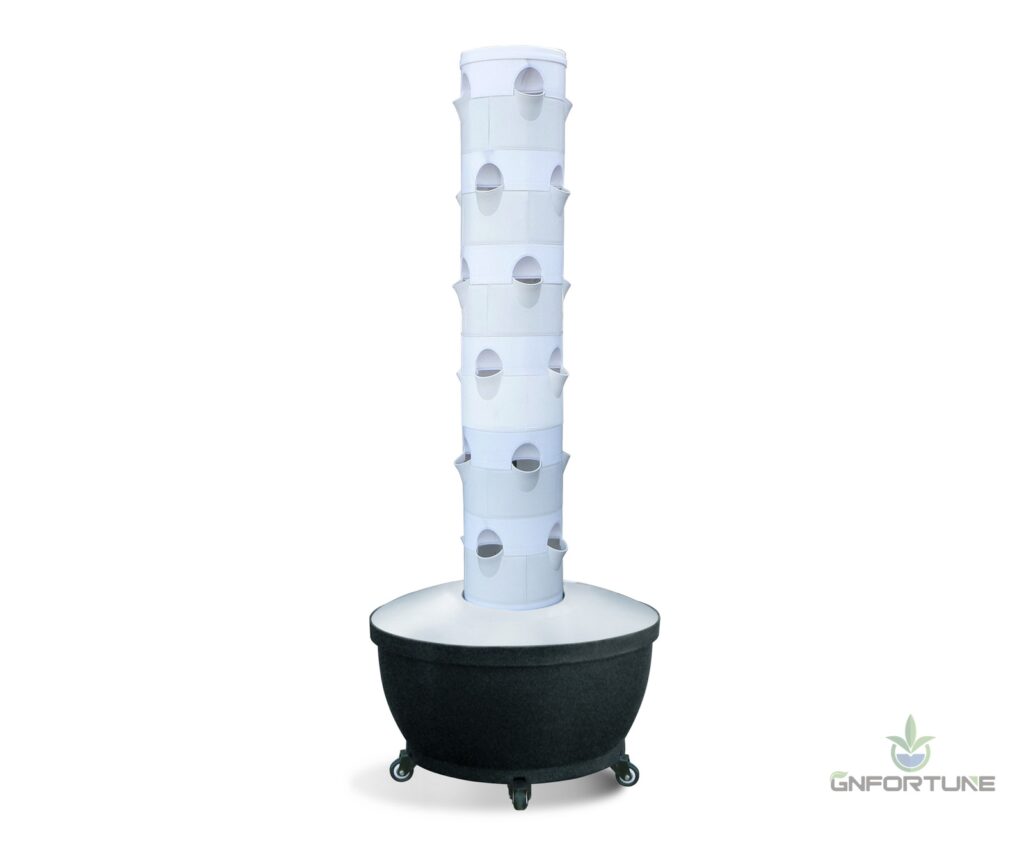
White aeroponic tower with multiple planting levelsThe fair comparison for leafy greens is aeroponic towers versus NFT channels — both are water-based, high-density systems, and most operators choose between them for leafy crop production. The trade-offs:
| Factor | Aeroponic towers | NFT channels |
|---|---|---|
| Plants per m² (lettuce) | Higher — vertical stacking | Lower — single horizontal plane |
| Root-zone oxygen | Highest — roots in air | Good — thin film of water |
| Water buffer if pump stops | Minutes — roots dry fast | Hours to days — channel holds water |
| Equipment complexity | High — high-pressure pump, nozzles, timer | Low — low-pressure pump, gravity flow |
| Maintenance demand | High — weekly nozzle checks | Low — periodic channel cleaning |
| Energy cost | Higher — high-pressure pump runs on a timer | Lower — low-flow pump runs continuously |
| Crop risk from failure | High — fast wilt, total loss possible | Low — slow decline, recoverable |
Towers win on density and root-zone oxygen; NFT channels win on reliability, simplicity, and operating cost. For a commercial leafy-green operation where uptime and labor efficiency are the priority, NFT channels are the lower-risk choice. For operations where space is the limiting factor and skilled daily maintenance is available, towers produce more per square meter. The full channel profile comparison is in the NFT channel size comparison, and the broader system trade-offs are in the aeroponic vs hydroponic guide. For vertical system options, our vertical hydroponic system page covers the equipment range, and the commercial vertical growing systems article covers the planning logic.
FAQ
How often should aeroponic towers mist?
A: Typically 3–15 seconds on, every 3–15 minutes off, depending on crop stage and humidity. Young plants need shorter off-intervals; mature plants with large root masses can handle longer dry periods.
What pressure does an aeroponic tower need?
A: 20–80 psi (1.5–5.5 bar). Below 20 psi, nozzles produce coarse droplets or streams instead of mist. The pump must maintain pressure at every nozzle simultaneously when all are open.
How long can aeroponic roots survive without mist?
A: 15–30 minutes before stress begins at normal greenhouse temperatures. Irreversible wilt can occur within 2–4 hours. A backup pump and power supply are mandatory at commercial scale.
Why do aeroponic nozzles clog?
A: Mineral deposits from hard water, biofilm from the reservoir, and particulate in the nutrient solution. Prevention requires a 100–200 micron pre-filter, weekly nozzle inspection, and quarterly acid descaling.
Are aeroponic towers better than NFT for lettuce?
A: Towers produce more per square meter due to vertical stacking, but NFT channels are simpler, cheaper to run, and far more forgiving of equipment failure. Most commercial leafy-green operations choose NFT for reliability; towers suit space-constrained operations with skilled maintenance staff.
Get Data Sheets for Towers and Channels
Comparing towers to channels? Get data sheets for both before you decide. Request the technical data sheets for aeroponic towers and NFT channels — including pump and nozzle specs, flow rates, and maintenance schedules — plus a comparison layout for your greenhouse footprint through the quote and engineering service.