

The nitrogen cycle in aquaponics is the biological process that turns fish waste into plant food. Fish excrete ammonia; bacteria convert it first to nitrite and then to nitrate, the form plants take up through their roots. Without this cycle, fish water is toxic to fish and useless to crops. Understanding how the cycle works and what your biofilter needs to sustain it is the single most important operating skill in any commercial aquaponics greenhouse.
What Is the Nitrogen Cycle in Aquaponics?
In an aquaponic system, fish, bacteria, and plants form a closed nutrient loop. Fish eat feed and release ammonia. Two groups of nitrifying bacteria live on every wet surface — mainly inside the biofilter media — and process that ammonia through two sequential steps until it becomes nitrate. Plants absorb nitrate through their roots. Clean water returns to the fish tank, and the loop repeats. The cycle is one of the core components of an aquaponics system that determines whether fish and crops stay healthy together.
The cycle runs continuously. If the biofilter stalls from low oxygen or a temperature shock, ammonia climbs within hours and fish start dying.
Ammonia to Nitrite to Nitrate: The Two-Stage Conversion
The conversion happens in two biological steps, each handled by a different group of bacteria:
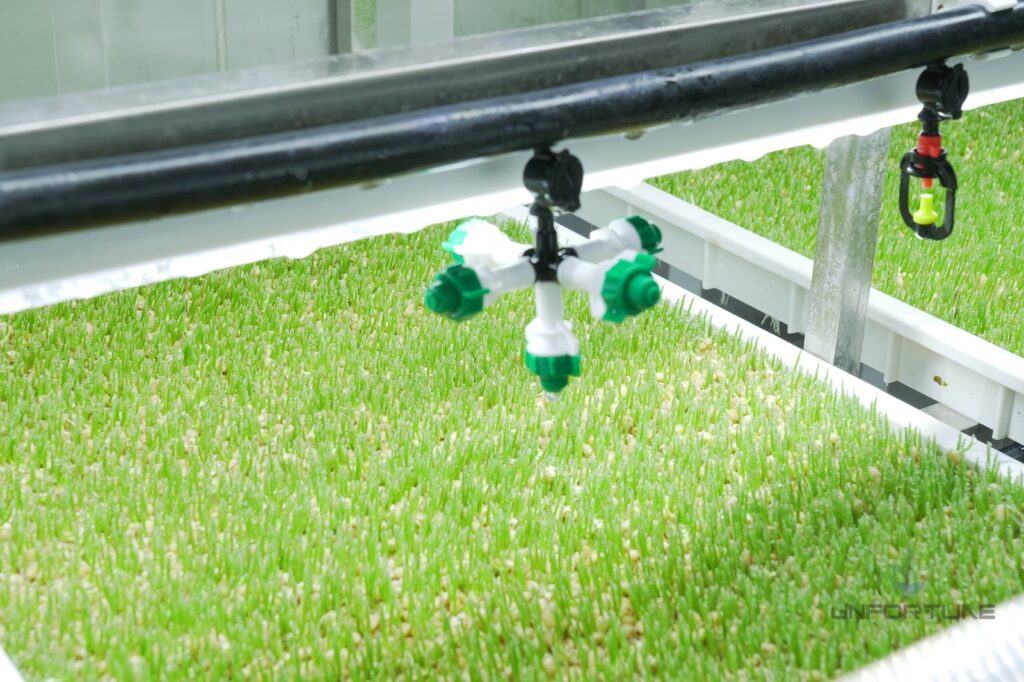
Green hydroponic shoots under misting irrigation, taking up nutrients- Step 1 — Ammonia to nitrite. Ammonia-oxidizing bacteria (AOB), primarily Nitrosomonas species, consume ammonia and excrete nitrite (NO2−). Ammonia is the most toxic form of nitrogen in the system; even 1–2 mg/L of un-ionized ammonia stresses fish.
- Step 2 — Nitrite to nitrate. Nitrite-oxidizing bacteria (NOB), primarily Nitrobacter and Nitrospira species, convert nitrite into nitrate (NO3−). Nitrite is less acutely toxic but still dangerous: it binds to hemoglobin in fish blood and causes brown blood disease above 5 mg/L. Nitrate is the least toxic and the form plants use most readily.
| Nitrogen form | Chemical symbol | Toxicity to fish | Who produces it | Who consumes it |
|---|---|---|---|---|
| Ammonia (unionized NH3) | NH3 / NH4+ | High — toxic above ~1–3 mg/L (pH and temperature dependent) | Fish metabolism, solid waste breakdown | Ammonia-oxidizing bacteria (AOB) |
| Nitrite | NO2− | Medium — chronic stress above ~5 mg/L; causes brown blood disease | AOB (from ammonia) | Nitrite-oxidizing bacteria (NOB) |
| Nitrate | NO3− | Low — tolerated up to ~150–300 mg/L in most systems | NOB (from nitrite) | Plants (uptake through roots) |
The practical takeaway: bacteria must process ammonia faster than fish produce it. If feeding rate outruns nitrification capacity, ammonia accumulates. This is why stocking density and feeding rate set the minimum biofilter size — covered in our aquaponics stocking density guide.
What Your Biofilter Needs: Surface Area, Oxygen, and Time
Nitrifying bacteria live as a biofilm on wet surfaces, not free-floating. The biofilter’s job is to maximize wet surface area in minimum volume while keeping water oxygenated and flowing. Three requirements decide whether it works:
- Surface area. The total wetted area of media determines how many bacteria can colonize. Moving bed media (K1/K3 style) typically delivers 500–800 m²/m³ of protected surface; fixed structured blocks can reach 700–1000 m²/m³. Rule of thumb: provide roughly 0.5–1.0 m² of biofilter surface per gram of feed per day.
- Dissolved oxygen. Nitrifying bacteria are aerobic — they consume roughly 4.5 g of oxygen per gram of ammonia nitrogen oxidized. If DO drops below 4 mg/L, nitrification slows sharply. Most operators target 6–8 mg/L at the biofilter inlet. The biofilter is the largest oxygen consumer after the fish themselves.
- Time and stability. A new biofilter takes 4–8 weeks to reach full capacity at 22–28°C. The bacteria reproduce slowly — roughly every 16–24 hours — so a colony wiped out by a chlorine shock takes weeks, not days, to rebuild. This is why systems are cycled before fish are added.
The consultant’s reminder: A biofilter is a living asset, not a piece of pipe. It has no moving parts and no replacement schedule — until the day it crashes, and then it takes a month to rebuild. Budget for redundancy in aeration, protect the biofilter from chlorine and copper, and never assume a quiet system on Friday will still be quiet on Monday if the feed rate changed.
Temperature and pH also affect nitrification: the process is fastest at 25–30°C and slows below 18°C; it is most efficient at pH 7.0–8.5, but crop-focused systems often run at pH 6.0–6.5 for plant uptake, which means the biofilter must be oversized.
How to Cycle a New System Before Adding Fish
Every new aquaponics system must go through a startup cycle before fish are stocked — building a bacterial colony large enough to process the daily ammonia load. Two practical approaches exist:
- Fishless cycling (preferred for commercial). Add a measured ammonia source — pure ammonium chloride — at roughly 2–3 mg/L ammonia-N. Test daily for ammonia, nitrite, and nitrate. Over 4–6 weeks you will see ammonia drop, nitrite spike then drop, and nitrate climb. When the system processes 2–3 mg/L ammonia-N to near-zero within 24 hours, it is ready for fish.
- Fish-in cycling (hardy species at low density). Stock at 20–30% of target density, feed lightly, test twice daily. Risk is higher — ammonia or nitrite spikes can kill fish — so frequent water changes are needed. Commercial systems prefer fishless cycling because losing a stock batch is too expensive.
In both methods, add a bacterial inoculant from an established system or a commercial product to seed the biofilter. Hardy species — tilapia, catfish, and trout — are detailed in our best fish for aquaponics guide, along with temperature ranges that affect biofilter establishment.
Reading Water Tests Like an Operator
Water testing is how you “see” the nitrogen cycle. A commercial system tests ammonia, nitrite, nitrate, pH, and dissolved oxygen daily during startup and 2–3 times per week once stable.
| Parameter | Safe range (stable system) | What it tells you | Action if out of range |
|---|---|---|---|
| Ammonia (NH3/NH4+ total) | < 0.5 mg/L | Is the biofilter keeping up with fish load? | Reduce feed 50%, check aeration and flow, partial water change if > 2 mg/L |
| Nitrite (NO2−) | < 1 mg/L | Is Step 2 of the cycle working? | Check biofilter oxygen and temperature; salt can protect fish gills short-term |
| Nitrate (NO3−) | 50–150 mg/L | Are plants taking up nitrogen? | Too low: underfed fish or undersized crop area. Too high: add more plants or do partial water change |
| pH | 6.5–7.5 | Balance between fish comfort and nitrification efficiency vs. plant uptake | Adjust slowly; avoid swings > 0.5 units per day |
| Dissolved oxygen | > 6 mg/L | Are fish and biofilter getting enough air? | Increase aeration immediately; check biofilter flow and tank mixing |
The key is reading the three nitrogen forms together: a stable system shows low ammonia, low nitrite, and steady nitrate. If ammonia rises and nitrite does not follow, the second-stage bacteria are underperforming — usually a temperature or oxygen problem in the biofilter.
For a broader comparison of how aquaponics stacks up against hydroponics and aeroponics — and why the nitrogen cycle makes aquaponics fundamentally different from both — the aeroponic vs hydroponic resource covers the system-level trade-offs.
FAQ
How long does it take to cycle an aquaponics system?
A: A new biofilter reaches full nitrification capacity in 4–8 weeks at 22–28°C. Fishless cycling with a commercial bacteria inoculant can shorten this to 3–4 weeks.
What ammonia level is dangerous to fish?
A: Un-ionized ammonia (NH3) is stressful above 0.05–0.1 mg/L and lethal above 0.2 mg/L. The toxic fraction rises with pH and temperature, so the same total ammonia reading is far more dangerous at pH 8.0 and 28°C than at pH 6.5 and 22°C.
Can I run an aquaponics system without a biofilter?
A: Not at commercial fish density. Without a dedicated biofilter with high surface area media, the colony cannot process ammonia fast enough to protect fish at normal feeding rates.
Why is my nitrite high but ammonia is low?
A: Step 1 (ammonia to nitrite) is working faster than Step 2 (nitrite to nitrate). This is common during startup and after temperature drops. Check biofilter oxygen and temperature, reduce feed, and wait for the NOB colony to catch up.
How often should I test water in an aquaponics system?
A: Daily for ammonia, nitrite, nitrate, pH, and DO during startup. Once stable for several weeks, 2–3 times per week is sufficient, with DO checked daily.
Get Filtration Sizing Help for Your Aquaponics Build
Need help sizing filtration for your aquaponics build? Ask our engineers. Send your target fish species, stocking density, crop area, and greenhouse climate through the quote form, and we will return a biofilter specification with media volume, aeration capacity, and a startup cycling plan — the same engineering and shipping terms that apply across our full aquaponics equipment range.