

Buying hydro net pots wholesale means committing to one specification — material, size, color, packaging, and supplier — for tens of thousands of pieces that must arrive consistent and on schedule. The price quoted for a trial box tells you very little about what a bulk order will cost, because unit price, minimum order quantity (MOQ), tooling, and container loading interact more than first-time importers expect. This guide breaks down what drives net pot pricing, how MOQ tiers change your landed cost, what packaging and container capacity really look like, and the supplier red flags that justify walking away before you sign an order.
Wholesale Net Pot Materials: PP, ABS, and Recycled Grades
Most commercial net pots are injection-molded from polypropylene (PP), with a smaller share in ABS and a growing number of quotes based on recycled or regrind resin. The resin grade is the largest source of price difference between otherwise identical quotes — and the easiest to miss, because different grades photograph the same.
| Material | Where you see it | Bulk price position | What to verify before ordering |
|---|---|---|---|
| Virgin food-grade PP | Standard cups in most NFT channels and buckets | Baseline | Food-grade certificate and resin datasheet for each production batch |
| ABS | Stiffer cups for heavy handling, larger sizes | 10–20% above PP | Confirm virgin ABS, not a blend; check impact resistance at cold storage temperatures |
| Recycled or regrind PP | Value lines, often gray or streaky in color | Lowest, sometimes 20–30% below virgin | Ask the recycled content percentage; regrind goes brittle and chalky under greenhouse UV and may fail food-contact audits |
A material certificate is not a marketing extra. If your crop is sold to a retailer with a food-safety audit, the resin traceability of the net pot is part of your paperwork trail. Ask whether the exporter can issue a certificate per batch number — a supplier who can only show a generic datasheet is telling you the material varies between runs.
How MOQ Changes Your Hydro Net Pot Unit Cost
Standard sizes run on open molds that the exporter already owns, so MOQs are usually modest. The interesting number is how unit price steps down as the order grows. The tiers below are a typical negotiating shape, not a fixed schedule — always ask for each tier in writing on a specific quote basis (EXW, FOB, or CIF).
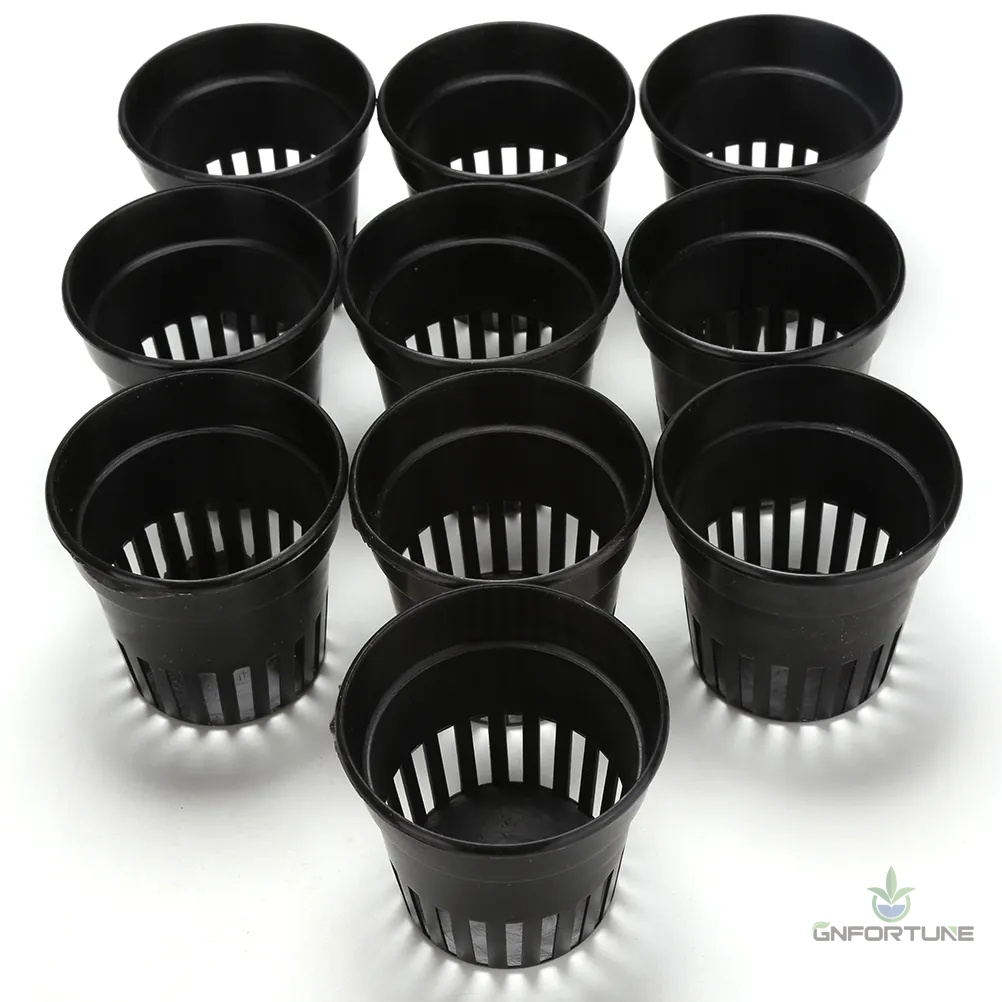
Bulk wholesale net pots arranged in a grid for commercial orders| Order size | Typical unit-price level | Why the step exists |
|---|---|---|
| 10,000 pcs | Baseline | Minimum batch for a standard item at many exporters; runs as a short production day |
| 50,000 pcs | Roughly 10–15% below baseline | Efficient mold cycles, fewer color changes, one production schedule |
| 200,000 pcs | Roughly 20–30% below baseline | Near the economy-of-scale floor; usually aligned with a full container plan |
Worked example: if a 3-inch virgin PP cup is quoted at $0.03 per piece at a 10,000-piece MOQ, the same cup at a 200,000-piece quantity commonly lands between $0.021 and $0.024 — before freight. That spread is real money at container scale, which is why MOQ tiers belong in the first email, not discovered after sampling. Two questions sharpen any negotiation: which price basis the quote uses, and whether a repeat order within twelve months keeps the larger-tier price.
Bulk Hydro Net Pots: Sizes, Colors, and Custom Molds
Open-mold sizes run from 2-inch cups for NFT channels up to 6-inch media baskets for Dutch buckets, with 3-inch and 4-inch as the highest-volume items in most export programs. Sizes and the crop and channel fit math behind them are covered in the net pot size guide; on the purchasing side, three boundaries matter:
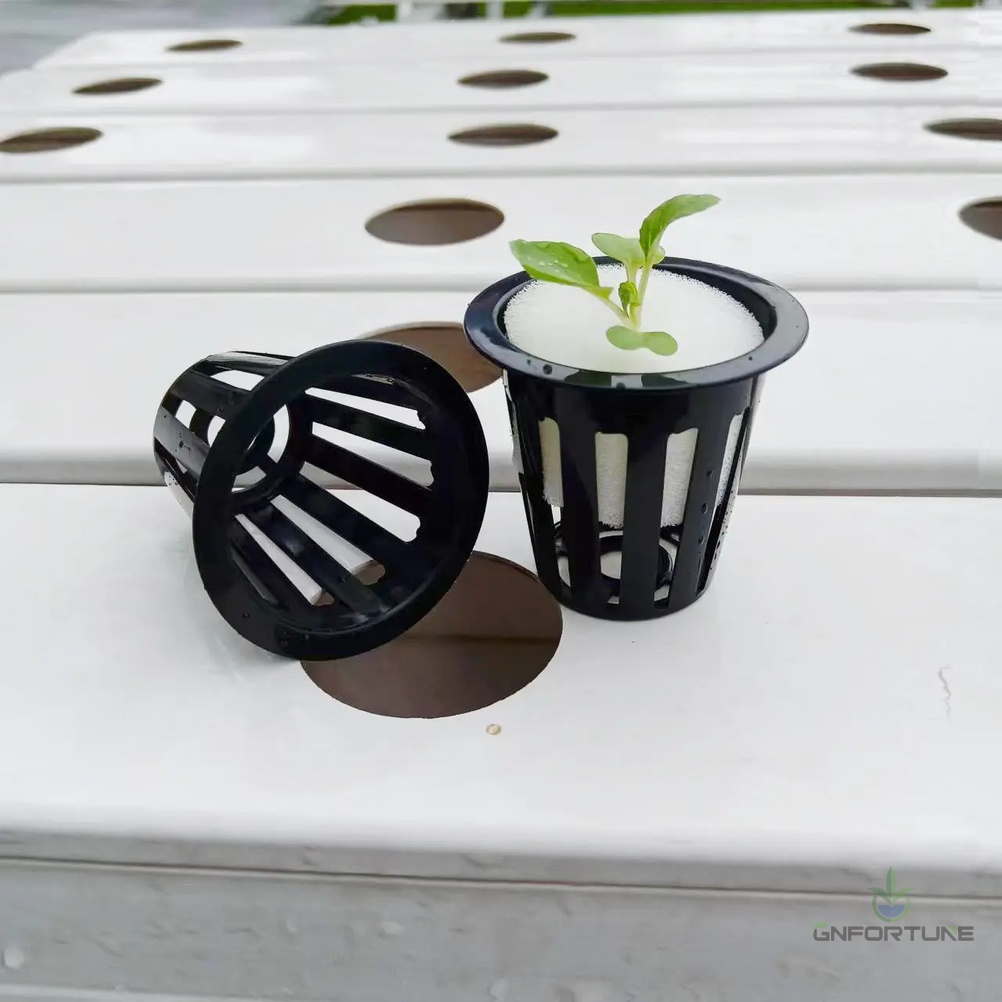
Net pots placed in a hydroponic growing tray- Color. Standard runs are white or black, set at the mold. A custom color needs a masterbatch formulation and minimum volume per color run — usually an extra per-kilogram resin cost plus a color-change charge. Budget for it only after your standard-color volume justifies it.
- Wall pattern. Buyers who need a true mesh pot — a denser, more open-wall pattern that holds fine coco or lets roots pass everywhere — are usually ordering a specific cavity rather than a standard cup. Confirm the open area percentage on the drawing, because two cups can look alike and drain very differently.
- Custom sizes and private label. A new cavity means new tooling, which is why custom sizes carry a mold cost and a longer lead time. Private-label color and logo printing on standard molds is more practical and fits our OEM program once volumes are established.
Check the depth figure, not just the diameter. A cheaper mold often cuts cup depth to save resin, which changes how much medium the cup holds and how it behaves in a channel. Ask for the drawing dimension table with the quote, not after sampling.
Packaging and Container Loading for Bulk Orders
Net pots are light and nestable, so bulk freight is a volume problem, not a weight problem. Your job is to get the packing spec in writing before the PO. As a budgeting example, assume a carton of 1,000 three-inch pots in the region of 0.08–0.10 m³; a 40HQ offers roughly 68 m³ of usable volume after door and load loss.
| Pot size | Typical pieces per 40HQ (budget range) | What shifts the number |
|---|---|---|
| 2-inch cups | ≈ 1.5–2.5 million | Nest height of the cavity; carton wall thickness |
| 3-inch cups | ≈ 0.9–1.4 million | Stack length per carton; whether pots are sleeved individually |
| 5–6 inch media baskets | ≈ 0.4–0.7 million | Basket depth; rigid rims that reduce nesting efficiency |
Treat those figures as budget ranges, not load guarantees — the real number depends on the specific cavity and carton, and a well-designed export carton can add 10–20% density. Confirm the carton dimensions, pieces per carton, gross weight, and pallet pattern with the supplier, then compare them against the full container-loading method in our hydroponic order container loading guide before you book freight.
Red Flags When Comparing Chinese Suppliers
Most net pot sourcing problems are not about the factory’s ability to mold plastic. They are about what happens between the sample you approve and the container you receive. The pattern of warning signs below is consistent across years of export orders:
Rule of thumb from the export desk: the sample shows what the supplier wants you to approve; the pre-shipment batch sample shows what you will actually receive. Insist on both, seal one master sample per production lot, and do not release payment terms that make a re-run impractical.
- A price 20–30% below every other quote on the same spec — the classic entry point for a material swap to regrind that looks identical in a photo.
- No batch-level material certificate. Ask for the food-grade certificate keyed to your batch number; a generic file is not traceability.
- No factory visit, video walk-through, or live mold demonstration. Molded parts are easy to verify; a supplier who cannot show the tooling usually does not own it.
- EXW-only quotes with freight, packing, and inspection added later. A quote that is not on a defined basis (EXW/FOB/CIF) is not a quote.
- Color shifts between production lots. Ask what color standard they hold to and whether every batch is checked against a master sample.
- Pots that feel thin or flex in the hand. Weigh 100 pieces from the batch sample and compare against the approved master; resin savings show up first as light cups.
Add an inspection step to your process: a photo report on the loaded container, a sealed master sample, and — for large orders — a third-party pre-shipment inspection with a 20% carton sample is cheaper than the cost of one bad batch. That discipline belongs in the purchase contract, not in the follow-up email.
FAQ
What is a realistic MOQ for standard net pots?
A: For standard sizes on open molds, most exporters quote from 5,000 to 20,000 pieces per size and color. Custom colors or custom cavities raise that number.
Will the bulk product match the sample?
A: Only if you verify it. Ask for a pre-production sample from the actual batch, hold a sealed master sample, and add a pre-shipment inspection for large orders.
Can I order custom colors or my own logo?
A: Custom color is possible once volume justifies the masterbatch and color-change cost; private-label runs with your logo fit our OEM program once the order size is established.
How many hydro net pots can I fit in a 40HQ?
A: As a budget range, roughly 0.4 million large 5–6 inch baskets up to 2.5 million 2-inch cups, depending on nest height and carton design. Confirm the packing spec in writing before booking freight.
How do I know the resin is food-safe?
A: Request a food-grade certificate and resin datasheet tied to your batch number. If your market audits food contact, keep that document with your crop records.
Request the Current Wholesale Net Pot Price List and MOQ Sheet
If your project centers on hydro net pots, confirm every spec that will reach your channel or bucket — material grade, size and depth, wall pattern, color, packaging, and MOQ tier — before you send the PO. Send your system type and target quantities, and request the current wholesale net pot price list and MOQ sheet through the quote form; we will reply with tier pricing, packing specs, and container options, and our general wholesale terms and shipping page covers the fine print.