

A net pot is the small perforated cup that holds a plant and its medium above or inside a hydroponic channel, tray, or bucket. The size you choose — 2, 3, 4, 5, or 6 inches — decides how much room the root zone has, how often irrigation must run, and how many plants fit per meter of channel. It is the most reordered component on a commercial farm, and the one growers most often buy wrong the first time. This guide covers net pot sizes by crop and system, spacing math, and the design details that separate cups that last years from cups that crack in the first season.
Why Net Pot Size Matters More Than You Think
Net pot size sits at the center of three decisions that are usually made separately:
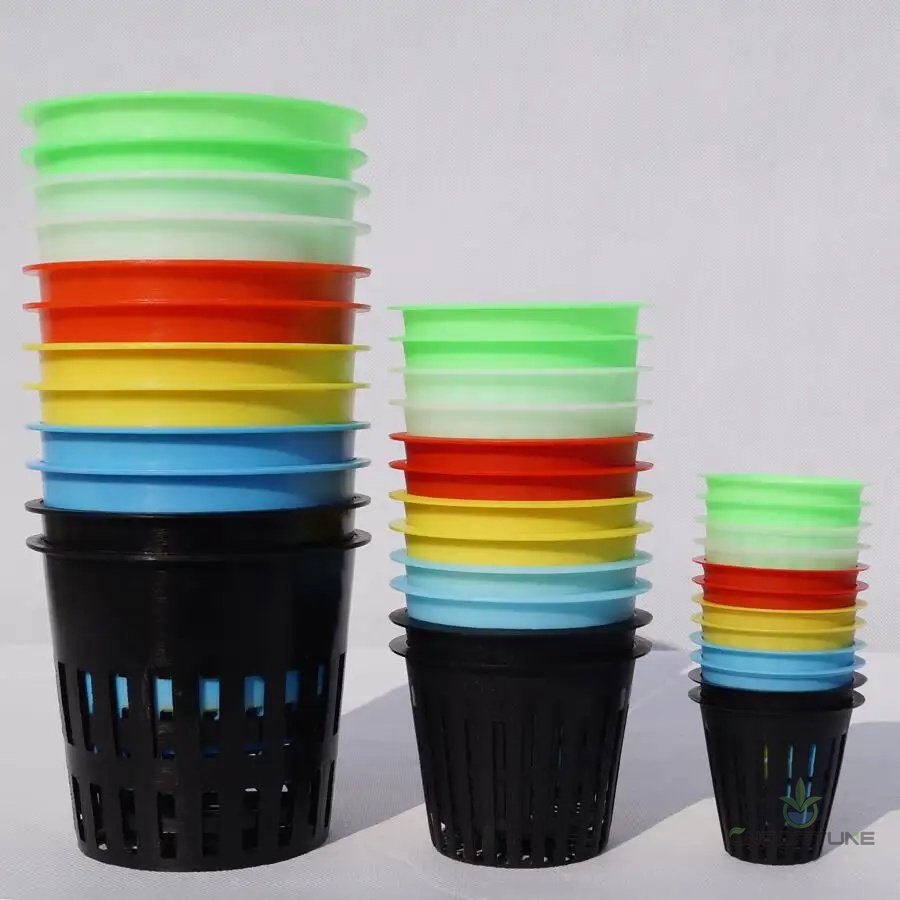
Stacked hydroponic net pots in three sizes for comparison- Root-zone space. A 2-inch cup holds roughly a quarter of the medium volume of a 4-inch cup. Leafy greens with short crop cycles do fine in small cups; fruiting crops that stay in the same channel for months do not.
- Irrigation frequency. The less medium a cup holds, the faster it dries, and the more often the system must deliver water. In hot greenhouses, undersized net pots mean irrigation timers running near their limits and tip burn on the hottest afternoons.
- Plants per meter. Bigger cups need wider spacing. Choosing the cup before you know the channel’s hole spacing is how farms end up cutting holes in perfectly good NFT channels.
The failures we fix on site trace back to these three more often than to pumps or nutrients. Match the pot to the root zone the crop will actually grow into, not to the smallest cup that fits the hole.
Net Pot Sizes Compared: 2″, 3″, 4″, 5″, and 6″
Net pot sizes are measured by top diameter in inches. Depth roughly tracks diameter, though cheap cups sometimes cut depth to save resin — always check the depth figure, not just the diameter.
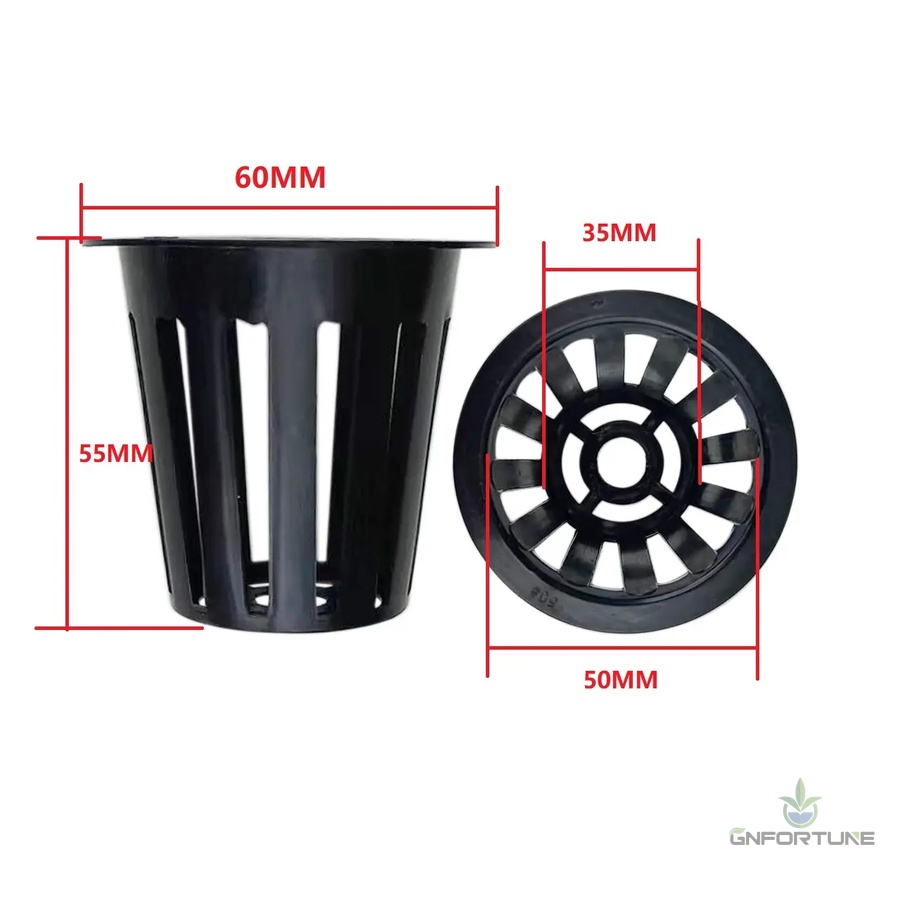
Net pot with dimension callouts for size selection| Size | Approx. top diameter | Typical depth | Best-fit crops | Common systems |
|---|---|---|---|---|
| 2″ | 51 mm | ~55 mm | Seedlings, small herbs, single lettuce starts from rockwool cubes | NFT channels with small holes, propagation |
| 3″ | 76 mm | ~75 mm | Lettuce, leafy greens, basil, small strawberries | NFT channels, gutter/rack systems |
| 4″ | 102 mm | ~100 mm | Large strawberries, chard, compact herbs in longer cycles | Wide NFT gutters, flood trays, rack shelves |
| 5″ | 127 mm | ~120 mm | Peppers, cucumbers, fruiting crops | Dutch bucket lids, media beds, deep water culture |
| 6″ | 152 mm | ~150 mm | Tomatoes, heavy fruiting crops with long seasons | Dutch buckets, large media containers |
The rule we give growers: if the crop will finish in the cup, size the cup for the root ball at harvest, not at transplant. A lettuce that looks comfortable in a 2-inch cup at week two may be root-bound at week six in a warm channel.
Matching Net Pots to Your NFT Channel or Dutch Bucket
The cup has to fit two things: the hole it sits in and the root space the crop needs. Start from the hardware:
- NFT channels: most commercial NFT channels have round holes in the 2–3 inch range. A 2-inch net pot is the safe default for standard 50 mm holes; 3-inch cups are used where the channel spec and hole spacing allow. The cup should hang with its rim seated on the channel cover and the bottom clear of the water film — if the cup touches the channel floor, the roots sit in waterlogged conditions the design never intended.
- Dutch buckets: bucket lids are typically opened to 4–6 inches to take a matching net pot filled with media. A 5-inch cup is the most common pairing for peppers and cucumbers; 6-inch for heavy tomato seasons. Unlike NFT, the cup here is a media basket — it must be rigid enough to hold several liters of perlite or clay pebbles without bulging.
- Flood trays and rack shelves: pots sit loose on the tray, so diameter and spacing are free choices driven by crop size and tray width. See the density math below.
If you are speccing a system from scratch, our NFT channel product page lists the hole pattern per profile, and the Dutch bucket system guide covers lid options — check those numbers before you order cups in bulk.
How Many Net Pots Fit a 4×8 Tray or a 1-Meter Channel
Density is set by the spacing the mature crop needs, then rounded down to a number that fits the tray or channel width cleanly.
| Scenario | Spacing | Fit per tray / meter | Note |
|---|---|---|---|
| 4×8 ft tray, 3″ pots | 6 × 6 inch grid | ~128 pots | Tight but workable for short leafy crops |
| 4×8 ft tray, 6″ pots | 8 × 8 inch grid | ~72 pots | Room for airflow between fruiting plants |
| 1 m NFT channel, 2″ pots | 150 mm centers | ~6 pots per meter | Typical lettuce density in NFT |
| 1 m NFT channel, 3″ pots | 200 mm centers | ~5 pots per meter | More headroom per plant, fewer plants per run |
One spacing mistake shows up on farms more than any other: matching hole spacing to the channel’s maximum, then wondering why plants shade each other. Lettuce spacing guidance by crop stage is covered in our commercial lettuce in NFT guide — it has the transplant and harvest spacings we run on commercial lines.
Net Pot Design: Slotted Sides, Mesh, and Rigidity
All net pots look similar in a photo. In your hand, the differences decide whether you reorder in one year or three:
- One-piece injection moulding vs cut baskets. A net pot moulded as a single piece keeps its shape when wet and stacks cleanly for storage. Cut or folded baskets save a little per unit but deform under repeated handling and can snag roots on their seams.
- Slot pattern vs full mesh. Vertical slots keep media in and let roots exit sideways once they reach the wall; dense mesh patterns hold finer media better but restrict larger root masses. Match the pattern to your medium — coarse clay pebbles want slots, fine coco wants a tighter wall.
- Rigidity and rim strength. The rim carries the plant’s weight in an NFT channel. A flexible rim pops out of the hole when plants get top-heavy; check rim stiffness and the lip that seats on the channel cover.
- Resin and food safety. Cups should be food-grade polypropylene, not recycled regrind that goes brittle under greenhouse UV. Ask for the material certificate if you are buying for a farm that sells to retailers with food-safety audits.
A field test worth doing before a big order: fill sample cups with your actual medium, soak them for a week, then squeeze and drop them from bench height. Cups that hold their shape and rim after that test will survive a season of handling; cups that distort on day one will annoy you for a thousand trays. We run this test on every net pot line we supply — and we have rejected supplier batches that looked perfect in the catalog.
Buying Net Pots for a Whole Farm: What to Ask
When the order is thousands of pieces, the per-unit price stops being the deciding question. Before you commit, get answers on:
- Size tolerance and batch consistency — a 0.5 mm variance in rim diameter matters when cups seat into 2,000 channel holes.
- Material grade and UV stability — food-grade PP with UV stabilizers, confirmed by certificate, not by sales talk.
- Packaging and storage — nestable cups in cartons that survive container shipping without crushing the rims.
- Lead time and reorder terms — a net pot is a consumable; you will reorder, and the second order should not be a surprise negotiation.
For wholesale quantities, MOQ tiers, and per-piece pricing across the 2–6 inch range, request the current price list — the quote form goes straight to our export team. If you are also sourcing channels or buckets in the same order, add the quantities and we will match the whole package. General wholesale terms and shipping apply.
FAQ
What is the most common net pot size?
A: 3-inch net pots for leafy greens in NFT channels, and 5-inch for fruiting crops in Dutch buckets. The 2-inch size is the standard for propagation and small channel holes.
Can I reuse net pots between crops?
A: Yes, if they are intact and you sanitize them. Wash off media and roots, soak in a sanitizer approved for your market, and inspect the rims — cracked rims leak plants into the channel. Factor a small replacement percentage into every crop cycle.
Do bigger net pots mean bigger plants?
A: Only up to a point — root-zone volume helps, but light, nutrition, and spacing set the ceiling. Oversized cups on tight spacing give you fewer plants per meter without a yield gain.
Do you sell net pots wholesale?
A: Yes, across the 2–6 inch range in food-grade PP with UV stabilizers. Send your sizes and quantities through the quote form and we will return per-piece pricing, MOQs, and lead time.
Size Your Net Pot Order Correctly
Send your system type, channel or bucket model, crop, and target plant count through the quote form, and our team will confirm the cup size, hole-fit, and density per meter or tray before quoting — so the cups you receive seat correctly the day they arrive.