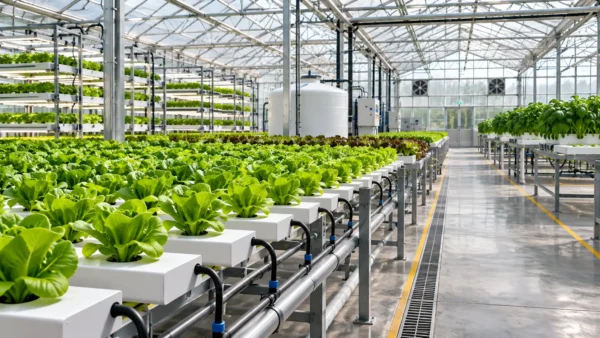
A successful commercial hydroponic project starts long before the first growing channel or planting container is installed. The growing system, greenhouse layout, irrigation network, drainage, and supporting equipment must all work together to meet the project’s production goals.
Choosing the right hydroponic system is one of the most important decisions for commercial growers, greenhouse contractors, and agricultural project developers. NFT channels, Dutch Bucket systems, substrate gutters, DWC installations, and aquaponics systems each have different design requirements and applications.
This guide explains the main types of commercial hydroponic systems, how to select a suitable growing method, and what buyers should consider when planning a complete project. It also covers practical layout decisions, equipment specifications, supplier drawing reviews, and the information that should be included in a commercial hydroponic system design package.
What Is a Commercial Hydroponic System?
A commercial hydroponic system is a soilless growing setup designed to produce crops at a planned scale using water-based nutrient delivery and controlled growing conditions. Instead of relying on conventional soil cultivation, plants receive water and essential nutrients through a growing system selected for their crop requirements and production environment.
A commercial installation usually combines several interconnected components:
- Growing structures, such as NFT channels, Dutch Buckets, substrate gutters, or DWC floating rafts.
- Irrigation equipment, including pumps, pipes, valves, and water distribution lines.
- Nutrient management components, such as tanks, filtration, and dosing equipment where required.
- Drainage and water collection arrangements.
- Supporting structures, growing benches, and access walkways.
- Environmental and monitoring equipment appropriate to the project.
The configuration varies according to the crop, production targets, greenhouse dimensions, available utilities, and operating requirements.
For example, a leafy-green production facility may use NFT channels or DWC growing boards, while a vine-crop greenhouse may use Dutch Buckets with substrate and drip irrigation. Commercial strawberry production may require dedicated gutter structures and drainage arrangements.
The goal of commercial hydroponic system design is to coordinate these components into a practical growing environment that supports production, maintenance, and future expansion.
Types of Commercial Hydroponic Systems
Commercial hydroponic projects can use different growing methods depending on the crop, root-zone requirements, irrigation approach, and available infrastructure.
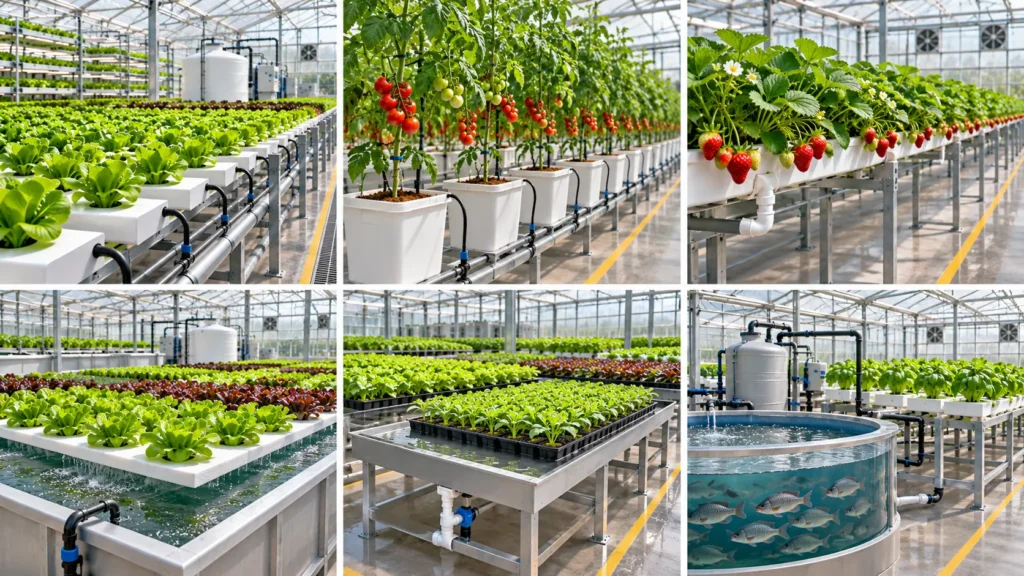
The main systems supplied or represented in G&N Hydroponic’s product range include NFT channels, Dutch Bucket systems, strawberry and substrate gutters, DWC growing components, Ebb and Flow equipment, and aquaponics-related systems.
Each system has different design considerations. Understanding these differences helps buyers identify which growing method is worth evaluating before finalizing a project layout.
NFT Hydroponic Systems
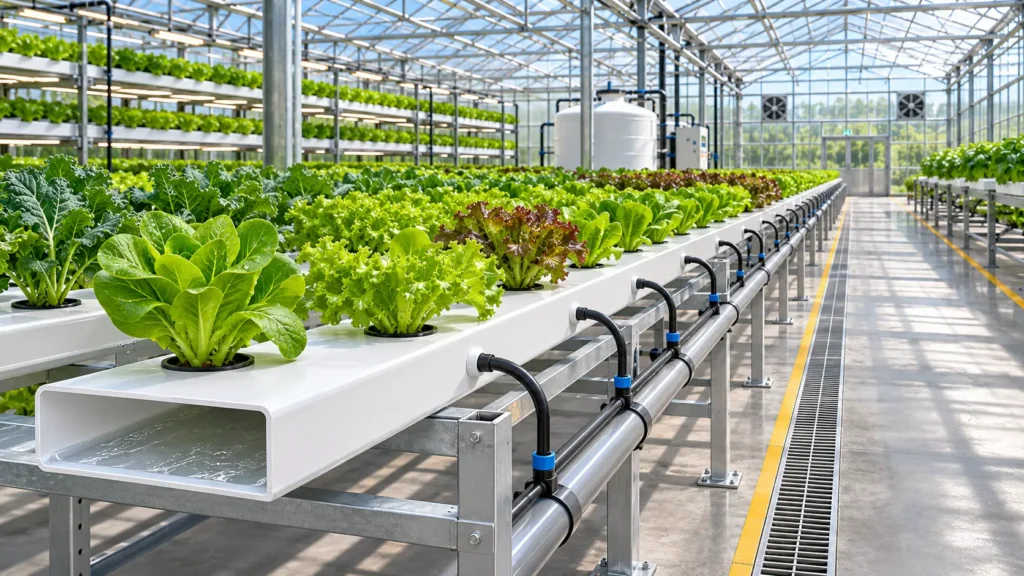
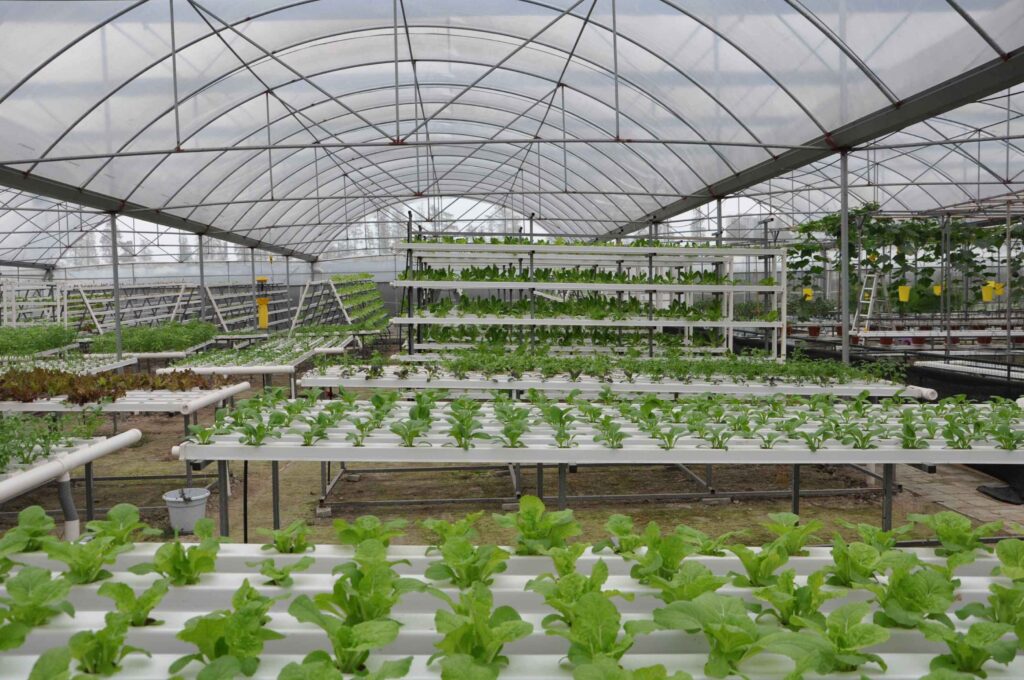
Nutrient Film Technique (NFT) is a hydroponic growing method in which a shallow stream of nutrient solution flows through channels and passes along the plant roots. The solution is collected and returned through the irrigation circuit, allowing it to circulate through the growing system.
NFT is commonly considered for commercial leafy-green production, including lettuce, herbs, and other crops suited to channel-based growing.
For commercial installations, the channel configuration should be selected according to plant size, root development, planting density, and the intended production layout.
G&N Hydroponic offers different NFT channel configurations for commercial growing applications. Available product specifications include 100 × 50 mm and 100 × 55 mm channel profiles, with 1.8 mm and 2.0 mm wall thickness options on the listed products. Standard lengths include 2.9 m and 5.8 m, with customization available according to product requirements.
Depending on the selected model, channel configurations can include different cover designs, end caps, drainage outlets, connectors, and support accessories.
When planning an NFT installation, buyers should evaluate:
- Channel dimensions and internal growing space.
- Planting-hole diameter and spacing.
- Channel length and installation slope.
- Nutrient solution flow distribution.
- Return-line capacity and drainage.
- Support structure and installation arrangement.
- Access for harvesting and cleaning.
A commercial NFT layout should be evaluated as a complete irrigation and growing arrangement rather than by channel quantity alone.
Dutch Bucket Systems
Dutch Bucket systems use individual growing containers filled with a suitable substrate to support plant roots. Nutrient solution is delivered through irrigation lines, while excess solution drains through the container’s drainage outlet and the connected return arrangement.
This growing method is widely considered for commercial vine crops and larger plants that benefit from individual root zones and substrate-based support. Typical applications include tomatoes, cucumbers, peppers, and eggplants.
G&N Hydroponic offers an 11-liter black Dutch Bucket measuring 30 × 25 × 23 cm. The listed product is made from eco-friendly polypropylene with UV stabilizer and is supplied with two siphon elbows. Drainage configurations include 40 mm and 50 mm outlet options, depending on the selected specification.
For commercial installations, the number of buckets, spacing, irrigation distribution, and drainage layout should be planned around the crop variety and production requirements.
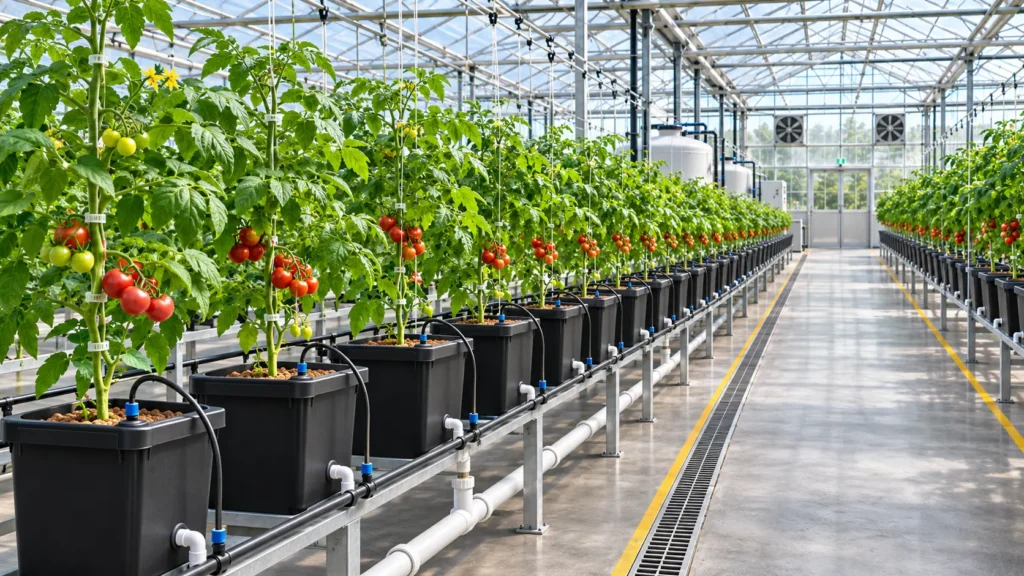
Important design considerations include:
- Bucket capacity and dimensions.
- Substrate type and volume.
- Dripper placement and irrigation uniformity.
- Drainage outlet configuration.
- Return-pipe routing and capacity.
- Plant spacing and trellis support.
- Access for pruning, harvesting, and maintenance.
Dutch Bucket systems should be evaluated together with their substrate, irrigation, drainage, and plant-support arrangements. Selecting containers without considering the complete layout can lead to unnecessary adjustments during installation.
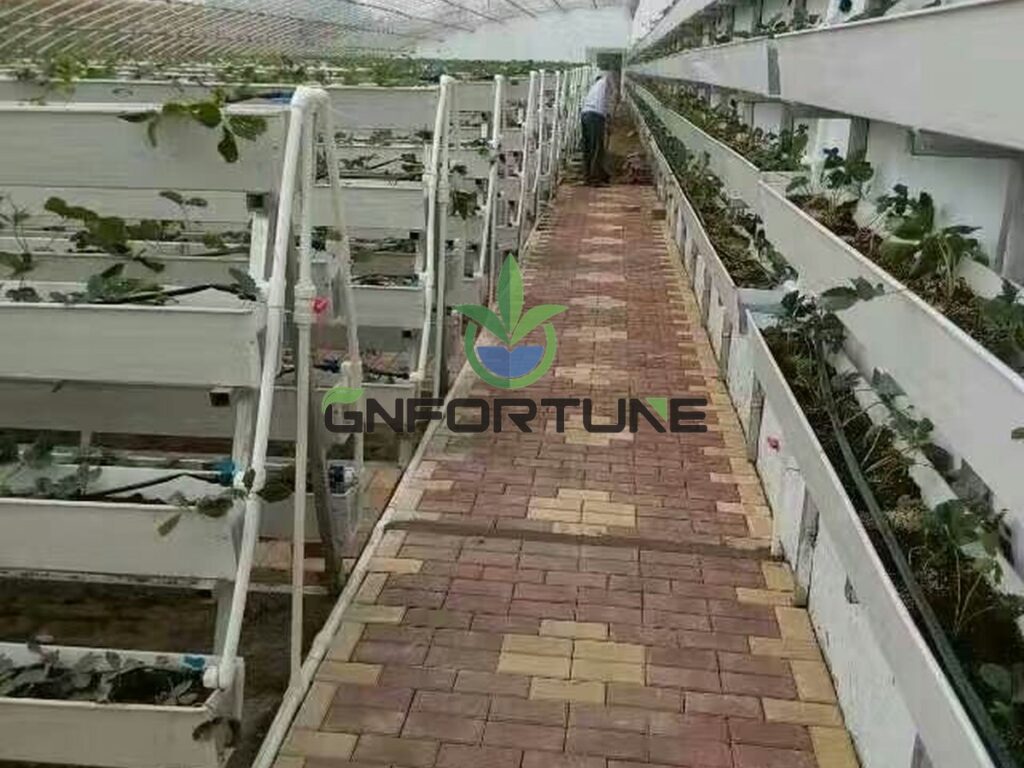
Strawberry & Substrate Gutter Systems
Strawberry and substrate gutter systems provide structured growing channels for crops cultivated in containers or growing media. They are commonly considered for commercial greenhouse projects where plant spacing, harvesting access, drainage, and the management of the root zone need to be carefully coordinated.
Unlike traditional soil beds, substrate-based gutter systems use dedicated structures to support growing media and direct excess irrigation water toward a collection or drainage arrangement.
G&N Hydroponic offers strawberry gutter products with different profile dimensions and installation configurations. The product range includes gutter structures with drainage boards, as well as options designed for different growing layouts.
Depending on the selected model, installation approaches may include A-frame, bench-mounted, and hanging-rail configurations.
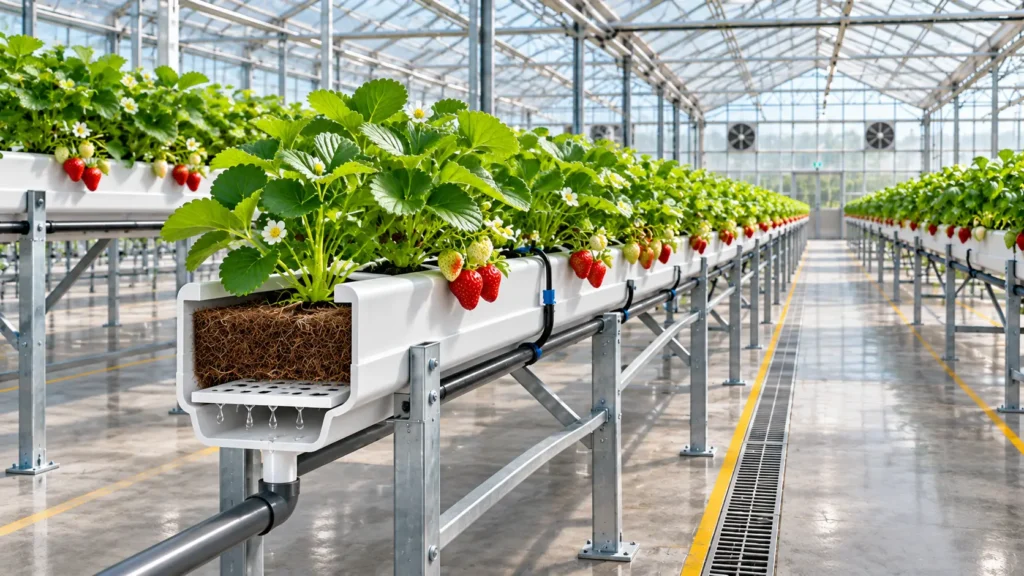
When planning a commercial strawberry or substrate growing project, buyers should consider:
- Gutter dimensions and growing-media capacity.
- Plant spacing and row arrangement.
- Drainage-board configuration.
- Irrigation distribution and excess-water collection.
- Installation height and supporting structure.
- Harvesting access and worker movement.
- Compatibility with the greenhouse layout.
The gutter profile, substrate, irrigation method, and supporting structure should be evaluated together. Their combination determines how the growing area is arranged and maintained throughout the production cycle.
Deep Water Culture (DWC) Systems
Deep Water Culture (DWC) is a hydroponic growing method in which plant roots are suspended in or exposed to a nutrient solution. In commercial configurations, plants are commonly supported by floating rafts or growing boards positioned above water-filled channels or tanks.
DWC systems are often considered for leafy-green production and other crops suited to water-based root environments.
G&N Hydroponic’s DWC product range includes XPS floating raft boards in different configurations and dimensions, together with related pond-lining products for water-retention applications.
The floating board dimensions and construction should be selected according to the planned growing area, planting-hole arrangement, water structure, and operating requirements.

Key design considerations include:
- Floating raft dimensions and material.
- Planting-hole spacing and board configuration.
- Water depth and growing-area layout.
- Water circulation and oxygenation.
- Nutrient solution temperature and monitoring.
- Tank or channel construction.
- Cleaning, maintenance, and drainage access.
In a commercial DWC project, floating boards are only one part of the system. The supporting water structure, circulation arrangement, oxygen supply, and nutrient management must also be considered when planning the complete installation.
Ebb and Flow Systems
Ebb and Flow, also known as flood and drain, is a hydroponic growing method in which nutrient solution periodically fills a growing tray or container before draining away. Plants are supported by a suitable growing medium, while the irrigation cycle supplies water and nutrients to the root zone.
This method can be considered for commercial propagation areas, nursery operations, and other growing applications where periodic irrigation is suitable.
G&N Hydroponic’s related product range includes flood trays and growing-table equipment in different configurations. These components can be considered when planning a suitable flood-and-drain growing arrangement.
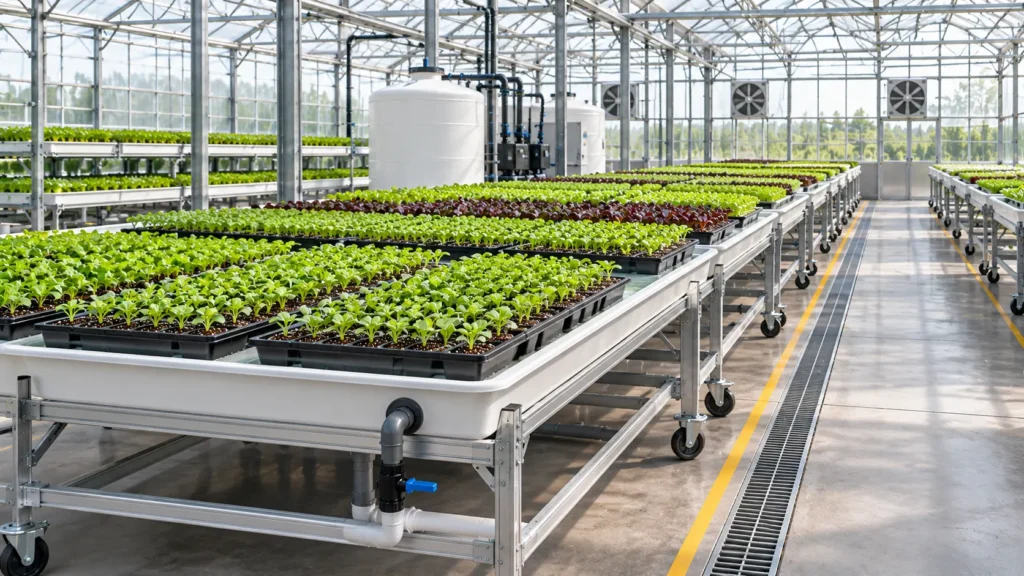
Important design considerations include:
- Tray dimensions and growing-area capacity.
- Flooding depth and irrigation cycle.
- Drainage outlets and return arrangement.
- Growing-medium selection.
- Structural support and load capacity.
- Water delivery and drainage control.
- Access for cleaning and maintenance.
For a commercial installation, the tray, support structure, water supply, drainage, and irrigation cycle should be planned as one coordinated arrangement.
Commercial Aquaponics Systems
Commercial aquaponics combines aquaculture and plant production in an integrated water-management system. Fish are raised in aquaculture tanks, while plants grow in connected growing areas that use water containing nutrients generated through the aquaculture process.
Unlike conventional hydroponics, aquaponics projects must consider both fish production and plant production. The relationship between fish stocking, feed input, filtration, water quality, and plant nutrient requirements needs to be evaluated as part of the overall system design.
G&N Hydroponic offers aquaponics-related products and system components, including fish-and-vegetable symbiosis NFT systems and related growing equipment.

A commercial aquaponics project may require consideration of:
- Fish tank capacity and aquaculture production targets.
- Mechanical filtration and solids removal.
- Biological filtration.
- Water circulation between aquaculture and plant-growing areas.
- Oxygenation and water-quality monitoring.
- Plant-growing structures and growing-area capacity.
- Backup equipment and contingency planning.
The system should be designed as an integrated production environment rather than simply combining a fish tank with hydroponic channels.
For buyers planning a complete aquaponics project, it is important to clarify the proposed system configuration, included equipment, filtration arrangements, and the division of installation responsibilities before approving a quotation.
How to Choose the Right Commercial Hydroponic System?
Choosing a commercial hydroponic system requires more than comparing product prices or growing-channel dimensions. The selected system should match the crop, production goals, site conditions, available infrastructure, and daily operating requirements.
The following factors can help buyers narrow down suitable system options.
Match the Growing System to the Crop
Different crops have different root structures, plant sizes, spacing requirements, and growing cycles.
NFT and DWC systems are commonly considered for leafy-green production. Dutch Bucket systems can be suitable for larger plants and vine crops such as tomatoes and cucumbers. Strawberry production may require dedicated substrate gutters, while aquaponics projects must account for both fish and plant production.
The crop plan should therefore be established before finalizing the equipment configuration.
Evaluate the Greenhouse or Growing-Site Layout
The available growing area is not the same as the total building area. Space must also be allocated for walkways, irrigation equipment, storage, harvesting, and maintenance.
Before selecting a system, review:
- Greenhouse dimensions and usable growing area.
- Floor conditions and drainage.
- Water source and quality.
- Available electrical capacity.
- Equipment access and installation routes.
- Potential areas for future expansion.
Compare Water and Irrigation Requirements
Different growing systems require different water-management arrangements.
NFT relies on controlled nutrient solution flow through channels. Dutch Bucket systems require irrigation distribution to individual containers. DWC needs appropriate water circulation and oxygenation, while aquaponics adds filtration and aquaculture water-quality requirements.
The irrigation and drainage design should match the selected growing method.
Consider Labor and Daily Operations
A commercial system must be practical to operate. Evaluate access for planting, harvesting, cleaning, pruning, equipment inspection, and routine maintenance.
A layout that maximizes growing density but makes daily work difficult may create operational problems over time.
Plan for Maintenance and Future Expansion
Commercial projects may expand as production demand grows. Consider whether additional growing zones, irrigation capacity, or supporting equipment can be added without disrupting existing operations.
Modular layouts, accessible control points, and clearly separated growing zones can help simplify future maintenance and expansion.
Compare the Complete Project Scope
When comparing supplier quotations, do not focus only on the unit price of channels, buckets, or trays.
Review the proposed growing structures, supporting equipment, irrigation components, quantities, specifications, design documentation, delivery arrangements, and installation responsibilities.
A complete project comparison should be based on the equipment and services actually included in each proposal.
| System | Typical applications | Main design considerations |
|---|---|---|
| NFT | Lettuce, herbs and leafy greens | Channel dimensions, slope, flow distribution |
| Dutch Bucket | Tomatoes, cucumbers and peppers | Substrate, irrigation, drainage, plant support |
| Strawberry Gutter | Commercial strawberry growing | Gutter profile, substrate, spacing, drainage |
| DWC | Leafy greens and suitable water-based crops | Water management, oxygenation, floating boards |
| Ebb and Flow | Propagation and suitable container growing | Flood cycle, trays, drainage |
| Aquaponics | Integrated fish and vegetable production | Filtration, water quality, fish and plant balance |
Where Design Starts: Not with Equipment
A proper design sequence runs in this order. Suppliers who start with a product catalog are selling, not designing:
- Crop plan & market — what sells, at what volume, in what size grade
- Site facts — greenhouse dimensions, floor level, power capacity, water source and quality
- System selection — NFT / buckets / gutters / mixed, per the crop plan (system comparison)
- Layout design — zones, rows, walkways, irrigation room
- Equipment spec — channels, stands, pumps, filtration, dosing
- Verification — flow rates at row ends, load checks, redundancy
This sequence matters because equipment specifications should follow the project requirements, not determine them.
For example, selecting NFT channels before confirming the crop plan may result in unsuitable planting spacing or channel configurations. Choosing Dutch Buckets without reviewing drainage and irrigation requirements can create unnecessary adjustments during installation.
The same principle applies to DWC, substrate gutter, and aquaponics projects. Each growing method introduces different requirements for water management, supporting structures, and daily operations.
A supplier should therefore understand the intended production environment before recommending a product configuration.
The Four Layout Decisions That Cannot Be Retro-fixed
| Decision | Why it’s permanent | Design check |
|---|---|---|
| Floor slope & drainage | Return lines run by gravity; dead-level floors pool | Verify actual floor levels — laser, not assumption |
| Irrigation room position | Pump head and pipe runs depend on it | Central, at the low end, with access for tanks |
| Nutrient loop split | Mixed crops need separate loops from day one | One loop per crop family, one panel |
| Zone partitioning | Expansion and shutdowns happen by zone | Each zone independently isolated and drained |
Not every component is equally difficult to change after installation. Growing channels, containers, and some irrigation accessories may be easier to adjust than the main infrastructure, but modifications can still involve additional labor and material costs.
Floor levels, drainage routes, irrigation-room locations, nutrient-supply zones, and the overall partitioning of the growing area should therefore be reviewed before construction begins.
For projects combining different crops or growing methods, these decisions become even more important because each production zone may have different irrigation, drainage, and maintenance requirements.
Reading a Supplier’s Diagram Like an Engineer
Whether you’re reviewing our drawings or another supplier’s, these are the checks that separate a real design from a picture:
- Flow rate annotated at row ends — not just at the pump. Head-end numbers hide tail-end starvation.
- Channel runs labeled with length and slope — any run over ~10–12 m should be split, or the drawing should say why it isn’t
- Pump duty point stated — flow at the actual head, not the pump’s open-flow rating
- Standpipe / return sizing — return capacity ≥ total supply, or rows back up at peak flow
- Water source & filter spec matched — a 120-micron screen on pond water is a clog calendar, not a design
- Load paths for gutters and trellis — weight goes somewhere; that somewhere should appear on the drawing
Additional Checks for Different Growing Systems
The technical review should also reflect the specific requirements of each hydroponic system.
When evaluating an NFT installation, check the channel dimensions, slope, planting-hole configuration, flow distribution, and return capacity.
Dutch Bucket systems require particular attention to bucket spacing, substrate selection, irrigation-line arrangement, and drainage connections.
Strawberry and substrate gutter systems should be assessed based on gutter dimensions, growing-media capacity, support height, and drainage-board configuration.
In DWC installations, floating-board dimensions, water structure, circulation arrangements, and oxygenation requirements are important factors to review.
Tray dimensions, flood-and-drain arrangements, and supporting structures should also be examined when assessing Ebb and Flow systems.
Aquaponics projects require a closer look at how fish tanks, filtration, water circulation, and plant-growing areas work together.
All these checks should be supported by relevant drawings and equipment specifications rather than general product descriptions.
Buyer’s test: ask the supplier to walk you through what happens when one pump fails mid-afternoon in summer. A designed system has an answer — backup pump, alarm, auto-swap.
An under-designed one has no clear answer.This single question has ended more bad purchases than any spec comparison.
Commercial Hydroponic Equipment and Specifications
Growing Channel and Gutter Specifications
- Material composition and suitability for the intended growing environment.
- Channel or gutter dimensions and wall construction.
- UV resistance where required by the installation environment.
- Product length, connection design, and drainage configuration.
- Compatibility with the proposed supporting structure.
Dutch Bucket and Planting Container Specifications
- Container capacity and dimensions.
- Material composition and durability.
- Drainage outlet size and configuration.
- Compatibility with the selected growing medium.
- Spacing and supporting arrangements.
Irrigation and Water Management Equipment
- Pump operating flow and duty point.
- Pipe dimensions and connection compatibility.
- Filtration capacity and filter specifications.
- Dripper flow rate and irrigation distribution.
- Nutrient tank and dosing arrangements where required.
DWC and Aquaponics Components
- Floating-board dimensions and material.
- Water-retention structure and liner specifications.
- Water circulation and oxygenation requirements.
- Filtration and water-quality management for aquaponics.
- Compatibility between growing structures and supporting equipment.
Documentation and Spare Parts
- Product material and technical specifications.
- Installation instructions where applicable.
- Relevant compliance documentation where required.
- Spare parts and replacement-component availability.
- Clear identification of included and optional accessories.
Full installation parameters (slope setting, flow checking, commissioning sequence) are covered in the NFT channel installation guide.
What a Complete Design Package Contains
- Zone layout drawing with dimensions and walkways
- Channel/row schedule (lengths, counts, spacing)
- Irrigation schematic — supply, return, filtration, dosing, pumps with duty points
- Electrical loads summary for your electrician
- Commissioning checklist and operating parameter sheet
For projects involving different growing systems, the design documentation should also identify the equipment and configuration specific to each production area.
For example, an NFT project may require channel schedules and flow-distribution information, while a Dutch Bucket installation may need container layouts, substrate specifications, irrigation-line arrangements, and drainage details.
A strawberry gutter project may require gutter profiles, support heights, and row-spacing information. DWC and aquaponics projects may also require additional documentation covering water structures, circulation, and filtration arrangements.
Before approving a proposal, buyers should clarify which drawings and technical documents are included in the supplier’s scope, which services are optional, and which installation responsibilities belong to the buyer or local contractor.
If a supplier’s “design” is a channel count and a price, you are buying parts, not a farm. The package above provides a practical reference for evaluating the design documentation included in a commercial hydroponic project proposal.
From System Design to Commercial Project Delivery
A commercial hydroponic project involves more than selecting growing equipment. Buyers and suppliers need to coordinate project requirements, system configuration, equipment specifications, production preparation, and installation planning.
The following stages provide a practical framework for organizing a commercial growing project.
Stage 1: Define Project Requirements
Establish the crop plan, production targets, growing environment, available space, water source, and expected project scope.
Stage 2: Select the Growing System
Compare suitable systems according to the crop, root-zone requirements, irrigation method, and operating conditions.
Stage 3: Review the Layout and Equipment Configuration
Confirm growing-area dimensions, row arrangements, supporting structures, irrigation components, drainage, and equipment quantities.
Stage 4: Confirm Product Specifications
Review product dimensions, materials, technical requirements, accessories, and the agreed supply scope before placing the order.
Stage 5: Coordinate Manufacturing and Delivery
Confirm production specifications, quantities, packaging, delivery arrangements, and the responsibilities of the buyer and supplier.
Stage 6: Installation and Commissioning
Coordinate equipment installation, water-system checks, irrigation distribution, and commissioning according to the project documentation and agreed responsibilities.
Stage 7: Operation and Future Expansion
Establish routine inspection and maintenance procedures. Review production performance and identify whether additional growing zones or supporting equipment may be required as the operation develops.
The exact project process depends on the system configuration, site conditions, and the services included in the supplier’s agreement.
FAQs About Commercial Hydroponic System Design
What is the best hydroponic system for commercial farming?
There is no single best hydroponic system for every commercial farm. NFT, Dutch Bucket, DWC, strawberry gutter, and aquaponics systems serve different growing requirements. The right choice depends on the crop, production targets, available space, water management, and operating conditions.
Which hydroponic system is suitable for commercial lettuce production?
NFT and DWC systems are commonly considered for commercial leafy-green production. The final choice depends on crop varieties, planting density, growing-area configuration, water management, and the operating preferences of the farm.
Are Dutch Bucket systems suitable for commercial tomato production?
Yes. Dutch Bucket systems are commonly used for commercial tomato production because they provide individual growing containers and allow substrate-based root support. Bucket spacing, substrate selection, irrigation distribution, drainage, and plant-support structures should be planned around the selected crop variety.
What is the difference between NFT and DWC hydroponic systems?
NFT systems deliver a shallow stream of nutrient solution through growing channels, while DWC systems support plant roots in or above a larger body of nutrient solution. Both methods can be considered for leafy-green production, but they have different requirements for water circulation, root support, and system management.
Can different hydroponic systems be combined in one commercial greenhouse?
Yes. A commercial greenhouse may use different growing systems for separate crop groups or production zones. However, irrigation, nutrient management, drainage, equipment capacity, and operational access should be planned carefully before combining systems.
What should be included in a commercial hydroponic system quotation?
A quotation should identify the proposed growing structures, equipment types, quantities, dimensions, specifications, and included accessories. Buyers should also clarify design documentation, installation responsibilities, packaging, delivery terms, and any optional services.
What information does a supplier need to design a commercial hydroponic system?
Useful starting information includes greenhouse dimensions, floor conditions, crop plan, target production, water source, water quality, available power, and the intended project scope. More detailed information may be required depending on the growing method and site conditions.
How long does commercial hydroponic system design take?
The timeline depends on project complexity, site information, crop planning, equipment configuration, and the number of design revisions. Buyers should confirm the expected design schedule and documentation scope with their supplier before starting.
Get Your Commercial Hydroponic Project Reviewed
Planning a commercial hydroponic project requires the right growing system, suitable equipment, and a layout designed around your production requirements.
G&N Hydroponic supplies commercial hydroponic growing equipment and related system components, including NFT channels, Dutch Buckets, strawberry gutters, DWC growing products, Ebb and Flow equipment, and aquaponics-related products.
Whether you are planning a new greenhouse, expanding an existing growing facility, or sourcing equipment for an agricultural project, our team can discuss your requirements and help identify suitable product configurations.
To discuss your project, share your greenhouse dimensions, intended crops, target production capacity, water source, and equipment requirements with our team. Contact G&N Hydroponic to discuss your commercial hydroponic project.