
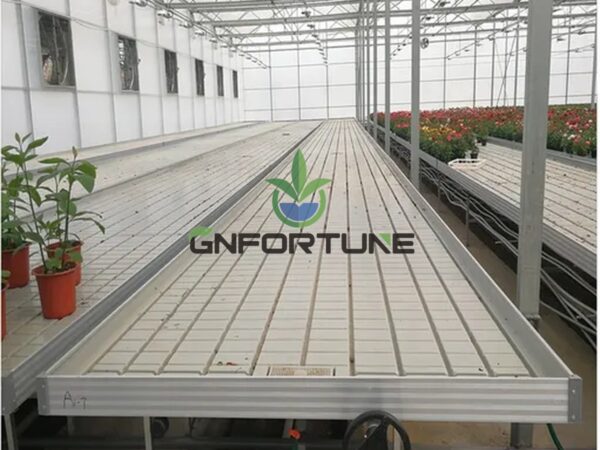
Hydroponic harvest carts look like a commodity purchase until the first harvest day, when a castor catches on a drain grate, a bin slides off a smooth deck, or two crews fight over the only greenhouse trolley that fits the aisle. The equipment is cheap relative to a greenhouse and expensive relative to a harvest, because every trip it fails to make is paid in labour. This guide covers the specification side: wheels and floors, load and deck geometry, bins, hygiene, weighing, and how to count the units you need.
Routing and layout are a separate problem; the focus here is the equipment itself.
What Harvest Logistics Equipment Has to Do
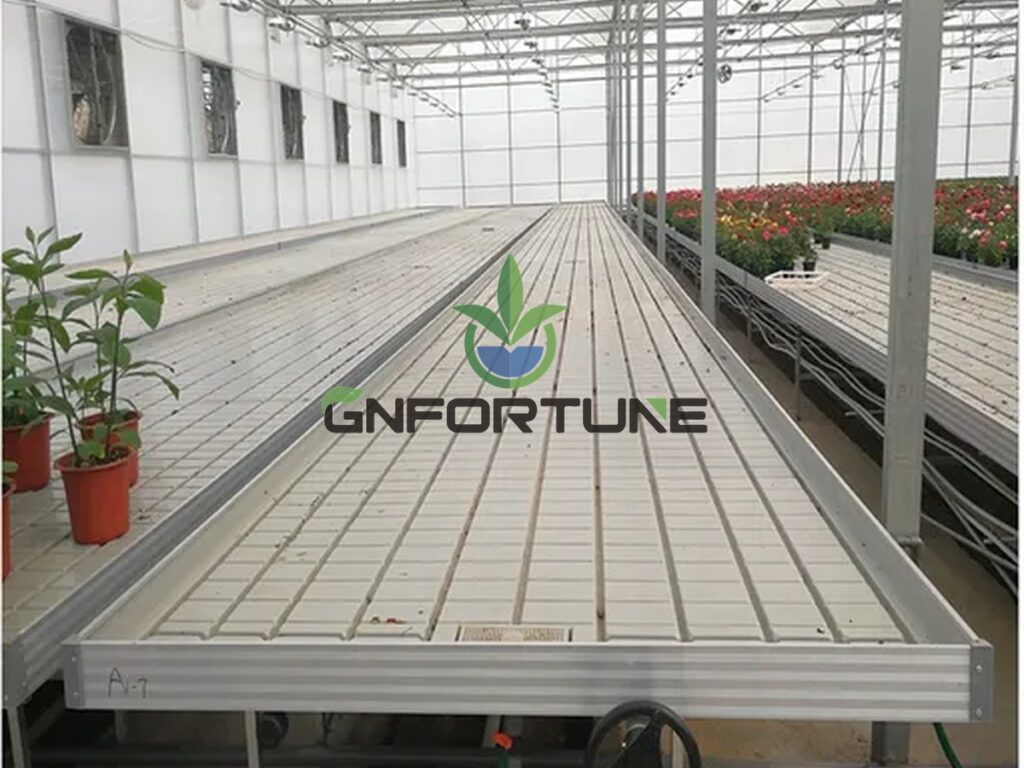
It moves crop and bins between bed, trim bench, scale and cold room in one pass, with the least lifting and the fewest trips. Every specification choice either shortens that cycle or adds seconds to it.
Three constraints dominate. The floor decides the wheel, the bin decides the deck, and the harvest peak decides the fleet. Buyers who start from a catalogue page usually reverse that order, then discover the cart does not fit the aisle or the cold room door.
Weight matters more than volume on leafy crops. A cart rated for 150 kg carrying three crates at 15 kg is working at a third of its rating, while the same cart loaded with wet bins after washdown can approach the limit unnoticed.
Wheel Diameter and Floor Condition
Choose the wheel from the floor, not from the catalogue. Large wheels roll over joints, thresholds and drain covers; small castors stop dead at the first 20 mm lip, and the crew lifts the cart instead of rolling it.
| Wheel size | Works on | Watch out for |
|---|---|---|
| 75–100 mm castor | Smooth screed, packhouse and cold room floors | Drain grates, expansion joints, outdoor gravel |
| 125–160 mm | Typical concrete greenhouse aisles with joints | Soft ground, standing water, high thresholds |
| 200 mm and above | Gravel yards, uneven ground, outdoor runs | Aisle width, turning circle, deck height |
Tread compound matters as much as diameter. Polyurethane rolls easily but loses grip on wet concrete; rubber grips better and pushes harder; nylon is cheap, noisy and brittle in cold stores; pneumatic tyres smooth rough yards and puncture at the worst moment.
Castor arrangement completes the specification. Four swivel castors turn in their own length but track poorly; two fixed and two swivel track straight down a long aisle. Brakes belong on at least two wheels, because a cart that rolls during loading spills more crop than the brake costs.
Load Rating and Deck Geometry
Rate the cart for the worst realistic load, not the average. Dynamic loads from a dropped bin or a cart pushed over a threshold exceed the static figure, so allowing roughly twice the normal load is a sensible planning start.
- Bin weight: a 600×400 mm crate of trimmed leafy crop commonly lands in a 12–18 kg planning range, depending on crop and how wet it is packed.
- Stack height: three crates at 15 kg gives 45 kg per stack, and two stacks per deck is a 90 kg load before the cart itself.
- Deck height: somewhere around 550–750 mm suits most standing work; a low deck means more bending at every lift.
- Deck surface: a lip or retainer stops bins sliding, and a mesh or perforated deck drains washdown water instead of holding it.
Deck length is usually limited by the aisle, not the load. Measure the narrowest point on the route, including door frames and the gap beside a bench, and take 100 mm off that as the maximum width.
Bins: Footprint, Stacking and Washability
Standardise one or two bin sizes across the farm. Mixed bins waste deck space, stack badly and slow every count.
For bin handling equipment, the details that decide working life are unglamorous: rounded internal corners that clean out, drain holes that do not block, a stack shoulder that locates positively, and a tare weight stable enough to trust on a scale. Food-contact grade material and a smooth interior matter more than colour, although colour is what makes zoning work.
Check the footprint against both the cart and the cold room shelving before ordering. A bin that fits the cart but not the shelf forces a second transfer, which costs more labour than the bin saved.
Hygiene Zoning and Cleaning
Carts cross clean and dirty zones all day, which makes them a contamination route unless they are assigned. Give harvest-side carts and packhouse carts different colours, and keep the two fleets apart at the wash station.
The floor plan usually defines the boundary: soil, outdoor run and waste one way; trim, weighing and cold room the other. Wheels carry contamination between them, so a wheel wash at the boundary does more than a daily hose-down.
Material choice follows the wash regime. Stainless frames tolerate hypochlorite and hot water; galvanised frames corrode at welds and cut edges; powder coat hides rust until it flakes into a bin. Wood has no place on a cart entering a packhouse.
Weighing Stations and Throughput
Weigh where the crop changes hands, usually at the end of trim or immediately before the cold room. A scale in the wrong place gets bypassed, and a bypassed scale turns every yield figure into an estimate.
Platform scales set into the floor or flush with a bench let a full cart be weighed without unloading; a bench scale is cheaper and slower, because every bin is lifted twice. For leafy operations, 0.1–0.5 kg resolution on a 25–50 kg load is enough for production records, provided the scale sits on a level, rigid base and is calibrated on a schedule.
Cart tare belongs in the same conversation. A cart that gains 2 kg of wet debris during the day quietly distorts every harvest total, so either weigh bins alone or clean and re-tare the carts at fixed intervals.
How Many Hydroponic Harvest Carts to Buy
Count trips, not carts. The number that matters is how many cart cycles the peak harvest day needs, and how much of that time overlaps.
- Take the peak harvest weight for the day and divide by the load per trip to get trips.
- Time one full cycle: load, move, unload, return. Ten to fifteen minutes is a common planning range in a house with 40–60 m aisles.
- Multiply trips by cycle time to get cart-minutes, then divide by the minutes available in the harvest window.
- Round up, then add 10–20% for cleaning, maintenance and the cart that is always somewhere else.
As an illustration: 1,200 kg on the peak day at 40 kg per trip gives 30 trips; at 10 minutes each that is 300 cart-minutes, which needs two carts across a four-hour window, plus a spare. With a 90-minute window it needs four. Picking cart specs that ignore the window is why fleets run short on the days that matter.
What to Confirm Before Ordering
Put these on the purchase order, because each one is a place where a cheaper cart differs without looking different:
- Overall width and turning circle, checked against the narrowest aisle and every door on the route.
- Wheel diameter, tread compound, castor arrangement and brake position.
- Rated load, deck size, deck height and deck surface type.
- Frame material and finish, with the wash chemicals it must tolerate.
- Bin footprint compatibility, stack height and whether bins are supplied with the carts.
- Tare weight and how it is marked, if carts will be weighed loaded.
- Spare wheels and castors in the first order, plus the lead time on replacements.
FAQs About Hydroponic Harvest Carts
Solid or pneumatic wheels for a greenhouse?
Solid polyurethane or rubber suits most sealed greenhouse floors and avoids punctures. Pneumatic tyres earn their place on gravel yards and uneven outdoor runs, where air volume absorbs bumps a solid wheel passes to the load.
What load rating should we specify?
Start from the heaviest realistic stack and allow roughly double it for dynamic loads and wet bins. A cart rated close to its working load fails at the castors and frame joints first, usually in the busiest season.
Do we need stainless steel carts?
Only where the wash regime demands it, typically packhouse and cold room areas using hypochlorite or hot water. Galvanised frames are adequate in drier aisles, but check welds and cut edges, which corrode first.
How many carts does a one-hectare farm need?
It depends on peak harvest weight, load per trip and the length of the harvest window, not on area. Run the trip calculation on your own peak day, then add 10–20%.
Can one cart serve both harvest and packhouse?
It can, but it usually should not, because the same cart then carries soil into the clean zone. Two small fleets with different colours cost little more and remove a route that is hard to audit later.
Related Reading
- Internal Logistics for Commercial Hydroponic Farms: Layout, Routes and Labour — Layout, routes and labour: the system the carts run inside
- Aisle Widths and Bay Layout for Equipment Access — Aisle widths and bay layout for equipment access
- Hydroponic Harvesting and Packing Line Automation — Harvesting and packing line equipment downstream of the carts
- Greenhouse Floor, Drainage and Hygiene Zoning for Commercial Hydroponic Farms — Floor, drainage and hygiene zones that wheeled equipment crosses
- Crop Work Standards for Hydroponic Farms: Rates, Quality Criteria and Crew Training — Work rates and crew training behind a harvest shift
Next Step: What to Send for a Quotation
Hydroponic harvest carts and bins are priced on quantity and material, so aisle dimensions and peak harvest weight tell a supplier more than a floor area does.
For RFQ or project consultation, send: greenhouse dimensions and growing area; narrowest aisle width and door openings; floor type including drains and slopes; peak harvest weight per day and the harvest window; bin footprint and stack height, or the crates you already use; number of carts required; wash regime and chemicals; whether a weighing station is included; delivery schedule; and the budget band. G AND N FORTUNE LIMITED supplies NFT and DWC systems with matched handling and packing equipment, and quotes carts, bins and weighing stations against those parameters.


