Choose fasteners, brackets and wire for wet zones: how galvanising fails, where 304 stops and 316 starts, cost gaps at scale and the pairs that cause rust.
Galvanised vs Stainless Hardware in Wet Greenhouses
Fastener and bracket choice looks like a small line on a bill of materials until the second season, when the rust starts. Stainless vs galvanised fasteners is really a question about where the hardware sits: a hot-dip galvanised bolt above the gutter can outlast the structure, while the same bolt in a dosing room may not survive three years. Greenhouse hardware corrosion comes down to standing water, fertiliser salts and chloride acting together. This article sets out how the zinc layer fails, where 304 stops and 316 starts, what the grade change costs at order quantity, and the contact pairs that turn one metal into the sacrificial part.
Greenhouse Hardware Corrosion: The Wet-Zone Problem
Chloride is the variable that decides everything. It arrives in potassium chloride based fertiliser, in hypochlorite used for pack house washdown, in borehole water, and in coastal air carried a kilometer or more inland. Add a surface that stays wet for hours rather than minutes and the corrosion rate rises by an order of magnitude, because a wet film is an electrolyte and a dry one is not.
Map the site by wetness before specifying anything. Above the gutter line, steel sees condensation but dries daily. Below it, in the crop zone, everything is damp. The worst places are the dosing room, the pack house and any ledge that holds water.
Location
Chloride and wetness
Hardware to specify
Expected service
Structure above gutter
Low, dries daily
Hot-dip galvanised
20 to 30 years
Crop zone, gutters, channel brackets
Medium, damp most days
Galvanised, 304 for small fasteners
10 to 20 years
Propagation house, fogging zone
High humidity, low chloride
304 stainless
15 to 25 years
Dosing room, pack house washdown
High chloride, frequent wetting
316 stainless
15 to 25 years
Coastal site, within about 2 km of the sea
Airborne chloride
316 stainless in exposed positions
15 to 25 years
How Galvanising Works and Where It Fails
Hot-dip galvanising puts a zinc layer on steel that is both a barrier and a sacrificial anode: zinc corrodes in preference to the steel, so scratches and cut edges stay protected while zinc remains nearby. Typical thickness on structural steel runs 45 to 85 µm, and loss rates in a dry internal greenhouse environment are roughly 0.5 to 2 µm per year. That arithmetic gives decades above the gutter and a much shorter life where steel stays wet and salty.
Failure starts at the details. Sheared and drilled edges carry the thinnest coating, threads lose zinc during fitting, and bolt heads trap water against the plate. New parts stored stacked and wet develop white rust, a zinc hydroxide that looks alarming but is only surface attack. Galvanised bolts need nuts tapped oversize, so a galvanised bolt with a plain nut strips or fits loose.
Specify the coating thickness in the order, and specify it by what the part will sit in rather than by what the catalogue offers.
The recurring finding is not that galvanising failed but that it was never measured. A coating thickness gauge costs little, and a reading at handover is the only baseline that makes a year three inspection meaningful.
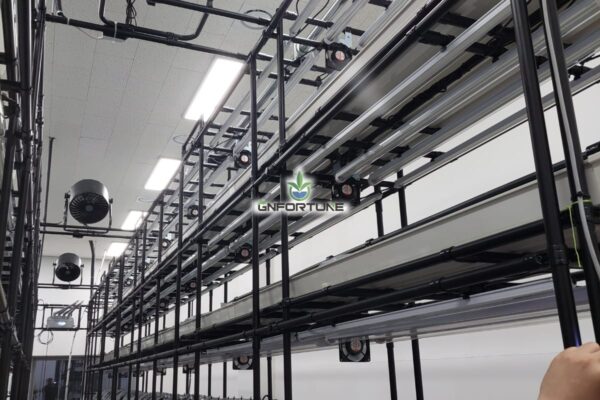
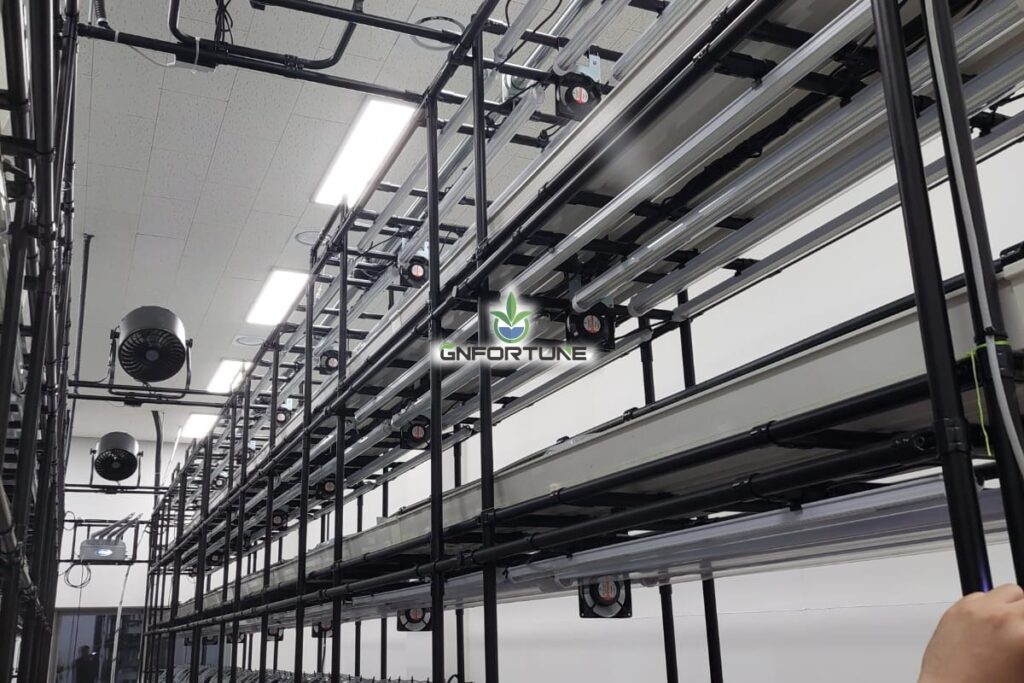
Steel A-frame rack structure inside a multi-tier growing house before fitting
Stainless vs Galvanised Fasteners: 304 Against 316
Stainless steel resists by a passive chromium oxide film rather than by sacrifice, which is why it survives wet zones and fails suddenly where chloride concentrates. The practical difference between grades is molybdenum: 304 has none, 316 carries about 2 to 3 percent, and that raises resistance to pitting and crevice attack. Marking follows the split, with A2 denoting 304 and A4 denoting 316, usually with a property class such as 70 on the head.
Option
Coating or grade
Where it works
Relative unit cost
Watch out for
Electro-zinc plated
5 to 25 µm
Dry indoor fixings only
1x
White rust within a season in wet zones
Hot-dip galvanised
45 to 85 µm
Structure, brackets, trellis
1.5 to 2x
Thin at cut edges and threads
Mechanical galvanised
25 to 50 µm
Small fasteners
2 to 3x
Thin coverage on sharp edges
304 stainless, A2
Passive film, no molybdenum
General wet areas
4 to 6x
Pitting and crevice attack with chloride
316 stainless, A4
2 to 3% molybdenum
Dosing, washdown, coastal
6 to 9x
Thread galling, cost premium
Two installation habits matter more than the grade. Austenitic stainless threads gall under load, so use anti-seize compound or nylon insert nuts and tighten at low speed rather than with an impact driver. Stainless is not maintenance free: with chloride in a crevice under a bolt head, 304 pits, and the pit stays hidden until the fastener snaps.
Cost Gaps at Order Quantity
The multipliers narrow as quantity rises, because the stainless premium is driven more by raw material than by machine time. On an order in the tens of thousands, expect the gap between galvanised and 316 to tighten by roughly 10 to 20 percent, and ask for both grades quoted on the same day so the alloy surcharge matches.
Keep the change in proportion. Hardware is typically 2 to 5 percent of a system package, so moving wet-zone fasteners to 316 might raise the hardware line by 40 to 70 percent while adding under 1 percent to the project. The same logic applies to parts with a three year life against a ten year life: a cheap fastener stops being cheap once the labor of replacing it inside a planted house is counted.
Galvanic Pairs: Steel Against Stainless and Aluminium
Joining two different metals in an electrolyte makes a battery. The less noble metal corrodes, and the speed depends on area: a small anode next to a large cathode corrodes fast, while a large anode next to a small cathode barely notices.
Stainless bolt in aluminium: aluminium is the anode and suffers. Isolate the fastener with a nylon washer and shoulder, or use an aluminium-compatible fastener.
Galvanised bolt in a stainless plate: the zinc is consumed quickly because the cathode is large. Where the joint must be stainless, use a stainless fastener and accept the cost.
Carbon steel bolt in a stainless bracket: the bolt rusts, and it rusts at the shank where nobody sees it. Match the metals or coat the stainless.
Copper and brass near steel: copper tubing and brass fittings drive steel corrosion hard. Keep them separate or isolate.
Year one checks are about installation, wear and storage damage. Year three checks are about remaining coating thickness and section loss.
Year 1: cut edges and drilled holes for rust bleed, bolt heads and threads, white rust on parts stored wet, water traps under brackets, and any fastener that has been replaced with the wrong grade during maintenance.
Year 3: gauge the remaining zinc on galvanised members in the wet zone, check column bases and gutter brackets, inspect trellis wire and screen hardware, and replace any fastener with visible section loss.
Both years: photograph the same 10 to 15 points, so change is visible rather than remembered.
Stainless vs galvanised fasteners is a decision made per location, not per order. Where galvanised steel has dropped below about 20 µm of remaining zinc, plan repair rather than replacement, and read the coating systems for greenhouse steel before ordering paint. Channel fixings are the highest count item on most sites, and the NFT channel installation guide shows the bracket pattern that keeps them out of standing water.
Frequently Asked Questions
Which stainless grade belongs in a nutrient dosing room? A: 316, marked A4. Grade 304 pits where chloride concentrates and the attack stays hidden under the bolt head.
Can stainless bolts be used with galvanised steel? A: They can, but the zinc around the hole is consumed faster. Isolate with a nylon washer, or use a galvanised bolt with a galvanised nut.
Why does a galvanised bracket rust first at the cut edge? A: The coating is thinnest at sheared and drilled edges, so protection there depends on the cathodic cover zinc gives over the first millimeter or two.
Do stainless nuts seize during installation? A: Austenitic stainless gall under load. Use anti-seize compound or nylon insert nuts and tighten at low speed rather than with an impact driver.
Is 316 worth specifying above the gutter? A: Usually not. Above the gutter the structure dries daily and galvanising lasts decades, so the premium belongs in the wet zone.
Get a Wet-Zone Hardware Specification
Stainless vs galvanised fasteners is decided zone by zone, not product by product. Greenhouse hardware corrosion is cheapest to prevent at specification stage, when the only cost is a higher grade on a short list of lines. Send the bill of materials for the next order, the wetness map of the site and any coastal or borehole chloride data, and the specification comes back marked by zone.
Why commercial projects choose a decoupled aquaponics system: separate RAS and plant loops, independent nutrient control, cost and risk compared with single-loop aquaponics.
Add bays while crops keep moving: tie-in points, utility stub-ups, phasing by bay, quarantine between zones and the commissioning handover that avoids drift.