
A Weekly Labour Calendar for Trellised Vine Crops
A vine crop labour schedule is what keeps a trellised tomato or cucumber crop from drifting: the same tasks, in the same order, at the same interval, every week. Farms that lose yield to labour rarely lose it for want of hands. They lose it because pruning ran a week late, clips went on after the stem had already leaned, or lowering happened in one large pass instead of two. This article sets out the weekly task list by crop stage, plants per worker-hour for each task, the clipping and lowering interval, crew structure, and how to track completion without software nobody opens.
Building the Vine Crop Labour Schedule by Crop Stage
Split the season by stage and the calendar writes itself.
| Stage | Weeks | Tasks on the weekly pass |
|---|---|---|
| Establishment | 1 to 3 | Gate check on plugs, first clip at 30 to 40 cm, sucker removal |
| Vegetative to first truss | 4 to 12 | Suckering, clipping, stringing, first lowering |
| Early production | 13 to 30 | Suckering, clipping, lowering, truss work, harvest |
| Late production | 31 to end | Lowering, leaf pruning, topping, harvest |
Stage one starts before the plant is in the house. Plants arriving across an EC gap or in a dry plug lose five to ten days that no amount of labour recovers, so the first item on the calendar is a gate check, not a pruning pass; the notes on hardening off before planting out set that check.
From first truss the calendar becomes fixed: a pass every seven days for suckering, clipping and truss work, lowering every seven to fourteen days, leaf pruning every fourteen to twenty-one days. Skipping a pass does not save the hours, since the next one takes longer.
Labour Rates: Plants per Worker-Hour by Task
Rates move with plant height, access and experience, so treat the figures as a planning range and measure your own over two weeks. The table assumes 2.5 plants per m², a rail or trolley for the upper half, and workers past their second season.
| Task | Plants per worker-hour | Interval | Hours per 1,000 m² per week |
|---|---|---|---|
| Suckering | 400 to 600 | 7 days | 4 to 6 |
| Clipping | 600 to 900 | 7 days | 3 to 4 |
| Lowering | 300 to 500 | 7 to 14 days | 3 to 6 |
| Leaf pruning | 250 to 400 | 14 to 21 days | 2 to 4 |
| Truss work | 300 to 450 | 7 days | 5 to 8 |
| Harvest | 200 to 350 | 2 to 3 passes a week | 7 to 12 |
Read the total, not the task: roughly 24 to 40 worker-hours per 1,000 m² per week in peak, or 240 to 400 per hectare, which is 6 to 10 full-time workers on a 40-hour week. Cucumber shifts the balance, with more harvest passes and no truss work.
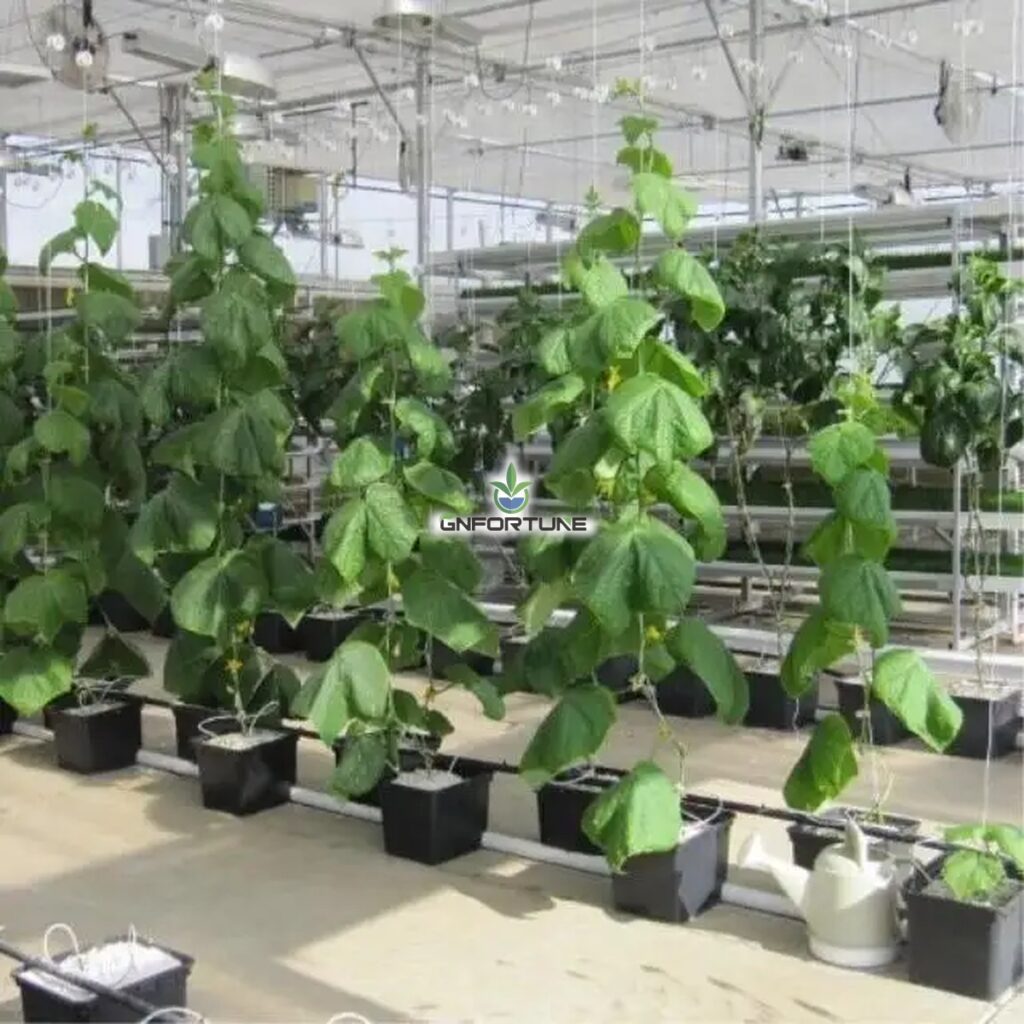
Density drives the total. A Dutch bucket layout at 1.5 to 2 plants per m² carries fewer plants per hectare and fewer hours per hectare, though not always fewer hours per tonne.
Clipping and Lowering: Interval and Stem Path
Clip on growth rather than on the date: every 20 to 30 cm of new stem, close to weekly in peak and every ten days in the shoulder seasons. Leave 1 to 2 cm of slack so the stem is not strangled as it thickens, and place the clip below a leaf petiole rather than across a truss.
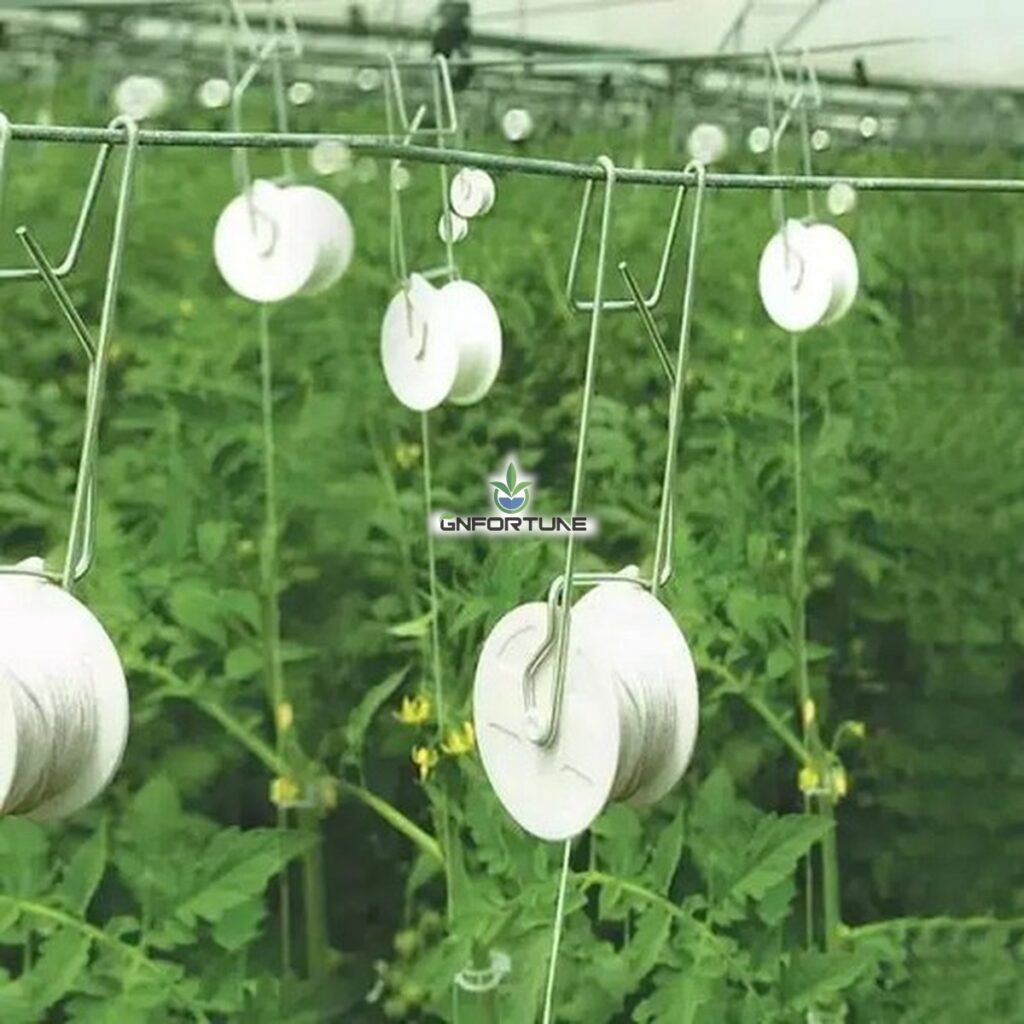
Lowering is the slowest routine task and the one most often deferred. Take 25 to 40 cm per pass every seven to fourteen days and keep the working head at 2.2 to 2.5 m. A single 80 cm pass bends the stem at the hook and costs more time than two smaller passes.
The stem path matters as much as the interval: lean the plant, set the hook on the same side, keep the stem vertical above the slab. Wire and hook choice sit in the notes on trellising and plant support for vine crops, and clip type is covered in the tomato clips and trellis hardware guide.
A missed pass is not saved time, it is borrowed time at a higher rate.
A week of skipped suckering turns a 5 cm side shoot into a 25 cm one, which takes three or four times as long to remove, shades a developing truss and leaves a wound large enough to matter. The cheapest labour hour on a vine crop is the one spent on schedule.
Leaf Pruning and Truss Work
Leaf pruning sets the light climate inside the canopy and the humidity around the fruit. Remove two or three leaves per plant per pass, starting below the oldest harvested truss, and keep 16 to 20 active leaves. Taking more opens the canopy faster than the fruit can adjust, which shows up as cracking.
Prune in the morning on a dry canopy and keep tools disinfected between blocks; wounds on a wet plant in the afternoon are where botrytis starts. Truss work rides on the same pass: thin beefsteak trusses to four or five fruit, leave five or six on a truss tomato, and support each truss before the fruit weight pulls it off.
Top the plant four to six weeks before planned final harvest, leaving two leaves above the top truss. Cucumber takes a different hand: side shoots to one leaf and one fruit, with the main stem kept running to the wire.
Crew Structure and Quality Checkpoints
Assign workers to fixed sections and keep them there for the season. A worker who walks the same rows every week gets faster, and a supervisor can trace any miss to a person and a day. One lead per eight to twelve workers is enough when the lead also carries a section.
Write the standard before it is needed: what counts as a missed sucker, how many leaves come off, where the clip goes. The format is set out in the crop work standards and crew training guide. Pair new workers with an experienced one for two weeks.
- Stem: deviation under about 5 cm per metre of height, no kink at the hook.
- Side shoots: none over 5 cm left in the section.
- Leaf count: 16 to 20 active leaves, nothing removed above the top ripening truss.
- Fruit: none left behind at harvest, no stem damage at the clip.
- Hardware: hook and twine aligned for a one-handed next pass.
Check one section per worker per day rather than every section at the week’s end: a miss found within 24 hours is fixed in minutes.
Tracking Completion: Board or Software
The record only has value if someone acts on it within a day. A whiteboard with sections down one side and weeks across the top does the job: the worker initials the cell when the pass is done, the supervisor signs off next morning, and a missed section is redone that day.
Software earns its keep at scale: several houses, rotating crews, or labour cost per kilo reported weekly. Against that sits the licence cost per user per month and the risk that data is entered at the end of a shift rather than in the row. Start with the board, and keep a weekly hours-per-task log.
Whatever the tool, the vine crop labour schedule has to show which task, which section and when. Record hours per task per week too, since the gap between planned and actual hours sets next season’s budget. Task card wording is covered in the notes on writing SOPs for a hydroponic farm.
Frequently Asked Questions
How often should tomato plants be clipped?
A: Every 20 to 30 cm of new growth, close to weekly in peak, leaving 1 to 2 cm of slack so the stem is not strangled.
How many plants can one worker prune in an hour?
A: 250 to 400 for leaf pruning and 400 to 600 for suckering, depending on canopy density and access height.
Should lowering be weekly or every two weeks?
A: Every 7 to 14 days at 25 to 40 cm per pass. One large pass bends the stem and costs more time than two small ones.
How many workers does a hectare of tomato need?
A: Budget 24 to 40 worker-hours per 1,000 m² per week in peak, roughly 6 to 10 full-time workers per hectare.
Does a vine crop labour schedule need software?
A: No. A section board signed off daily works, provided a supervisor checks it within 24 hours and missed sections are redone the next day.
Request the Vine Crop Weekly Planner
A vine crop labour schedule only holds if the rates are yours. Send row count, plant density, crop and working height, and the team will return a weekly planner with task order, interval and labour rates scaled to your rows.
To Ask for our vine crop weekly planner with labour rates you can adapt to your row counts, include the house area, plant spacing and whether crews use rails or trolleys.


