
Green Onions and Leeks: Hydroponic Production
Green onions hydroponics is one of the quieter commercial lines, and that is its advantage. Bunching onions are a short-cycle, low-feed crop that uses the same raft beds and channels a lettuce house already owns, sells into foodservice year round, and does not need the climate control a fruiting crop does. Leeks are the opposite on one axis: longer in the bed, more labour at harvest, and a better price per kilo. Both are worth modelling before a bed is committed, because the difference between them is a working-capital question rather than an agronomy question.
System Choice: Raft, Channel or Tray
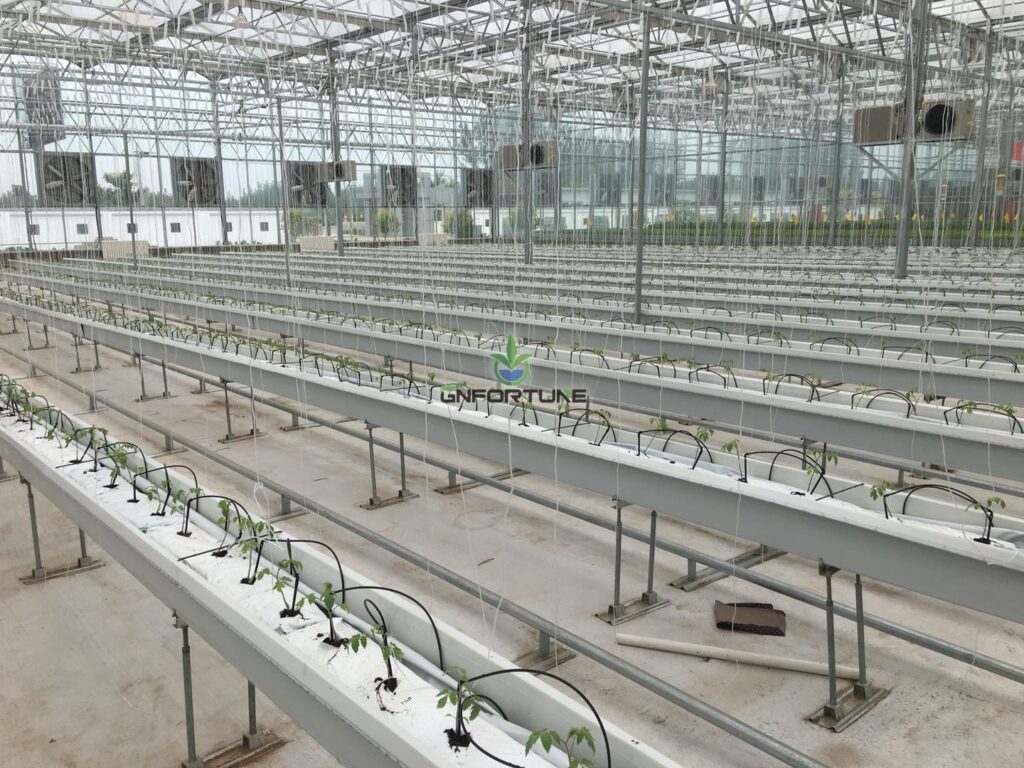
Pick the system by root depth and by how the crop leaves the house. Bunching onions have a shallow, fibrous root plate and are sold with the root trimmed, so a floating raft bed suits them: dense planting, uniform watering, and the whole board lifts for harvest. Leeks need depth to build the blanched shank buyers pay for, which points to a media tray or a deep bed.
| System | Best crop | Depth | Strength | Trade-off |
|---|---|---|---|---|
| Raft bed, deep water culture | Bunching onions, scallions | 5 to 10 cm of solution | Highest density, easiest harvest | Low buffer against pump failure |
| NFT channel | Bunching onions, cut regrowth | Shallow film | Uses existing lettuce lines | Root mats can bridge narrow troughs |
| Flood tray with media | Baby leeks | 8 to 12 cm of media | Clean harvest, reusable media | Media handling and washing |
| Deep media bed or trough | Leeks for blanched shank | 15 to 20 cm of media | Only way to blanch properly | Longest cycle, most bed time |
Most sites running a lettuce house already own the right hardware for bunching onions and only need a board with a tighter hole pattern. Leeks are the exception: they usually need a separate block, or a seasonal swap of a bed that can be taken out of lettuce for four months.
Spacing and Plants per Square Metre
Density is the number that makes or breaks the line, because these crops are sold by the bunch and priced modestly per kilo. Plant too tight and the bunch is thin and unsaleable; plant too loose and the square metre does not pay.
| Crop and format | Spacing | Plants per m² | Bunches per m² |
|---|---|---|---|
| Bunching onion, single harvest | 2.5 to 4 cm grid | 600 to 1,000 | 25 to 45 |
| Bunching onion, cut and regrowth | 4 to 6 cm grid | 300 to 600 | 15 to 30 per cut |
| Scallion, larger bulb base | 5 to 7 cm grid | 200 to 400 | 15 to 25 |
| Baby leek | 6 to 10 cm grid | 100 to 275 | 100 to 275 singles |
| Leek, full size blanched | 10 to 15 cm grid | 45 to 100 | 45 to 100 singles |
Those grids assume a square or staggered pattern on a board or bed, and they assume the market takes a standard bunch weight, commonly 100 to 250 g for bunching onions. Confirm the bunch specification with the buyer before fixing the board pattern, because re-drilling boards later costs more than the boards did.
Media Depth and Root Support
Alliums are shallow-rooted and undemanding, which is why they fit equipment built for something else. Bunching onions do most of their work in the top 5 to 10 cm and anchor well in a net pot or a board hole with a small plug. Leeks put down a deeper plate and need the media or bed depth to match, or the shank stays short.
- Propagation. Plugs or small blocks, transplanted at two to three true leaves.
- Anchor. A plug that sits tight in the board hole; loose plugs fall out at harvest.
- Root support. Leeks benefit from a media that holds shape around the base; coir blends or a coarse perlite mix both work.
- Oxygen. Keep the root plate wet but aerated; alliums tolerate shallow water poorly when it goes stagnant.
Feed is modest. A working band of EC 1.4 to 2.2 mS/cm at pH 6.0 to 6.5 covers both crops, lower than a fruiting crop and comparable to a lettuce programme. Sulphur supply drives pungency and flavour, so check the recipe carries enough; most blended allium programmes run higher sulphur than a lettuce formula does.
The decision that decides the return is bed time, not seed cost: a bunching onion block turns in 30 to 45 days and gives six to eight turns a year, while a leek block sits in the bed for 90 to 120 days and gives two or three. Same square metre, same overheads, a very different annual revenue line. Model revenue per square metre per year rather than per crop, and put the longer crop only on the beds that cannot otherwise turn fast.
Cycle Timing and Multiple Harvests
Cycle length is temperature-driven and the spread is wide. Bunching onions run 30 to 45 days in a warm house and 50 to 70 days in a cool one; baby leeks 60 to 80 days; full-size leeks 90 to 120 days. Figures vary by region and season, so hold the plan as a range and schedule transplanting in weekly blocks to smooth the labour load.
Cut-and-regrow works for bunching onions and is the main lever on propagation cost. Cut above the basal plate, leave the roots in place, feed lightly for a few days, and take a second and sometimes a third cut. Expect the second cut to come faster and slightly lighter; price the line accordingly rather than assuming three equal harvests.
Washing, Bunching and Cooling
Alliums leave the system with a root pocket full of media, and no wholesale buyer will take them that way. Washing is not optional and it is not a bucket of standing water: it is a controlled step with monitored water, because a dirty wash tank spreads contamination across every bunch that passes through it.
- Root trim. Trim to 1 to 2 cm and wash the basal plate before bunching.
- Wash water. Run a sanitised wash with monitored concentration and change on a fixed schedule, not on appearance.
- Bunching. Band or sleeve to the buyer’s weight and count specification.
- Cooling. Hydro-cool or force-air to 0 to 2 °C within 30 minutes of cutting.
- Storage. 0 to 2 °C at 95 percent relative humidity; shelf life is commonly 14 to 21 days.
The wash step is where a small farm either meets or fails a buyer audit. The wash water sanitation reference sets out monitoring and control limits, and the post-harvest cooling guide covers the cooling options.
Market Fit and Labour per Bunch
Bunching onions sell on continuity of supply rather than on price spikes. Foodservice and wholesale buyers want the same bunch every week, and a farm that can promise that gets a standing order; one that cannot is bidding spot. Leeks sell better per kilo but into a narrower market, and they carry more trimming labour.
Labour is the largest controllable cost on the line. Trimming, washing and bunching are hand operations, and throughput depends heavily on specification: a loose bunch with a sleeve moves faster than a counted, banded, root-trimmed bunch for a retail buyer. Budget generously and measure before committing volume; rates vary by region and season.
FAQ
Can green onions grow on the same raft beds as lettuce?
A: Yes. A tighter hole pattern is usually the only change needed, and the feed programme sits in a similar EC band.
How deep does media need to be for leeks?
A: 15 to 20 cm for a blanched shank at full size, 8 to 12 cm for baby leeks harvested young.
How many turns per year can a bunching onion block give?
A: Commonly six to eight at a 30 to 45 day summer cycle, fewer in a cold house. Figures vary by region and season.
Do alliums need a different nutrient recipe?
A: A similar band to lettuce, EC 1.4 to 2.2 mS/cm at pH 6.0 to 6.5, with attention to sulphur supply for flavour.
What limits shelf life after harvest?
A: Field heat and dirty wash water. Cool to 0 to 2 °C within 30 minutes and run a monitored wash to protect the 14 to 21 day window.
Green onions hydroponics and leeks hydroponics sit at opposite ends of the same equipment decision: one turns fast and sells on continuity, the other holds a bed and sells on price. Operators who plan bed time, bunch specification and the wash step before planting get a line that pays its overheads every week of the year.
Request a Raft Bed Layout Quote
Send your bed dimensions, crop choice and buyer bunch specification, and we will return a board layout with hole pattern, density, turn schedule and wash-down access set for allium production. Use the request a raft bed layout quote form, and see the raft bed design guide for the baseline build.


