
Hydroponic Equipment Lead Times: Full Path
Hydroponic system lead time is rarely lost in production. It is lost in the gaps between stages: the week a drawing waits for an internal signature, the fortnight a container sits at a transhipment port, the month a slab cures while the channel order has already shipped. For a commercial site, those gaps cost more than the equipment does, because installers, crop plans and financing all start on dates that equipment delivery controls. This article maps the full path from enquiry to commissioning and shows where to spend attention.
The Order-to-Commissioning Timeline
A commercial equipment order passes through roughly eight stages, and only two of them are inside the factory. Plan the eight, not the two. On a typical imported project the factory stages account for under half of the elapsed calendar time, so a supplier promising “four weeks production” is telling you about one third of your problem.
The table below gives industry-typical ranges for each stage. Treat them as planning ranges, not commitments; actual durations vary by region, season and order size.
| Stage | Typical range | Who controls it | Common slip |
|---|---|---|---|
| Specification and drawings | 1 to 4 weeks | Buyer and supplier jointly | Design inputs missing: water analysis, layout, load |
| Quotation and scope agreement | 1 to 3 weeks | Buyer | Scope exclusions discovered after signature |
| Sampling and approval | 2 to 5 weeks | Both | Sample shipped before spec is frozen |
| Tooling, if custom profile | 4 to 10 weeks | Supplier | Drawing change after tooling starts |
| Production | 3 to 8 weeks | Supplier | Order enters the queue after deposit clears |
| Inland haulage and export clearance | 3 to 10 days | Supplier and forwarder | Document errors on the packing list |
| Sea freight and import clearance | 20 to 45 days | Forwarder and buyer | Port congestion, customs queries, duty classification |
| Installation and commissioning | 2 to 10 weeks | Buyer and installer | Site not ready when the container lands |
Repeat orders of stock profiles skip tooling and sampling and can leave the factory three weeks after deposit. A first order with a custom channel and a dosing skid uses the long end of nearly every row.
Tooling and Sampling for Custom Parts
Tooling is the single biggest schedule decision in the plan, and it is usually made by accident. Custom extrusion dies, injection moulds for end caps or buckets, and pressed steel brackets all add weeks before production begins. The tooling fee is only half the cost; the other half is the calendar.
Where the crop programme allows it, take a stock profile and adapt the layout to it. Standard channel widths and bucket bodies exist in volume, ship from existing tooling, and can be reordered years later without a new die. G&N Fortune has manufactured hydroponic equipment since 1996 and runs 55 automated assembly lines across a 5,000 m² factory, and for most buyers the stock catalogue covers the layout they actually need.
When custom work is genuinely required, three rules protect the schedule:
- Freeze drawings before tooling starts. A dimensional change after the die is cut can restart the tooling clock, not just extend it.
- Approve a physical sample, not a photograph. Sample courier time is two to five days each way; build it in rather than absorbing it later.
- Ask who owns the tooling. Ownership affects whether a reorder in year three needs a fresh die and a fresh lead time.
Production Slots and Seasonal Peaks
Production slots are allocated, not infinite. Export-oriented factories run heaviest ahead of the northern planting season and again before autumn installation windows; Asian public holidays and the pre-holiday shipping rush compress capacity into the weeks before they fall. An order confirmed in a quiet month can be quoted and built faster than the identical order confirmed three weeks before a holiday closure.
Capacity is easier to read than most buyers assume. A 5,000 m² plant with 55 automated assembly lines absorbs a mid-size order quickly, unless four containers were booked into the same week. Ask where your order sits in the queue, and get the production start date in writing.
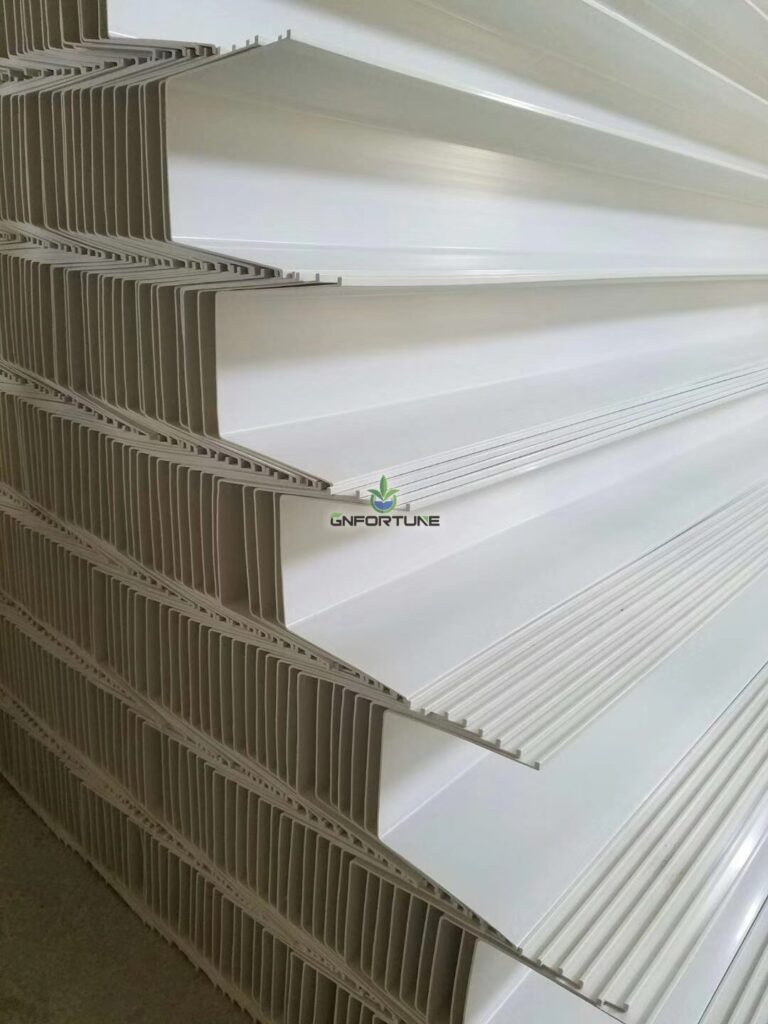
Minimum order quantities also interact with scheduling. Low-volume items may wait to be batched with another customer’s run; that wait is invisible unless you ask. For extruded profiles, G&N Fortune sets its NFT gutter MOQ at 1,000 m, which keeps a gutter order on its own production slot rather than queued behind a consolidation.
The cheapest schedule insurance is a frozen drawing: every change made after deposit is paid for twice, once in tooling and once in queue position. Buyers who treat the drawing as a commercial document rather than an engineering sketch lose two to six weeks that no amount of expediting recovers. Lock dimensions, material, colour and fitting counts before the deposit moves, and treat any later change as a new order.
Sea Freight, Customs and Inland Haulage
Freight is the stage buyers model least accurately. A quoted transit time describes port to port; door to door adds inland haulage at both ends, terminal handling and whatever customs examination decides to do. Transit windows of 20 to 45 days are normal, and figures vary by region and season.
Three documents decide clearance time: the commercial invoice, the packing list and the classification code. Agricultural equipment is classified differently from irrigation components in several markets, and a misclassification found at the border costs days. Agree the codes with your broker before the container ships.
Freight mode is a real trade-off. Full container load is cheaper per cubic metre and arrives with less handling damage; less than container load books faster for a small order but adds consolidation time at both ends. Long, light extrusions fill a container by volume long before they reach its weight limit, so packing method drives cost per metre. The importer’s checklist for hydroponic equipment covers the document set.
Site Readiness: What Must Be Done First
Equipment arriving before the site can receive it is the most expensive schedule error in the plan, because storage, double handling and demurrage all start on day one while the crop calendar does not move.
Before the container lands, the following should be complete or scheduled against a firm date:
- Slab, drainage and power. Floor falls, drain runs and the electrical supply to the pump and dosing position.
- Water supply and treatment. Storage capacity, filtration and any treatment plant, with the water analysis in hand.
- Structure and fixings. Purlins, hangers and any reinforcement for loaded tiers.
- Access. Door widths and turning room for 6 m lengths, and a route a forklift can use.
- Crew and installer booking. Confirmed against the delivery estimate, with a fallback date.
Buffers to Build into the Plan
Buffers are not padding, they are the difference between a project that absorbs a delay and one that loses a crop cycle. Add them where the risk is real and resist the temptation to shave them to make a date look achievable.
| Stage | Suggested buffer | Why |
|---|---|---|
| Specification to deposit | 1 to 2 weeks | Internal approvals and payment processing |
| Sampling and approval | 1 week | Return courier and rework if the sample fails |
| Custom tooling | 2 to 3 weeks | Die trial and first-article correction |
| Production | 1 to 2 weeks | Queue movement and material supply |
| Sea freight and clearance | 2 to 4 weeks | Rolled sailings, congestion, examination |
| Installation to first planting | 2 weeks | Commissioning faults and leak rectification |
Two further controls cost nothing: a production photograph at the halfway point of the build, and the packing list three days before loading so the broker can pre-clear paperwork.
FAQ
How long does a hydroponic equipment order take from enquiry to commissioning?
A: Commonly 14 to 30 weeks end to end, of which factory production is 3 to 8 weeks. Repeat stock orders sit at the short end; custom-tooled first orders at the long end.
Does custom tooling always add weeks to the schedule?
A: Yes, typically 4 to 10 weeks before production. Using a stock profile removes that stage entirely and is usually the faster route to a working crop.
What is the most common cause of delay on imported equipment?
A: Drawing changes after deposit and incomplete import documents, in that order. Both are buyer-controlled and both are preventable.
Can equipment ship in stages to start installation earlier?
A: Often yes. Ship structure and growing units first, with dosing and spares in a later container, and confirm the split does not raise freight cost per cubic metre beyond the benefit.
When should the installer be booked?
A: After the production start date is confirmed in writing, with a fallback window. Booking an installer against an estimated ship date is the usual cause of idle crew cost.
Hydroponic system lead time is a planning problem before it is a manufacturing problem. Operators who map all eight stages, freeze drawings early and hold real buffers get equipment on site in the month they planned for, and plant on schedule.
Request a Project Timeline With Your Quote
Send your growing area, system type and target planting month, and we will return a quote with a stage-by-stage timeline attached: specification, tooling if required, production slot, freight window and commissioning. Use the request a project timeline with your quote form, or start from the seven-step commercial setup plan.


