Modular vs Custom Hydroponic Packages: Which One Fits Your Project
Choosing between a modular hydroponic system and a custom-built package is a decision about time, money, and how much the site constrains the design. Modular packages ship from existing tooling, cost less per unit at low volume, and arrive sooner. Custom packages cost more upfront and take longer, but they fit awkward sites and give the operator control over the details that affect daily work. Most commercial projects land somewhere between the two, and the useful question is which parts of the system deserve custom treatment rather than whether the whole project should be custom.
Modular vs Custom: The Real Trade-Off
The trade-off is not quality versus compromise. It is flexibility against lead time and unit cost. A modular package is a set of standard components — channel profiles, bucket bodies, tank sizes, rack frames — assembled into a layout. A custom package introduces new tooling, new dimensions, or new material specifications that do not exist in the supplier’s catalogue.
Custom work is justified when the standard geometry costs the operator money every season: a channel width that wastes space in a narrow house, a rack height that blocks a spray line, a tank that will not fit the plant room. It is not justified for cosmetic preferences, which is where custom budgets most often leak.
Lead Time and Tooling Cost
Tooling is the first real cost of custom work, and it is paid before any hardware ships. New extrusion dies, injection moulds, or tray tools carry a one-off charge and a sampling period. The buyer should ask whether the tooling cost is a separate line, whether it is refundable against volume, and who owns the tool afterwards.
| Factor | Modular package | Custom package |
|---|---|---|
| Lead time | Existing tooling, shortest path to dispatch | Tooling and sampling add weeks to months |
| Upfront cost | No tooling charge | Tooling charge, sometimes amortised over volume |
| Unit cost at low volume | Lower | Higher |
| Unit cost at high volume | Standard | Can be lower if the design cuts material or labour |
| Minimum order | Catalogue quantities, often low | Production minimums, often 1,000 m or more on extruded profiles |
| Design risk | Proven geometry | First article needs verification before the run |
Lead time interacts with the rest of the project. Equipment arriving before the site is ready is rented storage; equipment arriving after the installers are on site is idle labour. The seven-step project plan maps where those two failures come from.
Running Cost and Spare Parts
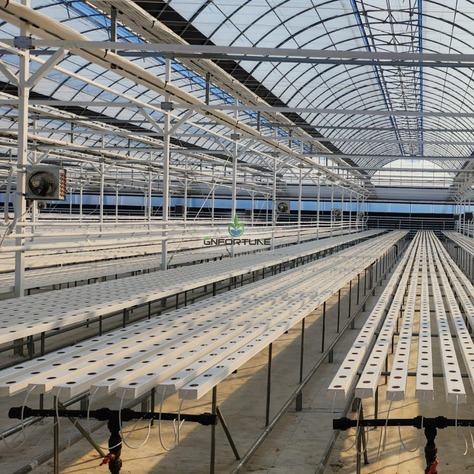
Spare parts are the strongest argument for modular. A standard channel, bucket, or gasket is replaceable from stock years later, and usually from more than one source. A custom profile ties the operator to the original tool and to the original supplier, which is tolerable while the relationship is good and expensive when it is not.
- Wear parts. Seals, emitters, nozzles, and net pots are consumable. Standard sizes keep them cheap and available.
- Structural parts. Channels, frames, and tanks should be specified with a spare factor of 1 to 3 percent on the first order.
- Documentation. Custom parts need a drawing on file. Without one, a replacement becomes a reverse-engineering job.
- Operator familiarity. Crews trained on standard components move between sites and between employers, which lowers training cost.
The running-cost difference rarely shows up in year one. It shows up in year five, when a custom part fails and the replacement has to be re-tooled at a minimum order quantity the farm does not need.
Expansion Later: What Fits What
Plan the second phase before ordering the first. Modular systems expand naturally because the same components are still in production. Custom systems expand well only if the original tooling is retained and the original specification is documented, and badly if the design has evolved since.

A practical approach for growing operations is to standardise the growing units and customise only the layout-critical parts. Keep the channel, bucket, and tower formats standard so they can be reordered in any quantity, and use custom work where the building forces it: a rack depth, a tank footprint, or a bracket that meets an existing column grid. The guide to scaling from pilot row to commercial production covers how the first phase sets the constraints for the next one.
Site Conditions That Force Custom
Some sites leave no choice. Recognising these early avoids paying for tooling twice, once for a modular design that will not fit and again for the design that does.
- Non-standard bay widths or column grids. A standard row length that leaves unusable strips at every bay end wastes floor area permanently.
- Height limits. Low gutters or overhead obstructions rule out stacked or tall configurations.
- Existing structure reuse. Retrofitting into a building with fixed anchor points usually needs bespoke brackets and hangers.
- Water and power constraints. A plant room with a fixed footprint can force a non-standard tank or skid layout.
- Climate extremes. High UV, high wind, or cold storage conditions can push material specification beyond the catalogue range.

The rule that saves the most money on this decision: buy custom only where the site forces it, and buy modular everywhere else. Almost every project that went fully custom regrets it at the first spare-part order, and almost every project that went fully modular regrets the bay ends it cannot use. Ask the supplier to mark the layout-critical items on the drawing and quote those separately from the catalogue components.
Decision Checklist
Run this list before requesting a quotation. Each answer moves the project one way or the other, and the pattern is usually clear after the first four.
| Project condition | Leans modular | Leans custom |
|---|---|---|
| Timeline to first harvest | Under 6 months | Over 9 months |
| Site geometry | Standard bays, new build | Retrofit, irregular grid |
| Order volume | Small or phased | Large single run |
| Expansion plan | Likely, in similar houses | One-off site |
| Spare parts strategy | Local stock preferred | Supplier-held stock acceptable |
| Layout knowledge | First commercial site | Proven layout being refined |
Operators buying a hydroponic system for the first time are usually better served by modular hardware plus a properly engineered layout. The engineering value is in the design work — row spacing, zone count, tank sizing, and access — not in reinventing the channel profile. The layout and specification guide covers that side, and the OEM and private label guide explains where custom tooling genuinely pays off, such as branded or private-label profiles at volume.
FAQ
Is a modular hydroponic system lower quality than a custom one?
A: No. Modular components come from proven tooling and are usually better tested. Custom work buys fit and control, not higher quality.
How much does custom tooling add to a project?
A: It depends on the part and the process. Ask for the tooling charge as a separate line and whether it is refundable against order volume.
What minimum order applies to custom extrusion?
A: Minimums vary by profile and supplier, and thresholds around 1,000 m are common for extruded growing gutter. Confirm before design work starts.
Can a modular system be expanded later?
A: Yes, provided the same components are still in production. Keep the original specification and part numbers on file.
When does custom clearly win?
A: Retrofits, irregular column grids, height-constrained sites, and large single runs where a design change saves material or labour on every unit.
Get Both Options Priced
Ask for two quotations against the same layout: a modular hydroponic system built from catalogue components and a variant with the layout-critical parts customised. Send floor dimensions, crop list, and site constraints through the request both a modular and a custom quote form and the team will return both bills of materials with tooling, lead time, and minimum quantities shown separately.