
What a Custom Tooling Fee Actually Buys
Custom tooling cost is a one-off engineering charge, and buyers misread it in the same two ways: treating it as a deposit against units, or treating it as a purchase of the tool. It is neither by default. The fee covers design work, the steel, trial runs and the engineering time to get a stable part; who owns the steel afterwards is a separate clause that has to be negotiated. A profile that is genuine intellectual property, such as a channel with a patented base geometry, is worth owning. A minor variation on a catalogue extrusion usually is not.
Extrusion Dies vs Injection Moulds
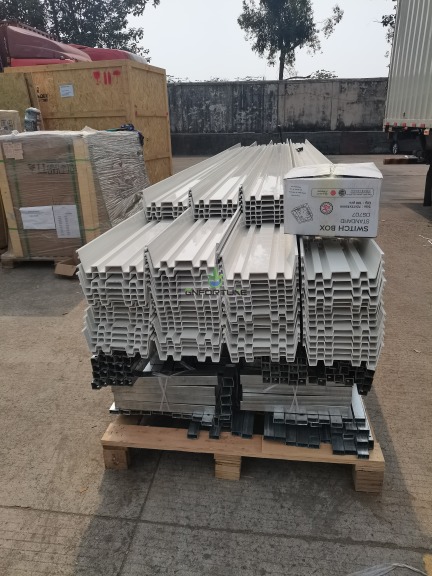
The two processes sit at different ends of the cost and lead-time scale, so the tooling conversation starts with which one the part needs. Continuous profiles — NFT channels, gutter sections, cover strips — are extruded. Discrete parts — net pots, buckets, elbows, end caps, trays — are injection moulded.
| Item | Extrusion die | Injection mould |
|---|---|---|
| Typical tooling level | Low four figures in USD, simple profiles | Mid four to low five figures, depending on cavities |
| Lead time to first sample | Roughly 2 to 5 weeks | Roughly 4 to 10 weeks |
| Cavities | Usually one, output measured in metres | Multiple cavities, output measured in shots |
| Tool life | Measured in tonnes extruded; re-land and re-work possible | Measured in shots, by steel grade, commonly hundreds of thousands to over a million |
| Revisions | Die land adjustment is relatively cheap | Steel removal is cheap; adding steel is not |
Figures vary by region and season, and they move with steel prices, part size and how busy the toolroom is. Treat any number as a range to be confirmed against a drawing, not as a price list. Because the range is wide, tooling questions belong in the first request for quotation, where every bidder prices the same specification.
What Moves the Price
Six variables explain most of the spread between two tooling quotes for the same drawing. Ask for each of them in writing; a quote that omits them is not comparable.
- Cavity count: the single biggest driver on injection work. Two cavities cost less than twice one, but cycle-time and part consistency change with it.
- Steel grade and hardness: pre-hardened steel suits short runs; hardened tool steel raises cost and multiplies shot life. Ask for the grade and the rated life in shots.
- Part complexity: side actions, lifters, threads and undercuts add mechanisms that cost money to build and to maintain.
- Tolerances and finish: tight dimensions and a polished or textured surface add finishing time and rework risk.
- Runner system: a hot runner cuts material waste on long runs and adds cost to the tool.
- Trials included: state how many trial runs, how many sample parts, and who pays for steel changes after the second iteration.
Wall thickness and material choice interact with all six. On extruded channel, thickness and UV package drive both the die design and the extrusion tolerance, covered in more detail in how PVC NFT channels are extruded.
Plastic Mould Amortisation Across Volumes
Plastic mould amortisation is the tooling fee divided by the units you actually buy, and it is the number that decides whether custom tooling pays. Take a single-cavity extrusion die at an assumed 2,000 USD and a four-cavity injection mould at an assumed 12,000 USD; the per-unit burden collapses as volume rises.
| Volume | Extrusion: tooling per metre | Injection: tooling per part |
|---|---|---|
| 1,000 m / 50,000 parts | 2.00 USD per metre | 0.24 USD per part |
| 5,000 m / 200,000 parts | 0.40 USD per metre | 0.06 USD per part |
| 20,000 m / 500,000 parts | 0.10 USD per metre | 0.024 USD per part |
| 50,000 m / 1,000,000 parts | 0.04 USD per metre | 0.012 USD per part |
Read the first row carefully. At the minimum order quantity a custom die can add more per metre than the market tolerates, which is why minimums exist: tooling priced into a 1,000 m first order is a marketing exercise, and tooling priced into a 20,000 m programme is a rounding error. Compare the burden against your own landed unit price before deciding.
Who Owns the Tool, and What That Means
Ownership is a contract clause, not a physical fact — the steel sits in the factory either way. If the buyer funds the tool, the buyer should own it, and the quotation should say so.
A tooling quote without steel grade, cavity count, rated life and ownership is a deposit request wearing an engineering hat. Ask for all four, and add two clauses: the tool is marked with your part number, and it will not be run for another customer without written consent. Then ask what happens at end of life — who pays for re-landing, re-cutting or replacement, and how many units that commitment runs to. A manufacturer that designs its own profiles answers those questions from its toolroom records; a trading company has to ask someone else and will answer vaguely.
- Buyer-funded: lower unit price, capital up front, and the right to move the tool. Get drawings, cavity count and a transfer clause.
- Supplier-funded: no capital outlay, higher unit price, and usually a volume commitment. Check what happens if you miss the volume.
- “Free” tooling: the cost is in the unit price. Fine if the volume and the term are written down, expensive if they are not.
- Exclusivity: if the geometry is your differentiation, exclusivity matters more than ownership. Ask for it in years or in units.
Approval: Trials, Samples and the Golden Sample
Tooling is not finished when the steel is cut; it is finished when a part off that tool is approved. The usual sequence is a first trial, a dimensional report against the drawing, a short run for fit and function, then a retained reference part.
- Trial output: agree how many metres or shots constitute a trial, and who pays for material.
- Dimensional report: measured against the drawing, with the method and the tolerance stated. Read the supplier’s CAD drawings and datasheets before signing it off.
- Golden sample: one approved part, signed, photographed and retained by both sides as the referee for the whole order.
- Change control: after approval, any change to steel, material or process should require written notice. Otherwise the tenth container quietly differs from the sample.
At G&N Fortune, custom profiles are trialled in a 2,400 m² trial greenhouse before a production slot is booked, and the extrusion programme runs on 55 automated assembly lines in a 5,000 m² factory — a manufacturer in-house since 1996 with 8 national patents on channel geometry. Minimum order quantity for an NFT gutter profile starts at 1,000 m, which is the volume at which a custom die begins to make commercial sense.
Frequently Asked Questions
How much does tooling for a custom NFT channel cost?
A: A single-cavity extrusion die commonly sits in the low four figures in USD, with lead times of roughly 2 to 5 weeks. Figures vary by region and season, and with profile size and wall thickness.
Should the buyer or the supplier pay for the mould?
A: Buyer-funded tooling gives a lower unit price and the right to move the tool; supplier-funded tooling avoids capital outlay but usually carries a volume commitment. Put ownership in writing either way.
What does “free tooling” usually mean?
A: The cost is amortised into the unit price. It is reasonable when the volume and the term are written down, and expensive when they are not.
How is tooling amortised across an order?
A: Divide the tooling fee by the units bought. At 1,000 m the burden can be several times the burden at 20,000 m, so quote tooling per unit at each volume step you might order.
Who owns the tool after production ends?
A: Whoever the contract says. If the buyer funded it, the contract should also cover marking, storage, maintenance and the right to transfer it to another factory.
Request a Tooling Quote With Amortisation
Custom tooling cost is only expensive when it is spread over too few units, and plastic mould amortisation is the calculation that shows where the break-even sits. Steel grade, cavity count, rated life and ownership turn a tooling fee from a leap of faith into a line item with a pay-back.
Send the drawing or the profile sketch, target annual volume, material and tolerance requirements, and the team will return a tooling quote with amortisation at each volume step. To request a tooling quote with volume amortisation, include whether you want the tool owned exclusively.


