
Propagation Media: Rockwool, Foam and Sponge
Propagation media are bought as a consumable and judged three weeks later, at transplant. A rooting medium has to hold a seed at a stable moisture and oxygen balance through germination, then release the seedling into a net pot, channel or slab without tearing roots. Rockwool plugs, phenolic foam and hydroponic sponge all do that job, and they differ on handling cost, water behaviour and waste volume. The differences appear on the propagation bench rather than in the product sheet.
What a Rooting Medium Has to Do
Four jobs, in order of failure rate. Hold the seed at a stable moisture and air balance. Keep the seed at a consistent depth in contact with the medium. Let the radicle exit the plug without resistance. Then carry the seedling into the growing system without a growth check.
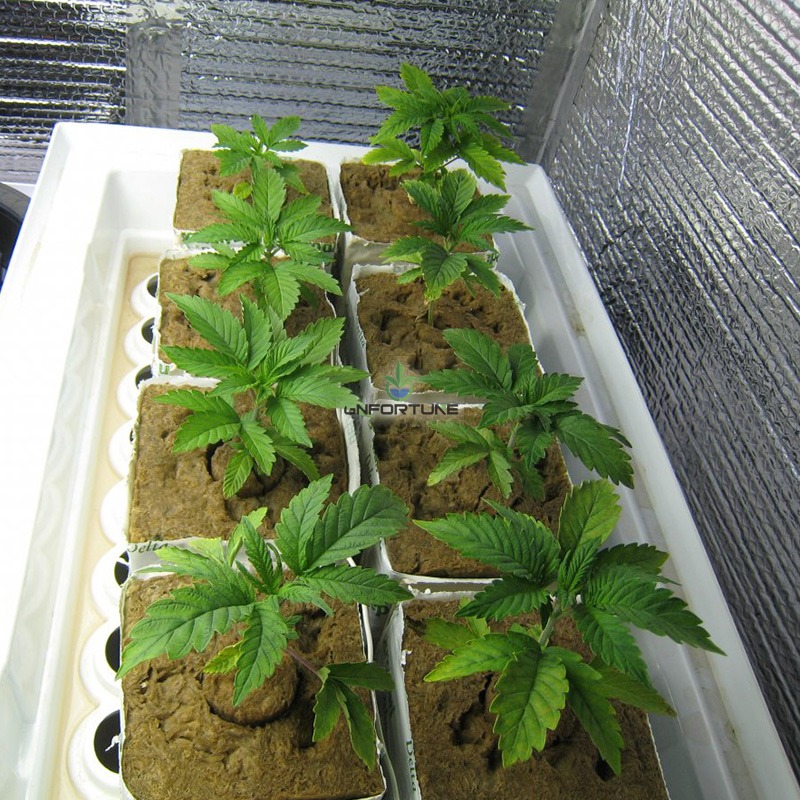
During germination the medium should sit near the wet end of its range, then be allowed to dry back once the radicle emerges, because a plug kept saturated after emergence loses oxygen at the root tip. That dry-back is the step most automated watering programs get wrong. Germination also runs on temperature, and a medium with a high water reserve in a cold room is the common cause of slow, uneven emergence.
Rockwool: Stability and Handling Cost
Rockwool is the reference material because it is uniform. Propagation grades run at roughly 70 to 90 kg per cubic metre, hold water at more than 90 percent by volume, and leave 15 to 25 percent air after drainage, which is enough to keep a seedling oxygenated if irrigation is not continuous.
The failure mode with rockwool is overwatering rather than under-watering. Because the material holds so much water, a plug kept wet under mist or under frequent irrigation loses air at the root tip, and the seedling shows a pale, checked root system that never recovers its schedule. Programs moving from sponge to rockwool usually need fewer irrigation events, not more.
Two handling costs come with it. New rockwool is alkaline, commonly pH 7.5 to 8.5, so plugs need conditioning in an acidified solution to bring them to roughly pH 5.5 to 6.0 before seeding; a soak of a few hours or overnight is standard practice. And the material needs wetting before use, which means a conditioning tank, a drain-down area and the labour to move sheets or blocks through it. Long-fibre grades are more pleasant to handle than short-fibre grades, and the difference is worth paying for where crews handle plugs all day.
Phenolic Foam: Clean but Pricey
Phenolic foam is the clean-room option. It is sterile, free of fibre and dust, light at roughly 15 to 30 kg per cubic metre, and dimensionally consistent, which is why it appears in facilities with strict hygiene rules. It carries a significant price premium per plug and two behaviour quirks.
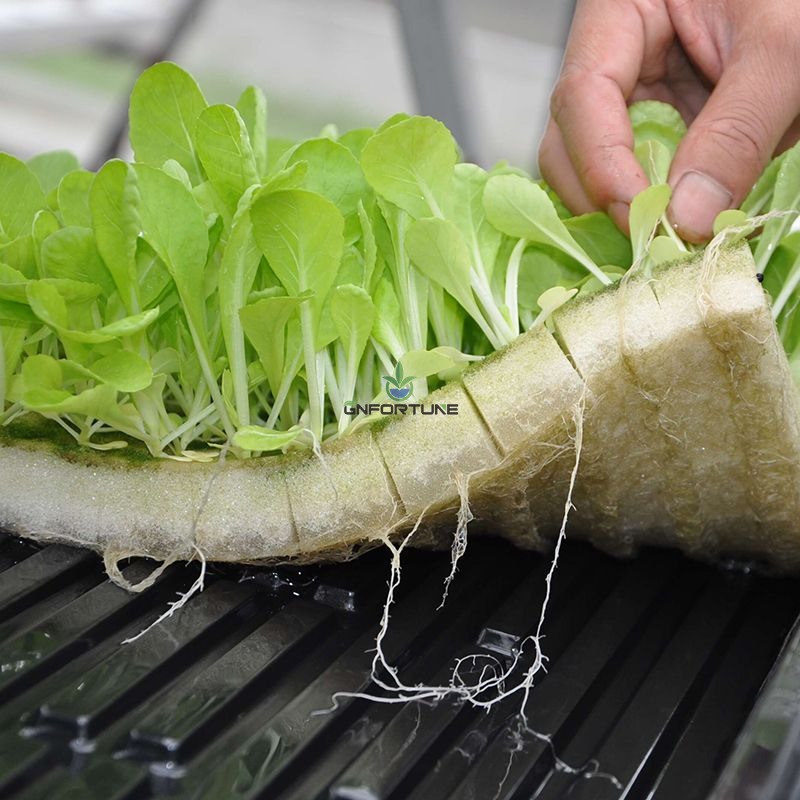
The first is hydrophobicity: dry phenolic foam resists water, so the first wetting needs a wetting agent or surfactant in the solution, and watering from below through a capillary mat or ebb bench works better than overhead mist. The second is water reserve. The open cell structure gives high air-filled porosity and a small buffer, so plugs dry quickly under mist and under greenhouse radiation, and irrigation has to be more frequent than a rockwool program.
Hydroponic Sponge: Cheapest per Plug
Hydroponic sponge, usually a slit or cross-cut polyurethane block at 20 to 35 kg per cubic metre, is the cheapest medium per plug and the standard choice for lettuce, herb and leafy plugs going straight into net pots. It holds water well, tolerates rough handling, and needs no conditioning.
The trade-offs are uniformity and structure. Density and cell size vary more between batches than rockwool does, the material loses resilience as it compresses over a cycle, and a plug that is too wet at the base restricts oxygen around the root tip. Sponge suits short cycles and small transplants; it is not the medium for vine seedlings held for weeks.
Sponge is also the forgiving choice where propagation runs on a simple bench with hand watering, because it tolerates a missed irrigation better than phenolic foam and needs no conditioning tank. Where plugs are dibbled or seeded automatically, check that the slit in the sponge matches the seeder, since a slit that closes under compression drops the seed too deep.
Grow Cubes Compared: Transplant Success by Medium
Grow cubes are compared properly on four columns: density, water reserve, air-filled porosity and relative cost per thousand plugs. Cost figures vary by region and season, so treat the index below as a ranking rather than a price.
| Medium | Density | Water reserve | Air after drainage | Cost index | Best fit |
|---|---|---|---|---|---|
| Rockwool plug | 70 to 90 kg/m³ | High | 15 to 25 percent | 2 to 4 | Vine seedlings, long holds |
| Phenolic foam | 15 to 30 kg/m³ | Low to moderate | 25 to 40 percent | 3 to 6 | Hygiene-critical rooms, sub-irrigated benches |
| Hydroponic sponge | 20 to 35 kg/m³ | High | 10 to 20 percent | 1 | Lettuce, herb and leafy plugs into net pots |
Transplant success follows three mechanical factors more than the material itself. Root exit: a plug that has rooted through its sides releases cleanly, one that has not will tear. Contact: the plug must sit flush in the net pot or slab hole. Moisture at the moment of transplant: a dry plug in a dry net pot loses a week.
Where it goes wrong on site: the plug is rarely the problem, the gap under it is. A plug seated 2 to 3 mm proud of the net pot or slab surface leaves an air gap at the base, the root tip dries out, and the crop shows a transplant check that looks like a nutrition fault.
Log transplant losses per thousand and sort them by cause before changing medium. Most programs that switch media are actually solving a seating or watering problem, and the switch hides it for a season. The propagation and transplanting guide covers the timing side of that measurement.
Waste Volume and Disposal
Spent plugs are a volume problem at scale. A 25 mm cube is roughly 15 mL and a 36 mm cube roughly 45 mL, so a thousand transplants generate somewhere between 15 and 50 L of spent plug media, before slabs are counted. Weight is trivial; volume and local rules are what cost money.
| Medium | Spent volume per 1,000 plugs | Disposal route | Note |
|---|---|---|---|
| Rockwool | 15 to 50 L | Landfill, or shredding where permitted | Inert, not biodegradable; check local rules |
| Phenolic foam | 15 to 50 L, lowest weight | Landfill | Bulky and light; haulage by volume |
| Hydroponic sponge | 15 to 50 L | Landfill in most markets | Plastic; recycling routes are rare |
Rockwool is inert and does not break down, so most of it leaves the site as solid waste unless a local outlet accepts it as a soil conditioner, and slab volumes dwarf plug volumes on any vine crop. Where disposal fees are charged by cubic metre, it is worth pricing the whole media stream, plugs and slabs together, before choosing a plug format.
On a vine crop, the slab or bucket media dominates the waste line. A slab program at roughly 3 to 4 plants per slab leaves several cubic metres of spent media per 1,000 m² of house at each crop change, so plug waste is the small number and slab disposal is the budget item. Programs that move from slabs to reusable containers are usually reacting to that disposal cost rather than to media performance.
Batch quality matters on arrival as much as performance in the room. Check plug dimensions, density and moisture on receipt and keep the record, because a drift in plug height is what breaks automatic dibbling and seeding. The incoming inspection routine for seeds and media sets out the acceptance checks, and the soilless substrate guide places plugs in the wider media picture.
Frequently Asked Questions
Which medium suits lettuce plugs?
A: Hydroponic sponge for short cycles into net pots, or rockwool mini plugs where the seedling is held longer or handled mechanically.
Do rockwool plugs need soaking before seeding?
A: Yes. Condition them in an acidified solution to roughly pH 5.5 to 6.0, typically for a few hours or overnight, then let them drain.
Why does phenolic foam stay dry after misting?
A: It is hydrophobic when dry, so it needs a wetting agent in the first irrigation and watering from below rather than overhead mist.
How much waste do plugs generate?
A: Roughly 15 to 50 L of spent plug media per 1,000 transplants depending on cube size, plus slab volume on vine crops.
Can propagation plugs be reused?
A: No. Plugs are single-cycle items, and reuse carries disease risk that costs far more than the plugs.
A rooting medium is a small purchase that decides a large part of transplant success, so the choice is worth a measured trial rather than a price comparison. Run the plugs you are considering side by side on one bench for one full cycle.
Test Plugs on Your Own Bench
Send the crop, the plug size, the transplant target and the monthly volume, and ask for density, pH after conditioning and dimensional tolerance in writing. Rockwool plugs, foam and sponge each behave differently on a particular bench, so request propagation media samples and run them through one full cycle before committing a season.


