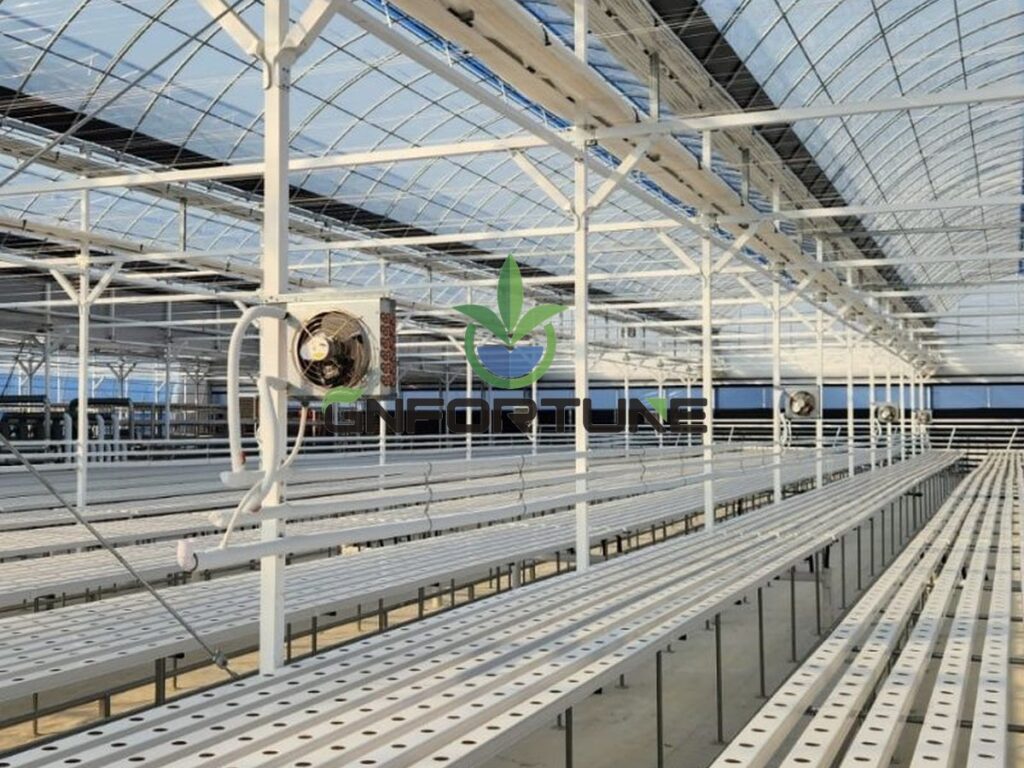
Before spending on a chiller, most farms can buy several degrees of nutrient temperature control with placement, insulation and paint. Passive control will not hold a setpoint the way refrigeration does, but it moves the afternoon peak, slows the daily swing, and on temperate sites it is often all the crop actually needs. This piece covers those levers and the point where they stop working.
Chiller selection and sizing is its own topic, covered in the guide to water chiller sizing for nutrient temperature control. Here the assumption is the opposite: no chiller on the project, by budget or by climate.
Why Root-Zone Temperature Sets the Ceiling
Two mechanisms make solution temperature the limiting variable in warm greenhouses. The first is oxygen: dissolved oxygen capacity falls steeply as water warms, so a solution that held comfortable oxygen at 20 °C holds materially less at 28 °C while root respiration demand rises. The relationship and the aeration equipment behind it are covered in the article on dissolved oxygen design targets.
The second is disease: warm, low-oxygen solution is precisely the window where root rot pathogens move fastest, and the Pythium dynamics in NFT and DWC track temperature closely. As planning references — not guarantees — many leafy-green operations try to keep solution between roughly 18–22 °C, and treat sustained solution above about 24–25 °C as the zone where root problems multiply, assuming a recirculating NFT or DWC system with a full canopy. Confirm targets against your own crop and observed disease history.
The Four Passive Levers, Ranked
Passive control works by reducing heat entering the tank and by storing the heat that does enter in a larger mass. Four levers, roughly in order of leverage:
- Placement. Moving the tank out of direct solar gain and out of the hottest air is the single biggest effect. A tank in a shaded, ventilated fertigation room behaves differently from one standing in a bright glasshouse corner.
- Volume. Thermal mass is the buffer: the same heat load spread over 5,000 L moves the temperature a fifth as far as over 1,000 L. Volume as buffer is treated in depth in the article on hydroponic system water volume; here it matters as a temperature lever.
- Insulation. Foam or foil-faced insulation on the tank shell slows heat crossing the wall in both directions — it delays the afternoon peak and overnight cooling alike.
- Colour and surface. Light-coloured shells absorb less radiation where sun does reach the tank; the effect is real but smaller than placement, and it does nothing against warm air.
None of these levers creates coolness — they only prevent heat from arriving or spread what arrives. On a 38 °C afternoon, a passive design can narrow the rise; it cannot pull the solution below the ambient band the site lives in.
Tank Colour and Surface Heat Gain
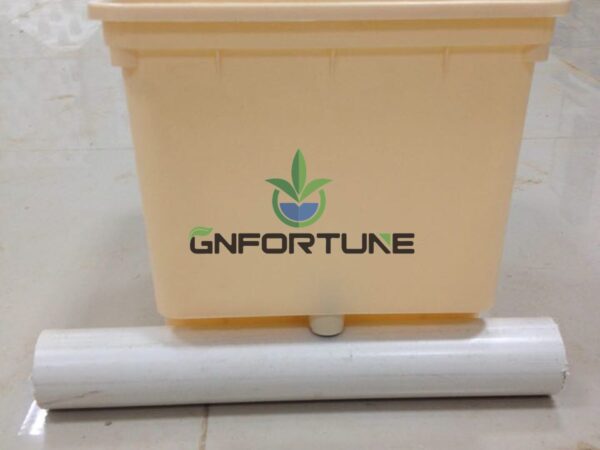
Where a tank stands in light, shell colour changes how much radiation becomes heat. Dark tanks in direct sun gain heat through the wall quickly; white or reflective shells cut that gain substantially. As a planning-order illustration, a black tank in full sun on a hot day can run several degrees warmer than the same tank painted white or shaded — the exact figure depends on radiation load, wind and shell material, so measure on site rather than quote a universal number.
Two practical notes from project work. First, colour only matters where radiation reaches: a tank inside a shaded room gains nothing from white paint and loses nothing from black. Second, pale shells also help winter — a white tank sheds heat faster in the cold months, which is a cost in unheated rooms; if winters matter, insulation moderates both directions better than colour does either.
Placement Options Compared
The table compares the placements commercial projects actually choose, with planning-order effects on afternoon peak rise in warm weather. All figures assume a recirculating system of a few thousand litres and a hot summer day; verify on your own site.
| Placement | Heat exposure | Afternoon rise (planning range) | Costs and limits |
|---|---|---|---|
| Inside greenhouse, in light | Direct radiation plus warm air | Highest — the worst common choice | None of the levers work well; expect the biggest swings and the fastest root problems |
| Inside greenhouse, shaded corner | Warm air only | Several degrees better than in-light placement | Uses cropping floor space; still tracks house air temperature closely |
| Dedicated shaded fertigation room | Low radiation, ventilated air | Noticeably flatter curve; the common commercial answer | Building cost and floor space; needs ventilation design of its own |
| In-ground / earth-sheltered | Ground temperature, stable year-round | Smallest daily swing of the passive options | Excavation and waterproofing cost; access and hygiene design harder; draining and cleaning more awkward |
The fertigation room itself is a design exercise with safety and layout dimensions — the fertigation room article listed below covers those. From a temperature view, the room is valuable because it decouples the tank from both radiation and the house’s peak air temperature.
Operating Habits That Support Passive Control
Placement and insulation set the envelope; a few habits work inside it:
- Make up volume with the coolest available water at the warmest part of the day, within recipe limits — top-up water is the one input a passive farm can steer.
- Cover every tank and sump. Open surfaces exchange heat with room air and invite algae; the hygiene side is covered in the tank hygiene article.
- Pipe runs count too. Supply lines in sun heat the solution between tank and channel; the same logic that puts pipes in shade for algae reasons serves temperature as well.
- Log solution temperature at the tank and at the channel end. The gap between the two readings is the pipework’s contribution, and it tells you whether the next euro goes into the tank shell or the pipe run.
Where Passive Control Runs Out
Passive levers fail in a predictable climate band. Once afternoon temperatures sit persistently above the mid-30s °C, the tank’s environment is warmer than the crop’s target solution even before radiation adds to it — no placement trick cools water below the air around it, and evaporation losses start costing recipe stability. In that band, refrigeration becomes the only reliable lever, and the chiller sizing guide above takes over.
The middle case — hot summers, mild rest of year — is where farms most often under-spec. Passive design carries spring and autumn comfortably, then the first genuinely hot fortnight produces the root symptoms the design was supposed to prevent. Buyers in such climates should size the placement and insulation as if passive will work, and reserve the floor space, power circuit and budget line for a chiller fitted later, because the economics say the purchase will come.
Nutrient temperature control without a chiller is a design exercise in keeping heat out and spreading what gets in. Get placement, volume, insulation and colour in that order, log the readings, and let the measurements — not optimism — tell you when the site has crossed into refrigeration territory.
FAQs About Nutrient Temperature Without a Chiller
What solution temperature should a leafy-green farm aim for?
As a planning band, roughly 18–22 °C suits most leafy greens on recirculating systems, with sustained readings above about 24–25 °C treated as elevated root-risk territory. Targets shift with crop and disease history, so set them from your own observations, not a universal number.
Does painting the tank white actually help?
Where the tank sits in light, yes — a reflective shell cuts radiation gain noticeably compared with a dark one. Where the tank is already shaded or indoors, colour does almost nothing; placement and insulation are the levers that matter there.
Can frozen bottles or ice replace a chiller?
Only as an emergency measure at small scale. The energy maths does not work at commercial volumes, ice dilutes the recipe as it melts, and the labour burden makes it a stopgap, not a control strategy.
Is a buried tank worth the excavation cost?
It gives the flattest temperature curve of the passive options and can be the right answer on new builds with suitable ground. Against that: waterproofing, access for cleaning, hygiene zoning and drainage design all get harder, so the decision is site-specific rather than general.
How do we know when passive control is no longer enough?
When logged solution temperature exceeds the crop target for most of the hot season despite good placement and insulation — usually afternoon peaks persistently above the mid-20s °C band. At that point add refrigeration rather than stacking more passive hardware on a losing position.
Related Reading
- Water Chiller Sizing: Nutrient Temperature Control — The refrigeration option, and when it becomes the only lever left
- Hydroponic System Water Volume: The Buffer Behind Stable EC — Volume as thermal mass and its other buffering roles
- Dissolved Oxygen in Hydroponics: Aeration Design Targets — The oxygen side of warm solution
- Hydroponic Water Tank Hygiene — Why covered, clean tanks matter beyond temperature
- Fertigation Room Layout: Tanks, Pumps, Dosing and Safety — Designing the room that decouples tanks from greenhouse heat
Next Step: What to Send for a Quotation
Whether passive control suffices on a site is decided by the climate record and the tank plan, both of which fit in an RFQ. Send the temperature data and the layout, and the insulation, placement and any future chiller provision can be specified against real numbers.
Specifying tank placement, insulation or future chiller provision? For RFQ or project consultation, send: seasonal temperature extremes on site; system type and total solution volume; proposed tank location and available space; whether a chiller may be added later (power circuit and floor space); crop type and target root-zone band; delivery schedule; and the budget band. G AND N FORTUNE LIMITED supplies nutrient tank sets, fertigation rooms and matched NFT, DWC, Dutch bucket and substrate systems quoted to those parameters.