

Retailers increasingly ask growers for a water number before they ask about price. The farms that answer well are not the ones with the smallest figure — they are the ones who can show how it was built. A hydroponic water footprint only carries weight when the boundary is clear, the inputs are metered, and the same method can be repeated next season.
This guide sets out what to measure, where hydroponics genuinely differs from soil production, and how to present a number that survives a follow-up question.
What Is a Hydroponic Water Footprint?
A hydroponic water footprint is the volume of water associated with producing a unit of saleable crop, normally expressed as litres per kilogram. For a recirculating system the meaningful figure is net consumption: water taken in from mains, borehole, harvested rainfall or delivered supply, minus water returned to the same source, with water lost to transpiration, biomass, substrate and discharge counted as consumed.
Two boundary decisions determine whether the number is comparable: whether transpired water counts as consumption (in most methods it does), and whether rainfall captured on site counts as an input (it usually does, when it substitutes for another source). State both in the method note.
Why Is Water Reporting Different in Hydroponics?
Soil production loses a large share of applied water to deep percolation and soil evaporation that never reaches the crop. Hydroponics largely removes that pathway, so water applied and water transpired sit much closer together — which is why recirculating systems can report consumption well below comparable field production.
The advantage is not automatic. A drain-to-waste system with generous leaching can use more water per kilogram than a well-managed drip-irrigated field crop. Designing for recirculation, and actually capturing the return flow, is what produces the result.
How Do You Calculate Litres per Kilogram?
- Meter every incoming source — mains, borehole and any delivered water.
- Meter or sample the discharge leaving the site, then extrapolate over the period.
- Record saleable packed weight per crop cycle, split by crop and house where possible.
- Subtract discharge from intake across the same period to get net consumption.
- Divide net consumption by saleable kilograms.
Keep the measurement period consistent between seasons. A footprint calculated across a summer cycle is not comparable with a winter one, and buyers notice when a favourable window has been chosen.
| System type | Water pathway | Reporting implication |
|---|---|---|
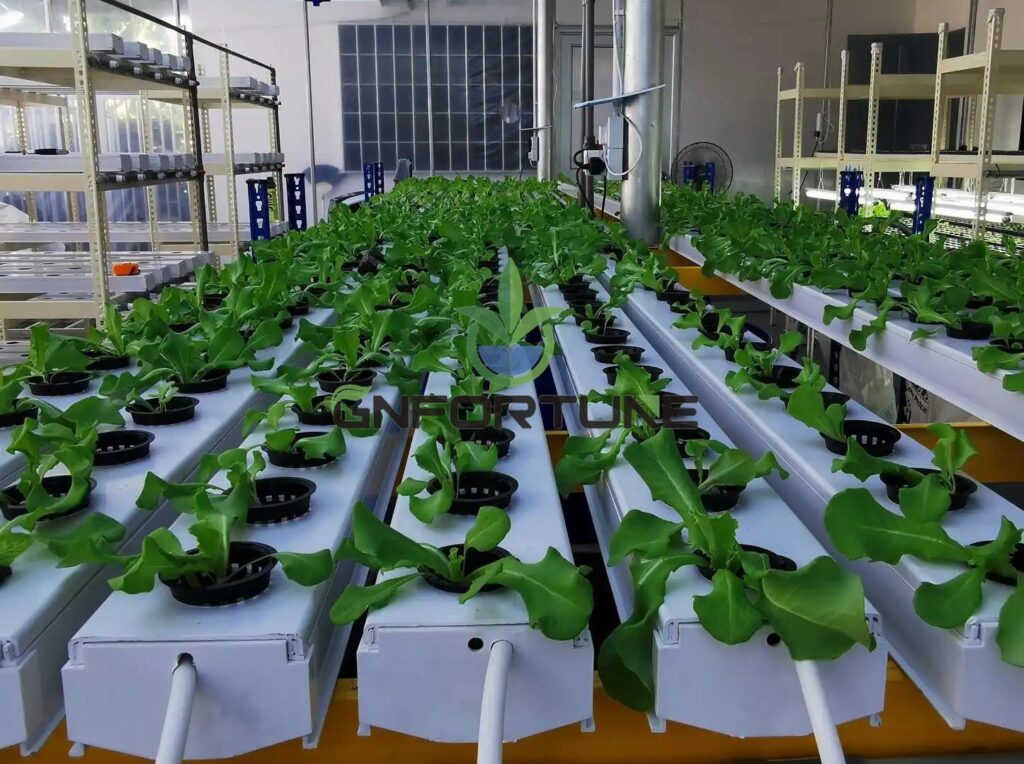
| Recirculating NFT or Dutch bucket | Return flow captured, topped up and reused | Lowest net consumption; needs intake and dump-cycle records |
| Drain-to-waste with partial capture | Fraction of return flow reused | Consumption depends on capture rate; meter both streams |
| Drain-to-waste, no capture | All applied water leaves as runoff | Highest consumption; discharge volume becomes the headline issue |
| Systems with rainwater harvesting | Harvested rainfall offsets intake | Count harvested volume as input; storage size shapes the seasonal profile |
What Should Be Counted — and What Is Commonly Missed?
Buyers generally accept a crop-level figure if the method behind it is stated. What undermines a submission is omission rather than a high number. Four items are most often left out:
- Transpiration: the largest real consumption pathway in a leafy greens house, and the one most likely to be quietly ignored.
- Dump cycles: periodic full or partial discharge of recirculating solution to control salt accumulation or disease.
- Cleaning water: between-crop wash-down, floor washing and crate sanitation, which can be a meaningful annual volume.
- Condensate: recovered from dehumidification or chilled surfaces — a genuine reduction, and worth claiming once measured.
Record the omissions explicitly if you cannot meter them yet. A stated estimate is defensible; a silent gap is not.
How Should the Number Be Presented to Buyers?
Auditors want method; buyers want a repeatable figure and a direction of travel. Prepare two artefacts: one headline number per kilogram for each main product, and a one-page method note covering boundary, period, sources metered and reuse systems in place.
Then use the rest of the page for trajectory — reduction across seasons, the recovery and reuse equipment installed, and the next improvement planned. Keep claims conservative: a defensible number that survives scrutiny is worth more than an impressive one that collapses under a follow-up question.
FAQs About Hydroponic Water Footprints
Is hydroponics more water efficient than soil growing?
Yes for recirculating systems, which typically use a fraction of the water per kilogram compared with open-field production of the same crop, because percolation and soil evaporation are largely removed. Drain-to-waste hydroponics without capture can lose that advantage, so system design determines the answer.
How many litres of water does hydroponic lettuce use per kilogram?
Recirculating lettuce operations commonly report figures in the low tens of litres per kilogram, while drain-to-waste systems can be several times higher. The range is wide because climate, system design and dump frequency differ; publish your own metered figure rather than an industry average.
Should harvested rainwater count as water use?
Yes, when it substitutes for another supply. Excluding it makes the footprint look smaller but creates an inconsistency buyers may challenge. Where rainfall is abundant, report it separately so the comparison with irrigated sites stays fair.
What water data do retailers usually request?
Most request a per-kilogram or per-unit water figure, the measurement period, the system boundary, and any reuse or recovery in place. Some ask for discharge volumes and treatment method as well. Having last season’s meter records on file answers most questionnaires without new work.
How often should the footprint be recalculated?
Once per crop cycle at minimum, using the same method each time. Annual recalculation with a consistent boundary lets you show trend, and trend is what makes the figure commercially useful rather than merely compliant.
What to Prepare Before Reporting Water Data
Meter records, discharge volumes, packed weights per cycle, a description of recirculation and reuse equipment, and the measurement period. Where discharge is regulated, keep the permit conditions alongside the data — buyers ask about compliance as often as they ask about volume.
Related reading: the choice between recirculation and drain-to-waste drives most of this number, reservoir and storage design sets how much can be captured, and discharge rules are covered in nutrient discharge and runoff compliance. Incoming water quality is the starting point for any recipe: reading a water analysis report.
Send your system type, crop plan, water source and available meter data, and we will advise on recirculation and storage options that reduce measured consumption: contact our team.