A hydroponic farm land lease puts a production asset with a long life onto a tenure that may be much shorter. Structures and systems are usually planned against a decade or more, while an agricultural lease may run five years, or ten with a rent review nobody modelled. Leasing or buying the land decides what a lender accepts as security, how the greenhouse is depreciated, who owns the structure when the term ends, and whether the business can be sold. Water, power, access and labour belong to site selection; this article is about tenure.
It is written for growers, engineering firms and investors who have found a workable site and must now decide what rights to take: a hydroponic farm land lease or a purchase.
What Land Tenure Actually Decides
Four things: how much capital is tied up in the ground, what a lender will accept as security, who owns the improvements at the end of the term, and whether the business can be transferred. Every other clause matters through those four.
| Factor | Leasehold | Freehold |
|---|---|---|
| Capital | Stays in the production asset | Part sits in the ground |
| Lender security | Depends on term and assignability | Land and improvements |
| Depreciation | Limited by remaining term | Follows asset life |
| Improvements at exit | Decided by the lease | Retained by the owner |
| Exit and transfer | Assignment consent required | Transfers with the land |
| Best fit | Short horizon, capital-constrained projects | Long horizon, proven site |
Leasing turns a capital cost into an operating one and keeps flexibility. Buying removes renewal risk and gives a lender something tangible, at the price of capital that could have funded growing area. The deciding variable is the gap between how long the asset must earn and how long the tenure is guaranteed.
Lease Length Against Payback
The term should outlast the period the project needs to repay its capital, with margin for a slow first year. A lease expiring near the payback date hands the landlord leverage at the wrong moment.
One planning heuristic is a term of roughly 1.5–2.5× the expected payback period, assuming the estimate already includes ramp-up and a first-year yield discount: on a five-year payback model, that points at a term in the 8–12 year band. It is a planning heuristic rather than a market figure, and a lender’s requirement overrides it.
Rent review timing matters as much as length. A fixed rent for three years with a market review in year four inserts an unmodelled variable into the year the crop should be stabilising; a formula or index is easier to plan against.
The Clauses That Decide Whether a Lease Works
Rent and area are the easy parts. Five clauses decide outcomes: renewal, rent review, assignment, default and cure, and restoration. Read them before the deposit, not after.
- Renewal — automatic, at whose option, how much notice. A lease that simply ends leaves the tenant negotiating weakly while the crop is still in the ground.
- Rent review — formula, index or open market, with a dispute route that does not require vacating.
- Assignment and change of control — whether the lease transfers to a buyer of the business, and whether consent can be withheld unreasonably.
- Default and cure — notice period and a real opportunity to remedy before termination.
- Restoration — whether the site must be returned to its original condition, which can cost more than the structure is worth by then.
Access deserves a line too: who may enter, and whether neighbouring operations can interfere with drainage.
Who Owns the Greenhouse When the Term Ends
Whatever the lease says: in many jurisdictions affixed structures pass to the landlord by default, which surprises tenants. Get the position written as a removal right, a restoration obligation, or a compensation formula.
Three outcomes are common. The tenant removes the structure and restores the site; the landlord keeps it with no payment; or the landlord keeps it and compensates at an agreed formula. The third is hardest to negotiate and the most valuable, being the only one where residual value comes back to the tenant.
The practical test is whether the structure has value at that point: a demountable gutter system on a bolted foundation may be worth moving, a slab and cast-in services are not. Confirm whether the landlord can compel removal, since stripping the site can cost more than the salvage.
What Lenders and Auditors See
Lenders want security and a term outlasting the facility; auditors want a depreciation period that does not exceed the tenure. A short lease breaks both, and neither can be corrected after signing.
Leasehold improvements are generally depreciated over the shorter of useful life and remaining term, subject to local rules. Where structures and systems are planned against a range of 7–20 years depending on component, a five-year remaining term compresses the charge and distorts the cost per kilo the project was priced on.
Security is the harder obstacle. A lender taking the greenhouse as collateral needs rights over the land, or a lease long enough and assignable enough to stand in for it. Some lend against equipment alone; many do not.
Exit: Whether the Business Can Be Sold
On freehold, land and asset transfer together. On leasehold the lease has to be assignable and the remaining term long enough for a buyer to care. Both are negotiable in the lease; neither is negotiable at the point of sale.
- Assignment consent and the grounds on which it can be refused.
- Remaining term. Buyers discount heavily for a short tail, since they inherit the renewal negotiation.
- Rent exposure. An imminent review transfers unpriced risk to the buyer.
- Improvement ownership. If the landlord keeps the structure, the buyer acquires a contract rather than an asset.
Where tenure is short, expect valuation closer to an operating contract with equipment attached: a different buyer pool and multiple.
Buying: What the Money Could Have Funded Instead
Purchase converts rent into a fixed asset and removes renewal risk. The real comparison is opportunity cost: what the same capital would have funded if it stayed in the business.
The test is marginal. If the land absorbs a large share of project capital, compare it against the output that capital would otherwise buy — additional bays, packing and cooling capacity, or the buffer covering the pre-revenue cash gap. A site that consumes the capital for the second phase can hold a project at half its viable scale.
Ownership brings obligations leasing does not: land tax or rates, boundary and drainage responsibility, planning constraints attaching to the title, and a slower exit if the site proves wrong. It suits a proven long-term site where capital is not the constraint on capacity.
Designing for a Tenure You Do Not Control
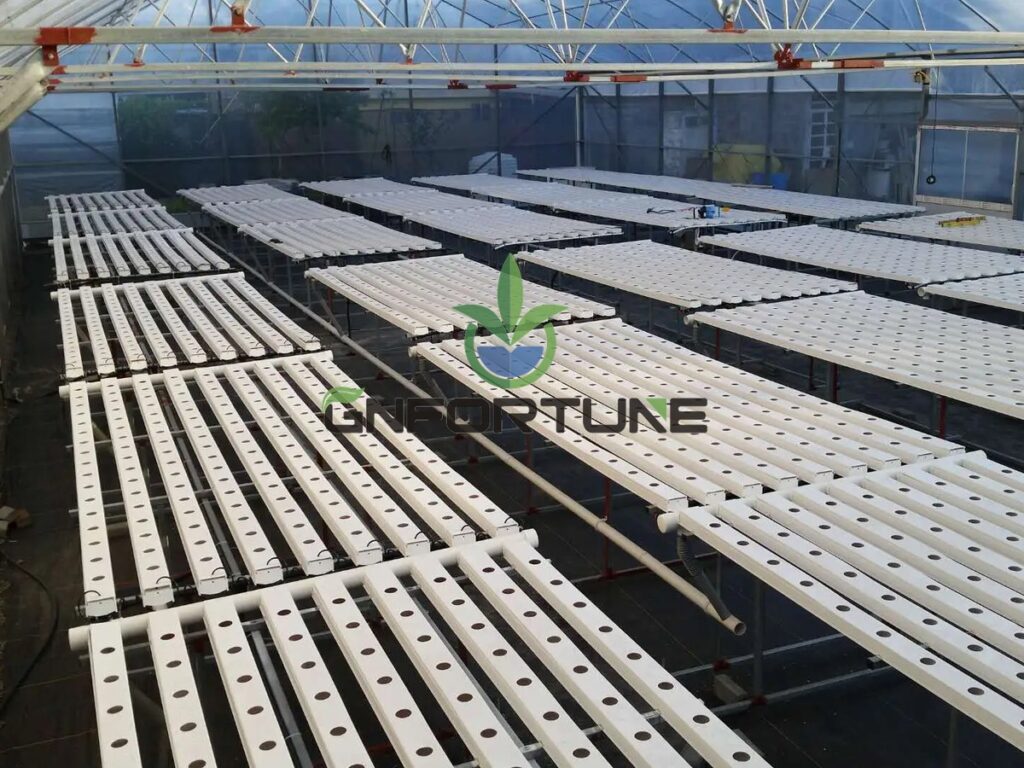
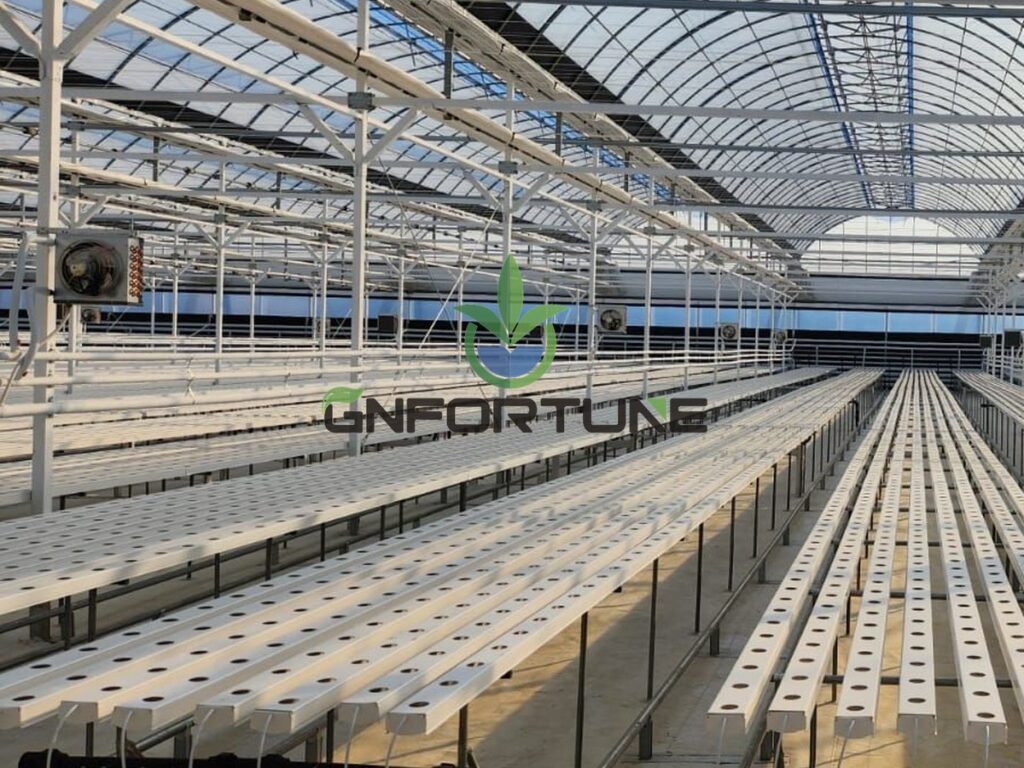
Where the term is short or uncertain, design for relocation: demountable structures, bolted rather than cast foundations, modular systems, services that can be disconnected. Where the land is owned or the term is long, those constraints are unnecessary and fixed construction is usually cheaper over the asset life.
The trade-offs are real — higher cost per square metre, foundations that limit what can be built on them, some loss of thermal performance. They are worth paying when the alternative is writing off a structure at the end of a term.
G AND N FORTUNE LIMITED supplies NFT, DWC and substrate systems and matched greenhouse packages quoted to project parameters, and can price demountable or fixed configurations depending on what the tenure allows.
FAQs About Hydroponic Farm Land Lease and Purchase
How long should a hydroponic farm land lease be?
Long enough to outlast the payback period with margin: a planning heuristic of 1.5–2.5× expected payback, so roughly 8–12 years on a five-year payback model. The limit is that a lender may require longer.
Who owns the greenhouse at the end of the lease?
Whoever the lease names. Absent a clause, affixed structures commonly pass to the landlord, so tenants should secure a removal right or a compensation formula before building. Local law varies and should be confirmed.
Can a leased hydroponic farm be sold as a going concern?
Yes, provided the lease is assignable and enough term remains to interest a buyer. Where assignment consent can be refused, or the remaining term is short, the sale becomes a negotiation with the landlord as well as the buyer.
Is buying the land always better for financing?
It is usually easier to collateralise, but not always better for the project. If capital is the binding constraint on growing area or working capital, spending it on land reduces the output the lender is being asked to fund.
Does a short lease change which system should be installed?
It favours demountable and modular designs, since residual value depends on what can be moved. The limitation is cost: demountable structures and bolted foundations can cost more per square metre and constrain layout.
Related Reading
- Choosing a Site for a Hydroponic Farm: Water, Power, Access and Labour — Water, power, access and labour: the site factors behind tenure
- Greenhouse Structural Design for Hydroponics: Wind, Snow and Foundation Loads — Structural loads, which a short lease makes harder to amortise
- Hydroponic Farm ROI: Cost per Acre & Payback Period — Payback period when the land is not an owned asset
- Container and Warehouse Hydroponic Farms: Retrofit Requirements, Loads and Costs — Retrofit options when land tenure is uncertain
- Hydroponic Equipment Lifespan: 10-Year vs 3-Year Parts — Equipment service life against lease length
Next Step: What to Send for a Quotation
Tenure changes the specification. A supplier quoting a permanent structure onto a five-year lease is solving a different problem from the one the site presents.
Planning a build on leased or purchased land? For RFQ or project consultation, send: greenhouse dimensions and usable area; land tenure — lease term remaining, renewal rights or freehold; whether the installation must be demountable and who owns improvements at term end; crop plan and target grade; target weekly or annual output; local climate range and raw water analysis; preferred system; automation level; delivery schedule; and the budget band. G AND N FORTUNE LIMITED supplies NFT channels, DWC and substrate systems and matched greenhouse packages quoted to those parameters.