

By the G&N commercial export team · First published: September 2026 · Reviewed for field accuracy
Hydroponic equipment shipments to Australia and New Zealand are small on a global map, but the buyers are sophisticated and the compliance burden is heavy. A typical order is one or two containers of NFT channels, Dutch buckets, irrigation panels, and climate-control hardware destined for a family greenhouse near Melbourne, a lettuce facility in South Auckland, or a research institution in Western Australia. This guide walks a supplier — and the grower behind the order — through what changes when the destination is Sydney or Christchurch: the AS/NZS electrical regime, the IP rating the greenhouse expects, biosecurity checks at the wharf, and the food-safety marks a buyer will ask for before signing the pro forma invoice.
Why ANZ Is a Small but High-Quality Hydroponic Market
ANZ is not a volume region for hydroponic equipment exporters. Per capita greenhouse area is lower than the Netherlands or Spain, and growers tend to install carefully rather than quickly. Orders that do land are well-specified, well-documented, and tied to a bank-side business plan. A B2B buyer expects a quotation that names standards, a drawing that calls out tolerances, and a shipping calendar that does not slip. What ANZ does buy reliably:
- NFT channels and Dutch buckets for greenhouse lettuce, basil, and strawberry.
- Drip irrigation kits and dosing systems for berry substrate farms and research greenhouses.
- Climate-control hardware — pad-and-fan walls, exhaust fans, and sensors built for high-UV exposure.
The common thread is quality over quantity. An ANZ buyer will pay more for a UV-stabilized resin, a documented IP rating, and an after-sales contact in business hours — and reject a quote that cannot produce those documents on request. For context, the ANZ market overview summarizes the pipeline.
Electrical Compliance: AS/NZS 3112 Plugs, RCDs, and Approval Marks
Australian and New Zealand electrical safety is governed by AS/NZS standards, not by CE or UL alone. A piece of equipment with a CE sticker and a European plug still has to clear local rules before it can be wired into a greenhouse. The most common documents an importer is asked to produce:
| Standard / mark | Scope | What a buyer should expect |
|---|---|---|
| AS/NZS 3112 | Plug and socket outline | Two-pin earthed plug with insulated active/neutral pins; not interchangeable with European CEE 7 |
| AS/NZS 60335.1 / 60335.2 | Household and similar electrical appliance safety | Most greenhouse electricals (pumps, fans, heaters) are assessed against this family; an accredited test report from an ILAC-MRA lab is the usual evidence |
| RCD (Residual Current Device) | Ground-fault protection | Required on every greenhouse circuit; 30 mA trip is the working baseline, 10 mA on worker-accessible outlets |
| RCM (Regulatory Compliance Mark) | Single compliance mark for electrical and electronic goods | Issued by an ACMA-recognized responsible supplier; replaces the older C-Tick for many products |
The most common mistake we see is a pump or panel that ships with a European CE plug and a CE Declaration of Conformity, neither of which is accepted at an Australian site inspection. The supplier is then asked to swap the plug or replace the panel, often at the buyer’s cost. Insist on AS/NZS 3112 plugs pre-fitted at the factory, and ask for a sample test report before the pro forma invoice is signed.
The procurement question that prevents the most rework: “Will the supplier re-spin the pump head or control panel for AS/NZS, or are we buying a generic global model and adapting it ourselves?” If the answer is the latter, the project now needs a local electrical contractor on day one of installation. Plan that cost before signing.
For food-contact and irrigation components that meet local plumbing rules, the food-safe materials in hydroponics guide explains which plastics carry the relevant documentation.
IP Ratings: IP55 Is the Baseline for a Working Greenhouse
Australian and New Zealand greenhouses are dusty, humid, and routinely hosed down during turn-around. Ingress protection is the rating an inspector checks first because it predicts whether equipment will still be running in year three. The minimum we quote for any active electrical in an ANZ greenhouse is IP55; for pumps and controllers in the pad-and-fan zone, IP65 is more realistic.
| Location | Minimum IP rating | Why |
|---|---|---|
| General greenhouse interior | IP54 | Dust ingress and splashes from drip and fogging lines |
| Near foggers / under drip lines | IP55 | Direct spray and continuous mist exposure |
| Pad-and-fan zone / pump room | IP65 | Saturated cellulose and pump-room splash |
| Outdoor pump station or reservoir | IP66 or IP67 | Rain and temporary submersion during storms |
| Climate controller cabinets | IP54 / IP65 cabinet | Controller must survive a wash-down and a voltage spike on the same day |
Two details are easy to miss. The rating on the nameplate is only as good as the cable gland — a stainless gland on a plain conduit entry voids the rating under field audit. UV resistance on plastic enclosures matters more in Western Australia than in Europe: a UV-stabilized ASA or polycarbonate enclosure outlasts a generic ABS by years. Ask for the resin spec as well as the IP number.
Biosecurity at the Border: Why “Dirty” Equipment Gets Held
Both Australia and New Zealand run island-style biosecurity, which means any soil, plant matter, straw, untreated wood, or organic residue on a container can trigger treatment, re-export, or destruction. The rules are straightforward — keep everything clean — but the consequences are not. Common holds on ANZ-bound containers:
- Untreated-wood pallets or crating. A missing IPPC stamp forces a re-pack at the port.
- Soil or rust on tools and frames. Even small amounts will pull the container for cleaning; we wash and shrink-wrap all product before packing.
- Plant matter in drippers or pipe ends. Open drip lines and unbagged emitters can hold dust or straw during the sea voyage. We bag every emitter and cap every open pipe end.
Three biosecurity asks we put on every ANZ order: (1) heat-treated pallets with IPPC stamps visible on two faces, (2) shrink-wrapped product and sealed pipe ends, (3) a packing declaration that lists every material in the container. Those three lines prevent most of the holds we see.
For buyers new to cross-border hydroponic orders, the importing hydroponic equipment from China page covers the document set, and the container loading guide shows how we pack to minimize in-transit damage and border holds.
Food Safety: FSANZ for Produce, State Rules for Water
Food safety in ANZ sits at the federal and state level. Food Standards Australia New Zealand (FSANZ) sets the rules for produce labeling, residues, and food-contact materials; state regulators (and the New Zealand equivalent) inspect actual operations. For hydroponic growers the most common asks are:
- Food-contact declaration. An importer will request an FDA or EU food-contact statement plus the resin grade for any NFT channel, Dutch bucket, reservoir, or pipe in contact with nutrient solution.
- Water source analysis. Australian states run specific irrigation-water testing protocols that differ between NSW, VIC, and QLD.
- Heavy metals and Listeria testing. Processors and supermarket supply chains ask for proof of regular testing; a hydroponic system record (inputs, pH, EC, harvest date) satisfies most of this by default.
The cheapest insurance is a clean document pack from the first order: food-contact statements, resin grades, batch traceability, and a recent irrigation-water analysis. Present the same pack every year and most state inspections finish in a single site visit. For buyers weighing ANZ against a North American project, the UL and CSA compliance guide walks the parallel US and Canada checklist.
Case: A One-Hectare Lettuce Farm Near Melbourne
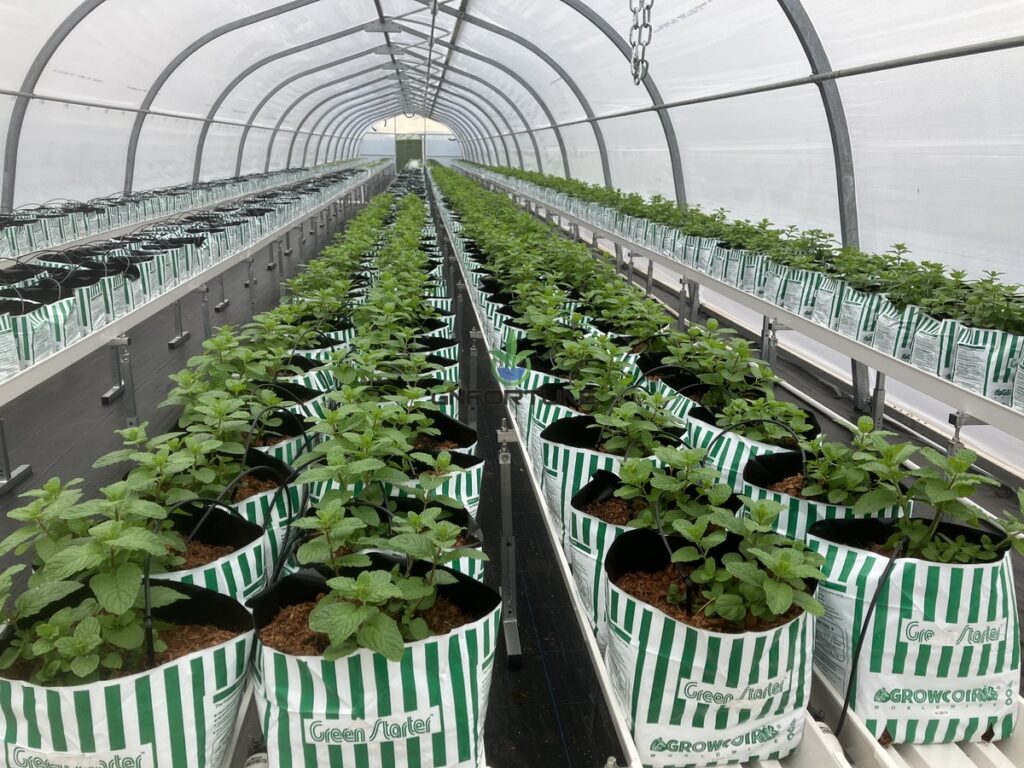
New Zealand greenhouse with bag-grown herbs in double rows on a steel trellis frameA recurring project is a 1-hectare greenhouse lettuce farm southeast of Melbourne, run as a family operation supplying a Victorian supermarket group. The brief was a clean NFT system with a Dutch-built climate screen, an AS/NZS electrical panel, and a one-pump-room layout that a single technician could service. Compliance work happened before the pro forma invoice was signed: an RCM-marked control panel with an AS/NZS 60335 test report, IP55-rated pump station, heat-treated pallets with IPPC stamps, and a packing declaration on the outside of the container. Engineering-wise the system was a standard 1.0–1.2 L/min NFT channel with a 1.6 mS/cm baseline EC. What changed for the ANZ build was the resin grade (UV-stabilized ASA for the outdoor pump skid), the electrical panel (RCD on every circuit, AS/NZS 3112 plugs throughout), and an 8% spare-parts kit. The system is in its fourth production year with only wear-parts retrofits. The compliance work done at quote time was the difference between that outcome and the projects where it gets done on the wharf.
Frequently Asked Questions
Does CE equipment pass inspection in Australia and New Zealand?
A: No. CE covers European conformity; AS/NZS covers Australian and New Zealand conformity. A CE Declaration plus an accredited AS/NZS test report is the most reliable combination.
What plug type do Australian greenhouses use?
A: AS/NZS 3112 two-pin earthed plugs. European CEE 7 plugs are not interchangeable, and adapters are not a permanent solution in a commercial greenhouse.
How strict is Australian biosecurity for hydroponic equipment?
A: Strict. Untreated pallets, soil, or plant residue trigger cleaning, fumigation, or re-export. Heat-treated pallets with IPPC stamps and a clean packing declaration prevent almost all holds.
Can a clean document pack be reused for repeat shipments?
A: Yes, if there has been no design change. We renew test reports every two to three years and reuse the same document set to keep inspections short.
Plan Your ANZ Shipment
Send your destination port, greenhouse size, crop, and electrical specification through the quote form, and our team will return a quotation that names the AS/NZS standards, IP ratings on every active component, and the biosecurity packing list. We have shipped to Melbourne, Sydney, Brisbane, Adelaide, Perth, and Auckland. The wholesale and shipping FAQ answers common cross-border questions; the parallel North American checklist lives on the UL and CSA compliance page.
— G&N Fortune Limited · hydroponic equipment manufacturer since 1996 · Reviewed by the engineering team