Fertiliser Storage on Farms: Segregation, Shelf Life, Pallets
Fertiliser looks inert in the bag, and that assumption is what spoils it. Most salt losses on a hydroponic farm start in the store rather than the mixer: a pallet set against a cold outside wall, an open bag returned to service after a wet week, an acid drum sharing a bund with the nitrate stack. Fertiliser storage hydroponic farm layout reduces to three inputs: segregation between incompatible salt groups, humidity below each salt’s caking threshold, and a rotation habit that survives shift changes. The sections below cover bay layout, why calcium nitrate storage fails first, open-bag windows and the records an auditor asks to see.
Fertiliser Storage Hydroponic Farm Segregation Rules
Segregation follows chemistry, not convenience. Four failure modes account for most store incidents on commercial farms: an oxidising salt beside combustible material, an ammonium or urea product beside free alkali, an acid beside a chlorine sanitiser, and a hygroscopic salt beside anything wet. Assign every product to a group at goods-in and mark that group on the floor.
| Group | Products | Keep clear of | Failure mode |
|---|---|---|---|
| Nitrate oxidisers | Calcium nitrate, potassium nitrate | Urea, ammonium salts, fuels, solvents | Oxidiser lowers ignition temperature |
| Ammonium and urea | Urea, ammonium nitrate, MAP, DAP | Lime, cement dust, wood ash | Ammonia released, nitrogen lost |
| Acids | Nitric, phosphoric, sulphuric acid | Hypochlorite stock, nitrate stacks | Chlorine or nitrogen oxide gas |
| Chelates | Iron EDTA, iron DTPA | Strong oxidisers, direct sunlight | Chelate breaks, iron precipitates |
Separation should be a full-height partition, or two metres of clear floor between incompatible groups with nothing bridged across the gap. Temporary stacking during a busy delivery week is where contamination starts, so build spare bay capacity into the layout.
Humidity, Temperature and Caking: What Actually Spoils Stock
Caking has a mechanism. Each salt has a critical relative humidity: above it the crystal surface dissolves into a saturated film, dissolved material migrates to contact points, and as humidity falls again those points recrystallise into solid bridges. Calcium nitrate punishes a lazy store first, since its critical humidity sits below ambient level in most coastal buildings.
| Salt | Critical RH | Store target | Stored failure |
|---|---|---|---|
| Calcium nitrate | 45 to 55% | Below 45% | Deliquescence, slurry in the bag |
| Ammonium nitrate | 55 to 65% | Below 50% | Prills fuse into solid blocks |
| Urea | 70 to 75% | Below 60% | Soft lumps and bridging |
| MAP and DAP | 80 to 90% | Below 65% | Surface crust |
| Potassium nitrate | 90 to 93% | Below 70% | Caking after temperature swings |
Set the target five to ten points below the lowest critical humidity of anything held inside. Calcium nitrate in the room puts the whole room near 45% RH, which usually means a dedicated dry bay with a sealed slab, vapour barrier and mechanical dehumidification rather than a corner of the packing shed. Temperature cycling matters as much as absolute humidity: a stack warmed by day and cooled overnight bridges even at moderate RH, so keep stacks off exterior walls and out of direct sun.
Open-Bag Shelf Life by Salt Type
Suppliers quote shelf life for sealed bags held indoors, which is not how a working store operates. Once a bag is opened the clock restarts on every opening cycle, so the useful question is how long an opened bag stays free-flowing.
| Product | Opened in a dry bay | Reject signal |
|---|---|---|
| Calcium nitrate | 2 to 6 weeks if resealed daily | Hardened slab or wet patches |
| Potassium nitrate | 8 to 12 weeks | Lumps needing breaking |
| MKP blends | 3 to 6 months | Damp crust on the top layer |
| Iron EDTA | 4 to 8 months away from light | Precipitate when dosed |
Transfer opened product into a lidded drum with a gasket rather than folding the bag over, and write the opening date on two faces. Empty part-bags into the mixer before opening new ones; half-bags left behind become the hardened stock written off at season end.
Pallet Layout, Turnover and FIFO
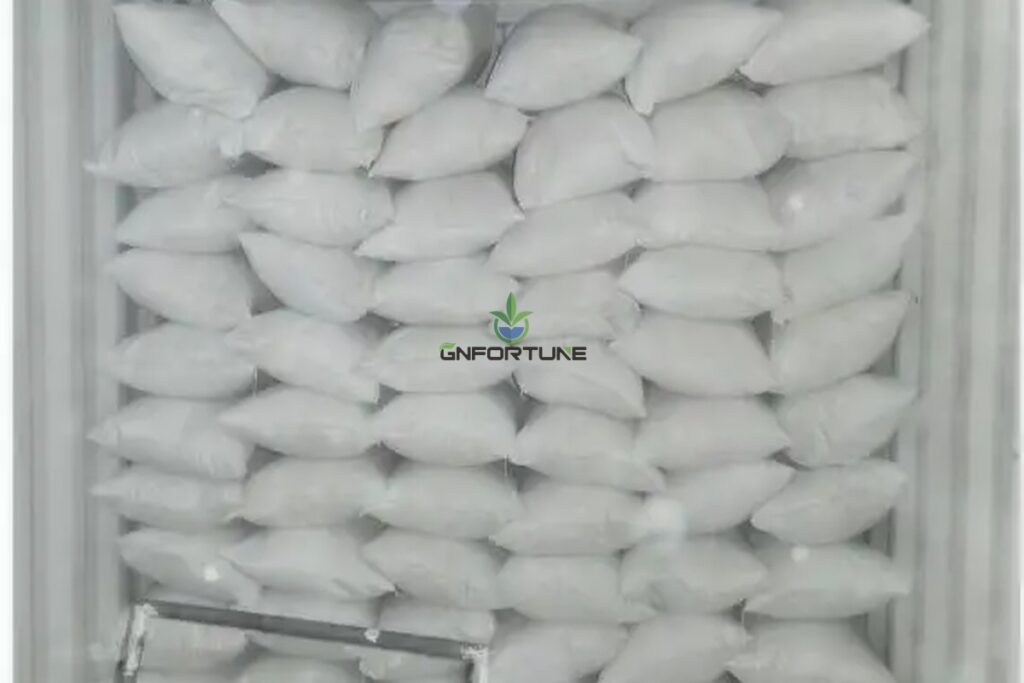
Layout numbers are ordinary warehouse figures, but they decide whether the store passes an audit. A standard pallet runs 1.2 by 1.0 m and carries about one metric ton of 25 kg bags stacked five layers of eight. Keep 0.3 to 0.5 m clear of walls for inspection, hold the stack 0.15 m off the floor and leave 0.5 to 1.0 m below the roof. Aisle width follows the machine: 1.2 to 1.5 m for a pallet truck, 2.5 to 3.0 m where a forklift turns.
Stock on hand follows directly from annual tonnage and cover days.
Stock held = annual tonnage x cover days / 365. A farm running 90 metric tons a year on 45 days of cover holds roughly 11 tons, meaning eleven pallet places plus receiving space. Most operations specify 30 to 60 days of cover on bulk salts and 14 to 21 days on acids, then add one spare bay because deliveries never arrive when planned.
Rotation must survive the night shift, so make first-expiry-first-out the physical default rather than a rule in a folder. Mark received dates on two faces of every pallet and stack one pallet deep wherever floor allows. Larger deliveries change only the magnitude; the cost side sits in the guide to bulk fertilizer buying for hydroponic farms.
Decanting Stations and Dedusting
A dedicated decanting bench keeps dust out of the store and gives one place to clean. Extraction should capture at 0.5 to 1.0 m per second at the opening, discharge outside rather than back into the room, and survive a corrosive atmosphere.
- Scales: readable to 0.01 to 0.05 kg, calibrated on schedule, logged to the mix sheet.
- Spills: absorbent, neutralising agent and a labelled bin at the bench; dry sweeping before any wet clean.
- PPE: gloves, eye protection and particulate protection rated to the safety data sheet.
Recovered material goes back into the mix instead of corroding door hardware. Handling rules sit in the article on chemical safety, PPE, storage and records; after the bay, the next place salt goes wrong is the mixer, covered in the guide to mixing nutrient solution in A and B tanks.
Acid Storage Separation and Bunding
Acids sit apart from every salt group in their own bunded bay. Bund capacity is normally 110% of the largest single container or 25% of total stored volume, whichever gives the larger figure, subject to the local fire rule. The bund takes no drain to floor, no pipe through its wall and no salt stock inside the footprint, because a leak reaching a nitrate stack generates heat and nitrogen oxide gas. Nitric and phosphoric acid need HDPE or compatible plastic containers and fittings, never brass or steel wetted parts, with eyewash within ten seconds of the decant point. The guide to pH adjustment acids shows how the acid choice changes storage requirements.
Records an Auditor Will Ask to See
An store audit takes about twenty minutes and asks for documents rather than explanations. Keep twelve months in one folder:
- Goods-in log with product, lot number, quantity and received date.
- Store map showing bays, groups, bund position and spill kit location.
- Temperature and RH log, with each excursion noted and an action recorded.
- Weekly rotation sheet confirming oldest-first picking.
Lot numbers only pay off when receiving records them at all, the discipline covered in the guide to batch acceptance on a commercial farm. Practising retrieval beats adding another form; see the internal audit checklist.
Frequently Asked Questions
What humidity should a fertiliser store run at?
A: Five to ten points below the critical humidity of the most sensitive salt held. With calcium nitrate present, that means about 45% RH.
How long does an opened bag of calcium nitrate last?
A: Two to six weeks once opened if resealed daily in a dry bay. Reject it once the contents harden into a slab or show wet patches.
Do acids need their own bund?
A: Yes. Give acids a separate bunded bay sized to 110% of the largest container, with no salt stock inside the bund footprint.
How much clearance does a salt pallet need?
A: Roughly 0.15 m off the floor, 0.3 to 0.5 m from walls for inspection, and 0.5 to 1.0 m clear below the roof line.
Which records does an auditor check first?
A: The goods-in log with lot numbers, the store map showing segregation, and the temperature and RH log with excursion actions.
Fertiliser storage hydroponic farm planning comes down to three inputs: annual tonnage, the salt groups purchased, and the lowest critical humidity among them. Give those figures and bay count, bund size and dehumidification duty follow without guessing.
Request a Fertiliser Bay Layout Sketch
To ask for our fertiliser bay layout sketch with bunding and segregation zones sized to your annual tonnage, send the delivery pattern, available floor dimensions and the building’s current RH range, noting whether calcium nitrate arrives bagged or in big bags.