Dehumidification in Sealed Plant Rooms: Sizing the Load
A sealed room has no vents, so every kilogram of water transpired by the crop has to be removed by machine. Under-size the dehumidification duty and humidity climbs until leaf wetness and botrytis decide the crop cycle; over-size it and the lights cannot run cool enough to hold VPD without constant reheat. Getting dehumidification for plant rooms right means estimating the water first, splitting the latent and sensible loads, then choosing equipment against the condensation rate rather than a rule of thumb. The sections below work through each step with practical ranges and a sizing example.
Where the Water Vapor Comes From
Four sources account for nearly everything the dehumidifier has to collect. Ranking them by volume keeps the estimate honest, because two of the four are commonly ignored at design stage.
Crop transpiration: the dominant source, typically 70 to 90% of the total; it tracks leaf area and light rather than room volume.
Open water surfaces: gutters, tank lids and any ungasketed channel; worth 5 to 20% where troughs stay uncovered.
Infiltration: door openings and poorly sealed penetrations, significant in humid coastal climates.
People and wet floors: small and steady, rising during wash-down shifts.
Room volume determines how fast humidity swings, not how much water arrives. A short cycling controller and a large air volume buy time; only capacity removes water.
Estimating Transpiration per Square Meter by Crop Stage
Use leaf area index as the multiplier. A seeded tray barely transpires, while a mature canopy at harvest pushes most of the load, so size for the last week rather than the first.
Crop stage
Crop
Water per m² per day
Comment
Seedling and plug
Lettuce, herbs
0.2 to 0.5 kg
Low leaf area, mostly media evaporation
Early vegetative
Lettuce, basil
0.6 to 1.2 kg
Load climbs sharply after canopy closure
Full canopy
Head lettuce
1.2 to 2.5 kg
Design case for most sealed rooms
Full canopy
Culinary herbs
2.0 to 4.0 kg
Higher leaf area index and air movement
Microgreens
Brassica and beet
0.8 to 1.5 kg
Dense but short cycle
Worked example: a 400 m² lettuce room at full canopy taking 1.5 kg per square meter per day produces 600 kg of water daily. Latent heat of vaporization is roughly 0.68 kWh per kilogram, so that is about 408 kWh per day of latent load, or some 25 kW averaged over the 16 hour photoperiod. Dehumidifier capacity is quoted at a stated room condition, so nominal capacity typically needs to sit 20 to 30% above the calculated figure to cover the drop in removal rate as the room dries out.
Latent vs Sensible Loads and Why Both Matter
Lighting usually dominates the total heat load, but it is the latent fraction that decides whether humidity stays controllable. Splitting them explicitly avoids the common error of buying cooling capacity and expecting humidity control to follow.
The split also tells you which machine belongs in the room: sensible load moves temperature, latent load moves water, and a coil asked to do both at once compromises both.
Size the latent load from the crop and the sensible load from the fixtures, then see which one governs. In that 400 m² example, fixtures at 300 watts per square meter across 400 m² produce about 120 kW sensible during the photoperiod, against roughly 25 kW latent: latent is only about a fifth of the total, and it is still the part that gets the specification wrong.
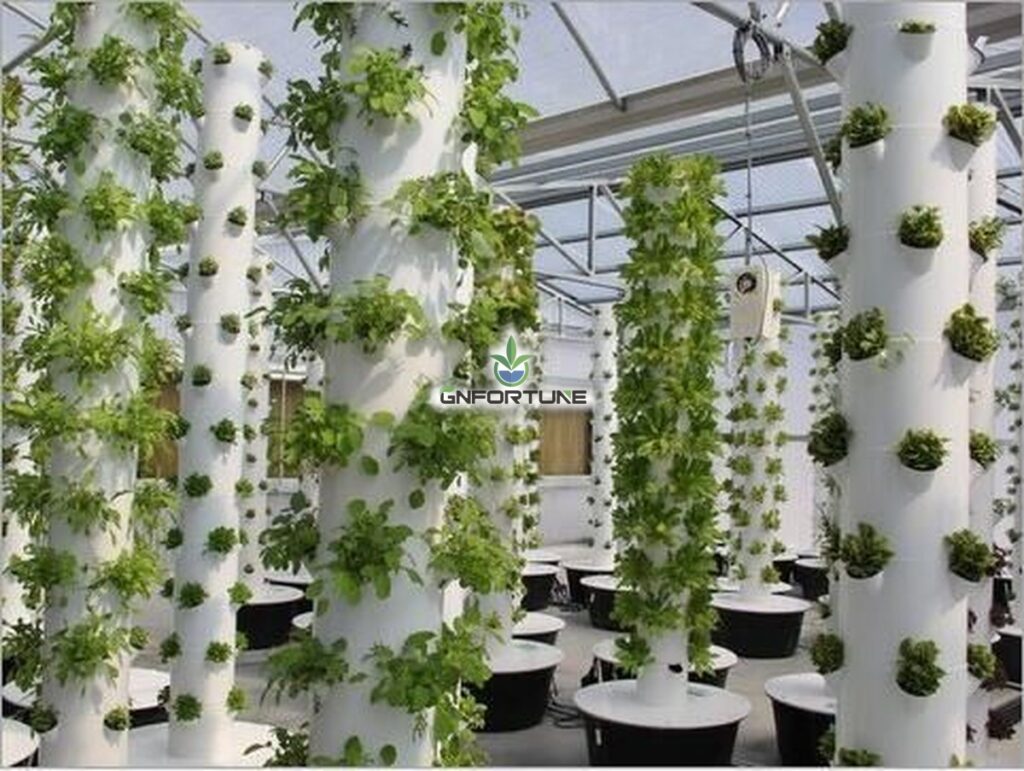
Vertical hydroponic towers in a bright indoor growing room under sealed climate control
A low latent ratio means the cooling plant holds temperature while humidity drifts upward. That combination calls for a deeper coil with lower leaving air temperature, or a desiccant stage trimming latent. Circulation design, set out in the guide to vents and HAF fans, applies here as movement rather than exchange.
Dehumidification for Plant Rooms: DX, Desiccant and Hybrid
Three equipment families cover the duty. Selection turns on target dew point and whether reheat energy is available cheaply.
Option
How it works
Strength
Limit
DX coil, standalone or in the air handler
Cools air below dew point, water drains off the coil
Low capital, handles sensible too
Capacity falls as RH drops; needs reheat to hold band
Desiccant wheel
Rotor adsorbs moisture, regenerated with heat
Holds low dew point regardless of room RH
Regeneration energy, more maintenance
Hybrid: DX plus desiccant trim
DX takes sensible, wheel trims latent
Stable RH with better energy than wheel alone
Highest capital and control complexity
A DX-only installation should be specified with its leaving air condition written down, not just a kW figure, since removal falls sharply below about 55% RH. Where the plant also carries a cooling load, compare this against the evaporative approaches covered in the guide to cooling options in hot climates, although evaporative methods add moisture and generally fight a sealed room’s objective.
Drain Routing and Condensate Recovery
The 600 kg example is 600 liters a day leaving through a pipe that many designs treat as an afterthought. Specify it early:
Slope and size: around 1 to 2% fall, sized for the peak rate rather than the daily average.
Trap and air gap: a trap on every coil drain and an air gap to the floor drain, so negative pressure cannot pull air back.
Material: corrosion-resistant pipe; condensate is acidic and carries metal traces from fins.
Treatment: filtration and disinfection before any reuse in irrigation; chlorination or UV depending on the local rule.
Recovery is attractive where water is expensive, and the recovery rates, storage sizing and treatment steps are set out in the guide to condensate and chilled water recovery. Submetering the plant separately also makes the operating cost visible, which is the argument made in the article on electricity submetering by zone.
Control Bands: RH and VPD Together
Holding a single RH number produces periods where the vapor pressure deficit drifts outside the crop window, because VPD depends on leaf temperature as well as room humidity. Run both.
Stage
RH band
Target VPD
Comment
Propagation
70 to 85%
0.4 to 0.8 kPa
Low transpiration, avoid desiccation
Vegetative lettuce
60 to 75%
0.8 to 1.1 kPa
Main production band
Late head formation
55 to 70%
1.0 to 1.2 kPa
Drier air limits tipburn risk
Herbs
55 to 70%
0.9 to 1.3 kPa
Tighter control protects oil content
Deadband and sensor position decide whether that control is achievable. A deadband wider than about 5 percentage points gives a sawtooth RH trace and condensation on cold surfaces; put return sensors where the crop actually sits rather than next to the coil, and average across the room. The crop background for these bands is covered in the guide to humidity control and VPD.
Common Install Mistakes Found on Site
The same defects appear across otherwise well-engineered rooms:
Coil mounted over the crop: condensate drips onto plants, and any pan overflow lands directly on the trays below.
Sensor beside the supply outlet: the controller reads conditioned air, short-cycles, and the canopy never dries.
No reheat source: the dehumidifier removes water but drags temperature below band, so the operator disables it at night.
Floor drains omitted: a coil pan needs somewhere to discharge during defrost, and buckets are not a program.
Thermal bridges ignored: uninsulated duct flanges and door frames sweat where the coldest surface meets room air.
Frequently Asked Questions
How much water does a lettuce room produce? A: Roughly 1.2 to 2.5 kg per square meter per day at full canopy. Multiply by growing area to get the daily condensation rate.
How do I convert that load to kilowatts? A: Multiply kilograms per day by about 0.68 kWh per kilogram, then divide by operating hours to get average kilowatts of latent duty.
When is a desiccant wheel justified? A: Where the target dew point stays low at partial load, or where reheat energy to run a DX coil alone becomes expensive.
Can condensate go back into the nutrient system? A: Only after filtration and disinfection, and after checking local rules. Route it with an air gap to the drain first.
What VPD band suits sealed room lettuce? A: Around 0.8 to 1.2 kPa through the main growth period, held with both RH limits and leaf temperature rather than RH alone.
Start dehumidification for plant rooms from water rather than equipment catalogs: transpiration at full canopy, latent heat at 0.68 kWh per kilogram, then margin for falling capacity as the room dries. The same figures anchor the plant factory vs greenhouse comparison.
Why commercial projects choose a decoupled aquaponics system: separate RAS and plant loops, independent nutrient control, cost and risk compared with single-loop aquaponics.
Add bays while crops keep moving: tie-in points, utility stub-ups, phasing by bay, quarantine between zones and the commissioning handover that avoids drift.