
Grafted Seedlings for Hydroponics: Rootstocks, Healing and When It Pays
Grafting Buys You a Root System, Not Vigour Magic A grafted plant is two plants joined: a scion chosen for fruit quality and a rootstock chosen for its roots. The promise is real — better tolerance to soil-borne disease, improved performance in cold or salty conditions, stronger uptake under stress — but it arrives with […]
Diagnosing Nutrient Deficiencies in Hydroponics: Symptoms, Causes and Fixes
Most “Deficiencies” Are Not Deficiencies A grower sees yellowing between the veins of a young leaf, concludes the crop needs magnesium, adds magnesium, and the symptom continues for another week. That sequence is common, and it is expensive in both inputs and time. In a hydroponic system the plant is standing in a solution you […]
Pollination in Commercial Hydroponic Greenhouses: Bumblebees, Vibration and Fruit Set
Pollination Is a Yield Line Item, Not a Detail In leafy crops, nothing has to be pollinated. In fruiting crops — tomato, pepper, cucumber, strawberry, blueberry — every fruit you sell began as a flower that either set or did not. A pollinated tomato flower becomes a marketable truss. An unpollinated one becomes a small, […]
Hydroponic Variety Selection and Seed Sourcing: How Commercial Farms Choose Genetics
Genetics Set the Ceiling on Everything Else You can optimise lighting, nutrition and labour for months and still be beaten by a variety that was never suited to your system. Hydroponic seed varieties differ in ways that matter commercially — days to maturity, uniformity, disease resistance, shelf life, tolerance of low light, and how they […]
Crop Scheduling for Continuous Production: Building a Planting Calendar That Holds
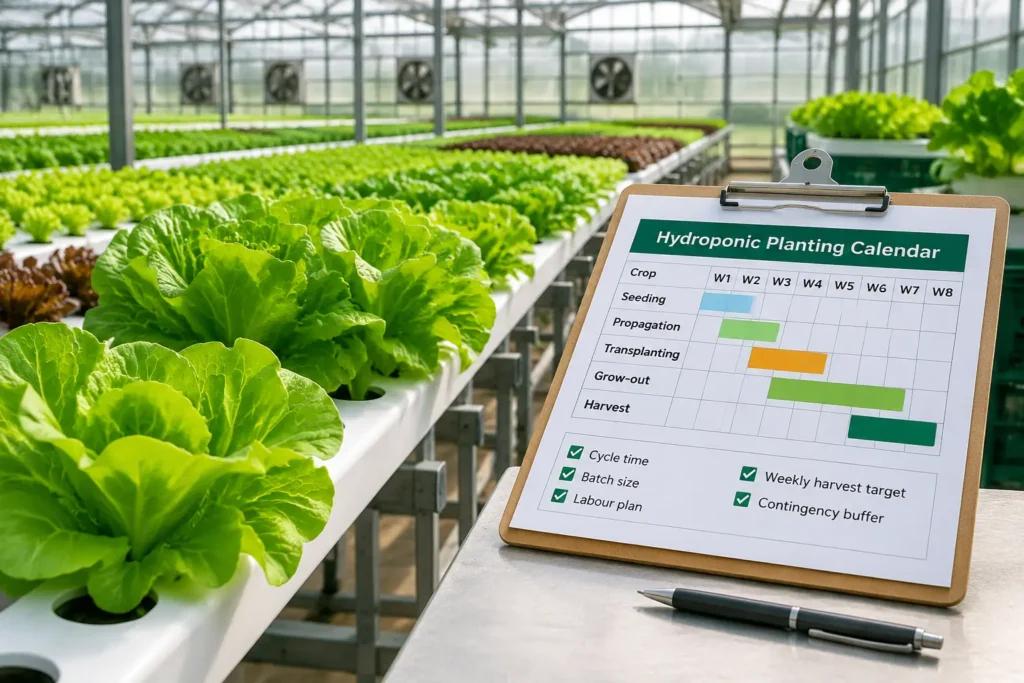
Why Continuous Production Is a Scheduling Problem, Not a Growing Problem A farm can grow excellent lettuce and still miss a standing order every week, because supply comes in waves. Three bays planted on the same day mature on the same day, the packing line is overwhelmed on Tuesday and idle on Friday, and the […]
Commercial Hydroponic Propagation & Transplanting: Plugs, Timing and Crop Establishment
Propagation Is Where Your Production Schedule Is Won or Lost Most commercial hydroponic projects are planned around channels, tanks and climate control. In practice, the crop calendar is governed by something smaller: how many saleable plugs you can raise, on time, in transplant-ready condition. A propagation room that runs two days late pushes every harvest […]
Hydroponic Peppers in Dutch Buckets: A Grower’s Guide
Hydroponic peppers are the second classic Dutch bucket crop after tomatoes: heavy, long-cycle, and picked for months. A well-managed block returns roughly 12–20 kg of marketable fruit per m² over a 30-week cycle, and prices hold steadier than leafy greens because peppers ship well. This guide covers spacing and drainage, EC and pH by stage, […]
Fungal Diseases in Hydroponics: Mildew and Botrytis
Powdery mildew in hydroponics, downy mildew in the greenhouse, and botrytis in greenhouses are not three unrelated problems with three separate cures. They are one problem — a climate profile that lets a spore land, germinate, and colonize faster than the crop grows away from it — expressed through three different fungi. All three respond […]
Hydroponic Spinach Production: A 35-Day Playbook
By the G&N commercial consulting team · First published: September 2026 · Reviewed for field accuracy Hydroponic spinach is the second-fastest leafy green a commercial grower can cycle, after radish and ahead of most lettuces. A well-run NFT or DWC line goes from a sown plug to a cut-and-pack leaf in 30–40 days, and a […]
Hydroponic Blueberries: Why Most Setups Fail
Blueberries are sold to hydroponic buyers as “the perfect niche crop” — high price per kg, gourmet channel demand, a plant that lives for decades. The actual failure rate on new hydroponic blueberry projects is high enough that any farmer considering the crop should plan around the pH trap before plan around the revenue projections. […]