

A salad processor buys greens the way a manufacturer buys components: to a specification, on a weekly schedule, in volumes that keep their wash line busy. Supplying that market profitably is not about growing “salad leaves” in general. It is about growing a deliberately planned commercial leafy greens program — the right varieties, at the right harvest stage, cut to the right size, and delivered on a day the processor has promised retail customers. This guide covers what processors actually buy, how to plan a mix by harvest window and shelf life, how density and harvest stage change the cut, food-safety expectations, and the contract volume math behind a processor account.
What Salad Processors Actually Buy
Processors buy two very different product classes, and mixing them up is a common first mistake:
- Whole-head product. Iceberg, romaine, and butterhead delivered as heads with defined weight and size bands, for processing into wedges, chopped salads, and food service packs. The buyer cares about head uniformity, core length, and internal quality.
- Cut-leaf product. Baby leaf and mature leaf for salads and mixes, specified by leaf size, cut size, color, and absence of blemish. The buyer cares about how the leaf behaves on a wash line and its shelf life in a bag.
Every account also comes with written or implied specifications: variety or leaf-size band, harvest stage, packaging unit, field-to-factory temperature window, defect tolerance, and residue testing requirements. Some processors publish them; others hold them inside the contract. In either case the practical rule is the same — grow to the spec, not to the season. Wholesale premium does not come from growing “better” greens; it comes from meeting the specification every single delivery.
Planning a Mix by Harvest Window and Shelf Life
A processor wants a stable blend across the year, which means your mix must contain crops whose harvest windows line up so that every week produces every component of the blend. If the blend needs spinach, arugula, and red leaf, and your spinach comes ready two weeks after your arugula, you cannot supply the blend — you can only supply the components.
| Leaf type | Indicative seed-to-harvest | Typical shelf life after cut | Role in the blend |
|---|---|---|---|
| Baby leaf (spinach, arugula, chard) | 4–7 weeks | 7–14 days when handled cold | The base of most processed mixes |
| Head types (romaine, butterhead) | 8–12 weeks | 10–21 days | Whole-head and chopped lines |
| Cut-and-come greens (some mustards, kales) | 5–9 weeks | 7–10 days | Color and bite components |
The table values are indicative; precise windows shift with variety, season, and light, and figures vary by region and season. The planning point is the structure: map every blend component to a harvest window, then stagger plantings so each window delivers weekly. A steady, machine-scheduled NFT or gutter system is the natural production unit here — the basics are covered in the NFT hydroponics explainer, with crop-specific practice in the lettuce NFT growing guide.
Growing for the Cut: Density and Harvest Stage
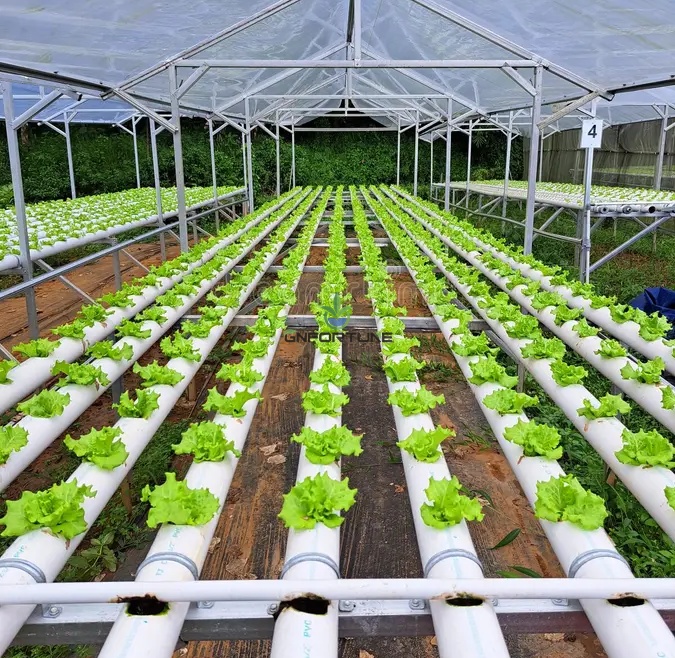
Baby lettuce growing in hydroponic pipes for salad processingCut size is decided at harvest, but it is enabled at planting. Two decisions dominate:
- Density. Baby leaf is sown densely so leaves stay small and tender; head crops are spaced for full development. Planting density is what makes a leaf “baby” — the same variety planted wider grows to a different product entirely. Higher-density plantings also harvest earlier, which matters when a processor account wants volume from a fixed area.
- Harvest stage. Processors set a leaf-length or head-weight band. Cut too early and the yield per square meter drops; cut too late and leaves exceed the spec, texture coarsens, and shelf life shortens. A clean, sharp cut and immediate cooling protect the cut edge — the edge is where the bag life is won or lost.
Leafy greens for processing are grown on flat, uniform surfaces that harvesters and crews can work quickly, which is why channel-based systems dominate the segment. The channel spacing and flow that suit this crop are laid out on the NFT channel product page.
Food Safety and Wash-Line Expectations
Processors and their retail customers audit farms, not just factories. Expect questions about water source and testing, fertilizer and pesticide records, worker hygiene, harvest tool sanitation, and temperature control from cut to delivery. Many retail programs require third-party certification such as GlobalG.A.P. or an equivalent food-safety scheme, and processors run their own incoming checks.
Three practical points from projects we have advised:
- Assume every leaf is eaten raw. Water quality, harvest hygiene, and storage temperature are food-safety decisions, not quality decisions.
- Match equipment materials to the crop. Everything the leaf touches — channel, harvest bin, cutting surface, packaging — should be cleanable and food-safe. The difference between food-grade and industrial-grade plastics is explained in the article on food-safe materials in hydroponics.
- Keep the cold chain short. Minutes between cut and cooling become days of shelf life at retail. Schedule harvest to the processor’s intake window, not to your convenience.
The wash line itself is the processor’s asset; your job ends at a clean, cool, correctly packaged delivery. But the earlier you know their line speed and cut specification, the earlier you can plant for it — which is why the commercial discussion happens before the agronomic one.
Contract Volume Math for a Processor Account
A processor account is a weekly volume commitment, and the growing area follows from arithmetic. The formula in plain terms:
- Weekly harvest area = weekly volume ÷ yield per square meter at the cut stage.
- Growing area = weekly harvest area × weeks of crop cycle, plus a buffer for germination failures, weather, and the week a buyer doubles an order.
Worked example with indicative numbers, re-run for your own yields and prices: a baby leaf account at 500 kg per week, cleared at about 2 kg/m² per cut, needs about 250 m² harvested weekly. A four-week crop cycle means roughly 1,000 m² of growing bed, plus 10–15% buffer for staging and failures — call it 1,100–1,200 m² of production area for one steady account. Because figures vary by region and season, the yield line of this calculation should come from your own harvest records, not from a table.
| Input | Indicative value | Where it comes from |
|---|---|---|
| Contracted weekly volume | 500 kg baby leaf | Processor supply agreement |
| Yield per m² per cut | 1.5–3 kg at spec stage | Your harvest records by crop and season |
| Crop cycle length | 4–6 weeks seed to cut | Your variety and light program |
| Production area needed | ~1,100–1,200 m² for the example | Math above plus buffer |
Two numbers in that table decide whether the account is profitable: yield at spec stage, and the harvest labor cost per kilogram. If the account is priced around a 2 kg/m² yield and your farm delivers 1.5, the weekly shortfall is invisible on one harvest and very visible at year end. Track both numbers from week one, because they are the difference between a processor account and a processor charity.
Advisor’s reminder on processor pricing: Never price a processor account on your best month. Price it on your average yield across all four seasons, because the processor will order every week of all four. A contract priced on summer numbers is a winter loss waiting to be discovered.
FAQ
What do salad processors look for in a leafy greens supplier?
A: Reliability first — the right leaf at the right cut size and stage, delivered weekly to the specification. Price matters, but a missed specification costs them a whole production run.
What is the difference between baby leaf and whole-head supply?
A: Baby leaf is grown densely and cut small, usually for processed mixes; whole-head product is grown to weight and size bands for chopped and food service lines. The two need different densities, harvest stages, and packing.
How much area do I need to supply a salad processor?
A: Divide contracted weekly volume by your yield per square meter per cut, then multiply by the crop cycle in weeks and add a 10–15% buffer. A 500 kg-per-week baby leaf account typically needs roughly 1,000–1,200 m² of production bed.
Can I grow the whole blend mix year-round?
A: Indoors, yes, with staggered plantings and variety choices matched to light levels. The limiting factor is usually harvest windows lining up, not the equipment.
Do processors require food-safety certification?
A: Most retail customers require third-party schemes such as GlobalG.A.P. or an equivalent, and processors run their own incoming audits. Assume certification and water testing are part of the account.
Building a Processor Supply Program
Processor accounts are won on the specification sheet and kept on the delivery dock. If you are planning a leafy greens program aimed at processor buyers, talk to us about volume pricing and system sizing — building a processor supply program? talk to us about volume pricing. Related reading: