
Arugula and Specialty Greens in NFT: Cycle Guide
Arugula hydroponics runs on a shorter cycle and a tighter spacing grid than head lettuce, and that difference drives nearly every equipment decision on the line. Specialty salad greens — wild and cultivated arugula, mustard, mizuna, tatsoi, cress and the frilly non-head lettuces — are grown as whole plants or as cut leaf, come off in 18 to 40 days, and are sold into blends where leaf length, colour and bite sit in the buyer specification. This article covers the crop group, spacing and channel choice against lettuce, the EC and nitrogen range that sets pungency, the cut window, and the pest load that decides whether a blend programme holds through summer.
What Sits in the Specialty Salad Greens Group
The group splits along botanical lines, and the split matters because the halves behave differently in the same channel. The brassica half carries the pungency and the pest profile; the lettuce-type frills behave like small salad lettuce with a shorter cycle.
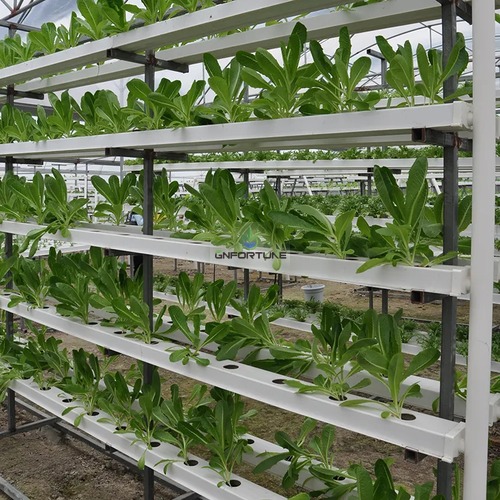
- Brassica greens: wild and cultivated arugula, red and green mustard, mizuna, tatsoi, garden cress. Bite from glucosinolates, fast cycling, attractive to flea beetle, prone to downy mildew.
- Frill and oak leaf types: small lettuce varieties cut young for colour and shape. Milder, standard salad recipe, lettuce pest profile.
- Cut-leaf specialists: cress and several mustards grown as a dense mat and cut once.
Running both halves on one recipe is where programmes drift. The brassica half wants lower EC, cooler air and a shorter cycle. Put arugula on lettuce settings and it turns hot and bolts before reaching spec length.
Channel Width and Spacing vs Lettuce
Lettuce sets the baseline most farms already own: a 100 x 50 mm channel, one row, 200 to 250 mm between plants, channel pitch 300 to 400 mm, about 12 to 16 plants per m² of floor. Specialty greens are harvested younger, so the same channel carries more rows.
For whole-plant arugula, mustard and mizuna the normal arrangement is two staggered rows 40 to 60 mm apart across the channel, with 80 to 120 mm between plants in each row. Above three rows the canopy closes before harvest and air stops moving through the leaf layer, which is where mildew begins. A lettuce house can usually reuse the channel and change only the hole layout, as set out in the commercial lettuce production guide for NFT channels.
Cut-leaf production stops treating the channel as the unit: a wide channel of 150 to 200 mm or a shallow bed, sown broadcast or on a tight grid. That format shares more with direct-sown baby leaf than with transplant production, including the washing line at the end.
| Crop and format | Plants per m² (floor) | Spacing within row | Row / channel arrangement |
|---|---|---|---|
| Head lettuce (reference) | 12 to 16 | 200 to 250 mm | 1 row, 300 to 400 mm pitch |
| Arugula, whole plant | 50 to 90 | 80 to 120 mm | 2 rows, 200 to 250 mm pitch |
| Mizuna, tatsoi, mustard | 30 to 50 | 100 to 150 mm | 2 rows, 250 to 350 mm pitch |
| Cut leaf / baby leaf | 120 to 200 | 25 to 40 mm grid | Wide channel or bed |
| Garden cress | 300 to 600 | Broadcast | Mat or bed, single cut |
Those densities assume harvest at young-leaf stage. Push the cycle two weeks longer and the same spacing becomes overcrowded, so spacing and cycle length have to be decided together.
EC and Nitrogen: Leaf Texture and Pungency
EC is the pungency dial. Lettuce runs 1.2 to 1.8 mS/cm; arugula and the mustard group run 0.8 to 1.4 mS/cm. Feed arugula at lettuce strength and the peppery note rises past what a mild blend specification allows.
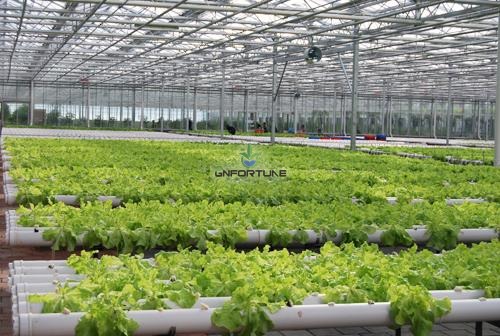
Nitrogen form does the finer work: keep ammonium-nitrogen below about 10 to 15% of total nitrogen. A nitrate-dominant feed gives a firmer, milder leaf that survives packing; more ammonium sharpens the bite, softens tissue and shortens shelf life in the bag.
Temperature interacts with both. Above roughly 24 to 26 °C day, arugula bolts and turns hot regardless of EC, so brassica greens want 15 to 22 °C day and 10 to 14 °C night, root zone at 18 to 22 °C.
| Parameter | Lettuce reference | Specialty salad greens | Effect on the crop |
|---|---|---|---|
| EC | 1.2 to 1.8 mS/cm | 0.8 to 1.4 mS/cm | Higher EC: more pungency |
| pH | 5.5 to 6.0 | 5.5 to 6.2 | Brassicas tolerate a wider band |
| Ammonium share of total N | Up to about 15% | 10% or less | More ammonium: sharper bite |
| Day / night air temperature | 18 to 24 / 12 to 16 °C | 15 to 22 / 10 to 14 °C | Heat drives bolting |
| Cycle, transplant to cut | 30 to 45 days | 18 to 35 days | Sets blocks running at once |
Set the brassica recipe from the buyer’s flavour specification, not from the lettuce recipe already in the controller. The failure mode we keep meeting is a farm running arugula at 1.6 mS/cm and 24 °C because that is what the lettuce house runs, then blaming the variety when the blend comes back too hot and bolts in week three.
Cycle Length and Cut Windows
Two production formats are in commercial use, and they do not share a harvest calendar. Whole-plant production transplants a plug and harvests the entire plant; cut-leaf production sows in place and takes one or two cuts.
- Whole-plant arugula: 18 to 30 days from transplant; 25 to 35 for wild types and most mustards.
- Mizuna and tatsoi: 25 to 40 days, longer in winter light.
- Cut leaf: first cut 21 to 30 days from sowing, optional second cut 12 to 18 days later.
- Cress: 14 to 21 days, single cut, no regrowth.
Harvest on leaf length, not on the calendar: whole-plant arugula at 60 to 100 mm, mizuna and mustard at 80 to 120 mm, with crew training built around a length gauge, since a week of hot weather moves a block past spec several days early. The guide to bolting and other physiological disorders covers what heat does at each stage.
A second cut usually disappoints: less yield, more senescing leaf and debris, more washing, which is why many salad processors specify a single cut.
Flea Beetle and Downy Mildew Pressure
Brassicas bring their own pests into a lettuce house. Flea beetle arrives through open vents and doors and chews shot-holes in young leaves, which makes the leaf unsaleable in a bagged blend.
- Exclusion: insect netting on vents and doorways, commonly 40 to 50 mesh or roughly 0.3 to 0.4 mm aperture.
- Monitoring: sticky traps at row ends and outside walls, read weekly.
- Housekeeping: no volunteer brassicas or weeds inside or outside the house.
Downy mildew on arugula is the disease that costs the most in this group, and it needs leaf wetness, still air and high humidity overnight. Hold relative humidity below about 85%, keep air moving across the canopy, irrigate early so foliage dries before dark, and remove an infected block whole. The fungal disease guide for hydroponic houses covers sanitation between blocks, which matters more here than in lettuce because a 21 to 30 day cycle means many turnovers a year.
Mixing Lots for Salad Blends
A blend is a scheduling problem before it is a growing problem. A typical specification runs three to six components at fixed weight ratios, and each component has its own cycle length, so each one sits in the house as its own block.
Ratio drift is the commercial risk: if one component runs short, the blend ratios move and the buyer rejects the lot. Hold one buffer block per component and plan the calendar around the pack-out date. Blend specifications are covered in the leafy greens guide for salad processors.
Yield and price for specialty greens vary by region and season, so build the case on your own trial data. The pack-out requirement does not vary: cut leaf needs a wash, rinse and dry line, whole-plant production needs a root trim and bunching bench.
Frequently Asked Questions
What EC should arugula run at in NFT?
A: 0.8 to 1.4 mS/cm, below the lettuce range of 1.2 to 1.8. Feeding arugula at lettuce strength pushes pungency past most blend specifications.
How many rows can one NFT channel carry?
A: Two rows for whole-plant arugula and mustard, up to three for the smallest types. Above that the canopy closes early and mildew pressure rises.
How long is the arugula cycle?
A: 18 to 30 days from transplant for cultivated types, 25 to 35 for wild arugula and mustard. Harvest on leaf length, not a day count.
Can arugula be cut and regrown?
A: A second cut follows 12 to 18 days later, but it yields less and carries more debris, so many processors specify a single cut.
Why does arugula bolt in summer?
A: Day temperatures above about 24 to 26 °C trigger bolting and a hotter flavour. Hold 15 to 22 °C day with 10 to 14 °C night.
Request an NFT Layout Quoted for Specialty Greens
A specialty salad greens programme comes down to four numbers: blend components, plants per m² for each, cycle length at your temperature, and weekly pack-out volume. Arugula hydroponics at 50 to 90 plants per m² needs a different hole layout, a lower EC band and more airflow than the lettuce line most farms start from; the channel itself is usually reusable with a new hole pattern.
Send the blend specification, weekly volume, channel length and target leaf length, and the engineering team will return a spacing layout, block count and cycle calendar. To request an NFT layout quoted for specialty greens, state whether you plan single or double cuts, since that changes the sowing calendar and the pack-out line.


