

Powdery mildew in hydroponics, downy mildew in the greenhouse, and botrytis in greenhouses are not three unrelated problems with three separate cures. They are one problem — a climate profile that lets a spore land, germinate, and colonize faster than the crop grows away from it — expressed through three different fungi. All three respond to the same sequence: change the climate first, the canopy second, and reach for a spray only after both have been done properly.
Why These Three Diseases Travel Together
The common thread is leaf wetness. Each pathogen needs a film of water or a saturated boundary layer at the leaf surface long enough to germinate a spore, and each spreads fastest when the canopy is dense and the air inside it is still. A greenhouse holding humidity above 85 percent overnight, with under 0.3 m per second of air moving through the canopy, is running a spore incubation chamber.
Where they diverge is in what they want next. Powdery mildew is the odd one out: it does best in moderate humidity with poor airflow and tolerates dry air far better than the other two. Downy mildew and botrytis both want free water, but downy arrives through splash and drip while botrytis enters through wounds and dying tissue. The wider program is set out in the hydroponic IPM checklist.
Powdery Mildew in Hydroponics: White Dust and the Dry-Humidity Paradox
Powdery mildew is the counterintuitive one. The fungus germinates best in moderate humidity, in the 50–70 percent band, and is suppressed by a genuinely wet leaf surface: it is a disease of dense canopies and stagnant air rather than of humidity itself.
Early symptoms are small circular white or pale gray patches on the upper leaf surface, spreading into a powdery coating that wipes off on a finger. New growth distorts, leaf edges cup upward, and chlorophyll loss follows. A susceptible cultivar under a still canopy can go from a few patches to a lost cycle within two weeks.
Downy Mildew in the Greenhouse: The Underside Killer
Downy mildew attacks from below. The first visible symptom is usually an angular yellow patch on the upper leaf surface with edges constrained by the leaf veins, and the evidence sits on the underside beneath it: gray, purple, or olive fuzzy growth during humid morning hours. By the time the yellowing is obvious from a standing position, the underside is already sporulating.
The one-line field rule that separates it from powdery mildew: powdery sits on top and wipes off, downy hides underneath and stays put. Downy mildew also needs four or more hours of leaf wetness and relative humidity above 85 percent, and it is most destructive between 15 and 22 °C. Air movement that keeps the boundary layer below saturation is the most effective control.
Botrytis in Greenhouses: The Gray Mold That Eats Your Harvest
Botrytis is a wound and senescence pathogen, and that is the whole strategy behind controlling it. Spores land on damaged tissue, dying leaves, spent flowers, or pruning cuts, and colonize dead matter first. From there the fungus spreads into healthy tissue and produces the soft brown rot and gray spore mass that gives the disease its name. In pepper, tomato, and strawberry, the classic entry point is the spent flower still attached to the fruit.
The second wave happens after harvest. Botrytis keeps developing at refrigeration temperatures, so a load that looks clean at packing can show gray mold on arrival. That is why rapid pre-cooling and culling damaged fruit at packing belong to disease control, not only quality control.
Climate Triggers: A Comparison Table
The three diseases overlap enough that one culture change shifts the balance, but the thresholds differ enough that scouting priorities change with the season.
| Parameter | Powdery mildew | Downy mildew | Botrytis |
|---|---|---|---|
| Optimal temperature | 20–27 °C | 15–22 °C | 15–23 °C |
| Humidity driver | Moderate RH, poor airflow | RH above 85 percent, 4 h leaf wetness | RH above 90 percent plus wound or dying tissue |
| Where it starts | Upper leaf, dense canopy | Leaf underside, oldest leaves | Pruning cuts, spent flowers |
| Field signature | White powder, no vein limitation | Yellow patch limited by veins, fuzz beneath | Soft brown rot with gray spore mass |
Read the table as a scouting instruction: a cool, humid week pushes downy mildew and botrytis to the front of the list, a warm week with a closed canopy moves powdery mildew up. The climate numbers are set by the humidity and VPD program in the greenhouse humidity and VPD control guide, which is where most of the leverage on all three diseases sits.
The Treatment Ladder: Cultural, Biological, Chemical
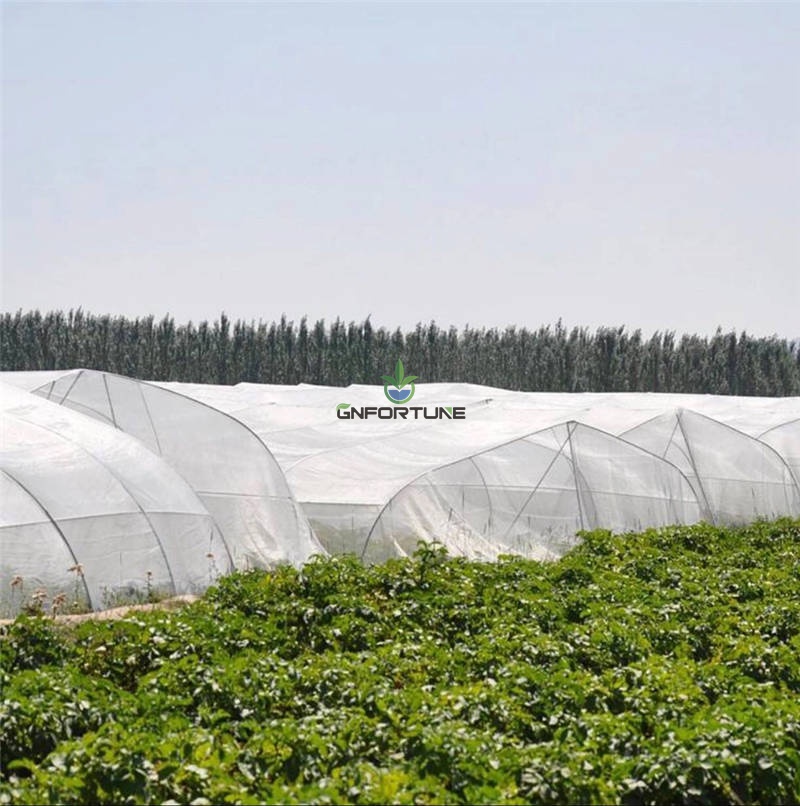
Field insect-screen tunnels used as the physical exclusion step in the cultural-control tier of greenhouse disease managementTreat the ladder as a sequence, not a menu. Chemical control used as step one produces resistance and residue problems within a few seasons, while the same product at step three — after climate and canopy are corrected — works reliably with few applications.
| Step | Action | Frequency | Notes |
|---|---|---|---|
| 0 — Climate | VPD 0.8–1.2 kPa, night RH below 85 percent, leaf wetness under 4 hours | Continuous | Cheapest and highest leverage |
| 1 — Canopy | Leaf removal, wider spacing, air movement 0.3–0.7 m/s at canopy | Weekly | Strip spent flowers before botrytis reaches the fruit |
| 2 — Biological | Bacillus subtilis, Trichoderma, Gliocladium | Preventive, 7-day interval | Needs full coverage and moderate humidity |
| 3 — Chemical | Single-site actives rotated by mode-of-action group | Only on confirmed pressure | Check MRL and pre-harvest interval per market |
The mistake we fix on site: the spray program is usually fine — the sequence above it is not. Growers strip lower leaves on Friday, leave the debris in the gutter, and spray on Monday against a spore load the dead leaves just multiplied. Removal followed immediately by a biological application and physical removal of the debris is what converts step one into a result.
Mistakes we fix on site
Four patterns show up repeatedly. Sensors mounted against a wall or at gutter height, reading a microclimate no plant occupies, so the controller believes the house is drier than the canopy is. Overhead irrigation or misting scheduled in late afternoon, extending leaf wetness into the night. And pre-harvest leaf stripping with no follow-up application, handing botrytis fresh wounds at the most humid moment of the day. Each is corrected by a written weekly routine. Prevented losses vary widely with crop and climate, and figures vary by region and season.
Resistance and Residue: Why Rotation Is Not Optional
Two forces make rotation mandatory. The first is resistance: powdery mildew and botrytis both produce enormous numbers of spores with short generation times, the classic setup for selecting a resistant population against any single-site active used repeatedly. Rotating across mode-of-action groups, not just product names, is what keeps a product usable. The second is residue: export markets enforce maximum residue limits, and a material that controls disease but leaves detectable residue above the limit has destroyed the crop’s value.
The working rule is a seven-day minimum interval, alternating between mode-of-action groups, with maximum residue limits and pre-harvest intervals checked for every destination market before a product enters the program. Keep the log with product, group, rate, date, and target disease; it is what a retailer or importer asks for when a residue question appears.
Scouting: How to Find It Five Days Early
A fixed weekly route through the house, always in the same order, is more reliable than walking wherever the problem was last time. Walk the perimeter first, since temperatures swing hardest there. Then enter the canopy at chest height and check the middle of the plant. Turn leaves over — the underside is where both mildew early stages show. Check spent flowers on fruiting crops every visit.
Record findings on a one-page form: date, zone, crop stage, disease seen, incidence, and action taken. Five-day detection is realistic with a disciplined route, and it is usually the difference between a spot treatment and losing a section of the house. The sanitation routine is covered in the greenhouse cleaning and sanitizing guide, and a printable record form sits in our frequently asked questions and downloads section.
FAQ
Q: Can I control powdery mildew just by lowering humidity?
A: Only partly, and it can backfire. Powdery mildew is suppressed by a wet leaf surface and thrives in moderate humidity with stagnant air, so canopy thinning and air movement are the reliable fixes.
Q: How do I tell powdery mildew from downy mildew quickly?
A: Look at where the growth sits. Powdery mildew is white powder on the upper surface that wipes off; downy mildew is a vein-limited yellow patch on top with fuzz beneath.
Q: Are biological products strong enough for a real outbreak?
A: They are preventive tools, not rescue treatments. On a seven-day schedule before symptoms appear, with good coverage, they hold pressure well. Once a canopy is heavily colonized they will not turn it around.
Q: How often should fungicides be rotated?
A: A seven-day minimum interval, alternating between mode-of-action groups, with maximum residue limits verified for each destination market before the first application.
Request the Disease Scouting Sheet and Rotation Table
Powdery mildew in hydroponics, downy mildew, and botrytis are climate problems before they are spray problems, and equipment choice follows the same logic: ventilation capacity, air movement at canopy level, humidity sensing, and dehumidification set the ceiling on what any ladder can achieve. Send your crop list, structure dimensions, and your last two cycles’ disease history to /quote/, and we will return a scouting sheet and rotation table matched to your climate zone.
- Greenhouse humidity and VPD control — the climate layer underneath every fungal program.
- Greenhouse cleaning and sanitizing — breaking the inoculum cycle between crops.
- Greenhouse covering materials — how glazing choice changes condensation and canopy humidity.