

Greenhouse covering materials are the least reversible purchase in a controlled-environment project. A one-hectare roof is bought once, yet it fixes light transmission for twenty-five years, sets the U-value behind every winter heating invoice, and determines the load the frame must carry. This guide compares glass, twin-wall polycarbonate, and film on the four variables that decide a covering: light, insulation, lifespan, and installed cost per square meter. Figures vary by region and season.
Why Greenhouse Covering Materials Decide Everything Downstream
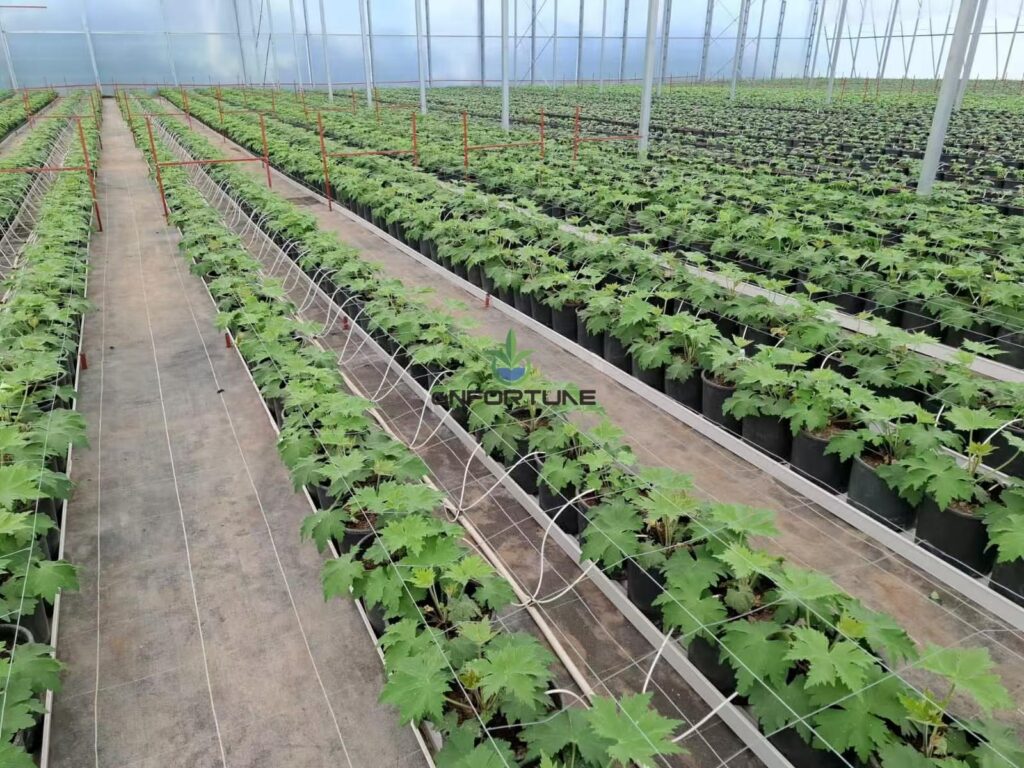
Interior of a film-covered commercial greenhouse in Kenya showing diffuse light under the roof covering and healthy crop rowsThree decisions are locked the day the covering is ordered. Light: transmission and haze set how much solar energy reaches the canopy, and whether supplemental lighting is an option or a permanent operating cost. Insulation: the U-value sets the winter heating load, which decides whether the site needs a boiler, a heat pump, or nothing. Load: the weight of the cover plus its wind and snow catch dictates column spacing, truss depth, and foundation size. The cover is roughly 10–20% of installed capital and 30–50% of the annual energy bill.
Light Transmission: Glass 90%, Twin-Wall PC 79%, Film 85–90%
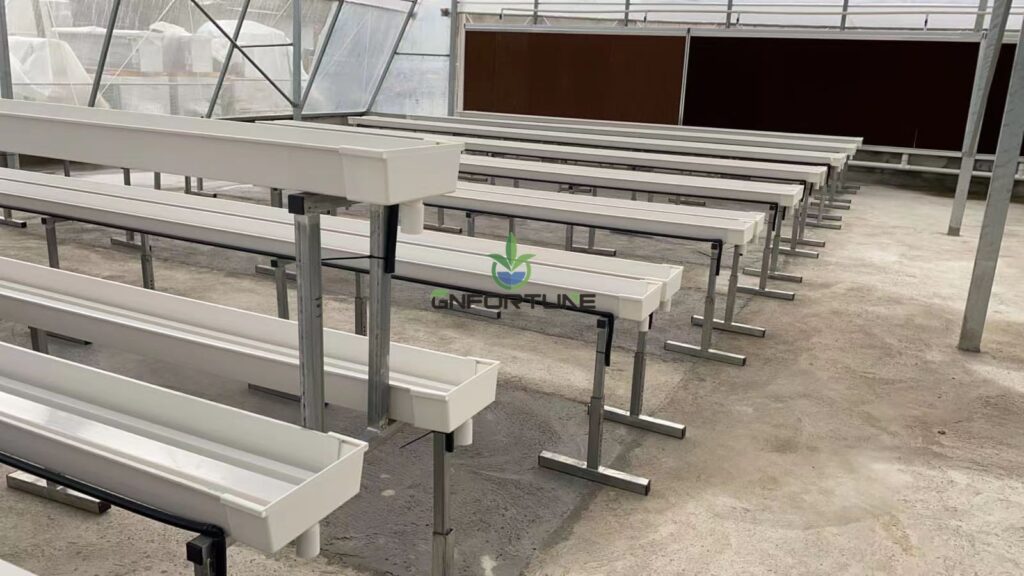
Glass greenhouse interior in the Philippines with empty NFT channel racks and an evaporative cooling pad wall at the gable endTransmission is quoted as-new, and it degrades: clean glass loses 1–2 percentage points over ten years to dust and frame shading, while single-layer film can lose 2–4 points in a season. Treat every published figure as a ceiling.
| Covering | Transmission (new) | Haze / diffusion | U-value (W/m²K) | Service life |
|---|---|---|---|---|
| 4 mm tempered clear glass | 88–91% | Low (0–10%) | 5.8 | 25 years and up |
| 4 mm patterned diffuse glass | 85–89% | High (40–70%) | 5.8 | 25 years and up |
| 8 mm twin-wall polycarbonate | 76–82% | Medium (20–40%) | 3.2–3.5 | 10–15 years |
| 16 mm triple-wall polycarbonate | 68–76% | Medium (25–45%) | 2.3–2.7 | 12–18 years |
| Single-layer PE film | 85–90% | Low (10–25%) | 5.5–6.5 | 1–2 years |
| Double-layer PO film, anti-drip | 85–90% | Medium-high (30–50%) | 2.8–3.5 | 4–6 years |
Haze matters in hot climates. Under direct summer sun the upper leaves take more light than they can use while the lower canopy sits shaded, so haze above 40% spreads the same flux over more leaf area — often worth more than the last three points of transmission. The DLI arithmetic sits in the supplemental lighting design guide.
Insulation: U-Values and What They Cost in kWh
U-value is conductive loss per square meter per degree of difference, so running it against roof area turns it into a number finance can act on. On a 10,000 m² roof at 18°C inside against 0°C outside — a 15 K difference — cover-only loss runs about 900 kW on single-layer film at 6.0 W/m²K, 495 kW on double inflated film or 8 mm twin-wall polycarbonate at 3.3, and 375 kW on 16 mm triple-wall polycarbonate at 2.5. That figure sizes the boiler or heat pump.
Mild-winter markets need vent capacity far more than insulation; continental and northern European sites usually find insulation worth more than three points of transmission.
Lifespan and Depreciation: 4 Years vs 10 vs 25
Replacement is not only material — it is labor, clips, tensioning, waste disposal, and a week of degraded climate control mid-cycle. Compare covers on installed cost divided by service life, then add re-skin labor to the film side of the ledger.
- Single-layer film, 1–2 years. Cheapest per square meter; justified in tropical low-wind sites.
- Double-layer inflated PE, 3–5 years. The temperate workhorse; hail pushes it to the low end.
- PO film, 4–6 years. Anti-drip and anti-fog surfaces; repaid by one avoided re-skin.
- Twin-wall polycarbonate, 10–15 years. Panels yellow and flutes collect dust, so year-twelve transmission can near 70%.
- Tempered glass, 25 years and up. Lowest lifetime cost where heating is modest and hail is rare.
Wind, Snow, and Hail: Structural Load by Material
The cover is the largest sail on the structure, so the material cascades into steel tonnage and foundations. Cover self-weight runs from 0.1–0.3 kg/m² for single film to about 10 kg/m² for 4 mm glass, and all-in roof dead load rises from roughly 8–15 kg/m² with frame to 30–45 kg/m². In a typhoon belt small stiff panels beat large ones; in a snow belt a shallow-pitch film roof ponds rather than sheds; in a hail belt the cheapest film is a consumable.
The question that sorts covering suppliers in five minutes: “What is the UV layer on this panel, how many kLy is the film rated for, and what does the warranty exclude?” A supplier who answers with a thickness and a price has not read the specification.
Condensation and Drip Control
A cover that falls below the dew point of the air touching it will condense, and the drip lands on the canopy. Leaf wetness duration is the biggest driver of grey mould and downy mildew pressure, so surface treatment is not cosmetic — the greenhouse humidity and VPD control guide covers that link.
Anti-drip (hydrophilic) surfaces let condensate sheet into the gutter instead of falling on the crop, and this is the treatment that matters for disease. Anti-fog surfaces reduce the droplet layer that scatters light on a condensing morning. Polycarbonate flutes collect condensate inside the panel, so specify a condensation-control interior face and detail the base closure.
Cost per m² Installed, All-In
Comparisons fail when they compare only material price. What a buyer signs off is cover, mullions, clips, seals, frame, foundation share, and labor. The bands below are planning ranges, not quotations; figures vary by region and season.
| Solution | Cover + fixings (USD/m²) | Frame + foundation (USD/m²) | All-in (USD/m²) | Climate zone fit |
|---|---|---|---|---|
| Single PE film, light frame | 2–5 | 8–14 | 10–18 | Tropical, low wind, seasonal production |
| Double inflated film, medium frame | 5–12 | 15–25 | 20–38 | Temperate, mild winter, cost-sensitive |
| 8 mm twin-wall PC | 18–35 | 25–40 | 45–75 | Cold winter, moderate snow, hail belt |
| 16 mm triple-wall PC | 28–50 | 30–45 | 58–95 | High latitude, high energy price |
| 4 mm tempered clear glass | 40–70 | 45–80 | 85–150 | Low snow, high light demand, premium build |
| Diffuse patterned glass | 50–85 | 45–80 | 95–165 | Hot, high irradiance, quality-premium crops |
The trap is buying the cover and ignoring the energy it produces: a single-layer film house in a cold climate can save 30–40 USD/m² upfront and then carry two to three times the heating load for twenty years. The commercial hydroponic system cost breakdown shows where covering sits in the capital stack.
Procurement Red Flags, MOQ, and Certification
Most covering disputes trace back to a specification that was never written down.
- Polycarbonate quoted as “8 mm twin-wall” with no UV face specification — ask which side carries the co-extruded layer and what the warranty covers in years.
- Film quoted by micron count alone — micron says nothing about UV stabilization; ask for the kLy rating.
- Tempered glass with no traceable standard mark and no drilling drawing agreed before production.
- Frame coating stated without a unit — galvanizing in g/m² and powder coat in film thickness are not interchangeable, and coastal sites need the heavier option plus stainless fasteners.
- Warranty exclusions left unread — hail, cleaning abrasion, sanitizer attack, and installation damage are normally excluded.
MOQ is set by packaging, not project size: film by roll size, polycarbonate by panel length, glass by crate. A container of glass hits its weight limit long before it runs out of volume, as the container loading guide sets out, and on a customised build the certification set should ship with the OEM production package.
FAQ
Q: Is polycarbonate better than glass for a commercial greenhouse?
A: It depends on the winter. Polycarbonate wins on insulation, impact resistance, weight, and installed cost; glass wins on transmission, cleanability, and life.
Q: How long does greenhouse film actually last?
A: One to two years for single-layer PE, three to five for double-layer inflated PE, and four to six for a good PO film.
Q: What U-value should a heated greenhouse cover target?
A: Under 3.5 W/m²K, which means double-layer film or twin-wall polycarbonate. Single-layer film only makes sense where heating is not a real design case.
Q: Does the cover change my HVAC sizing?
A: It sets the envelope load, the largest single input for any greenhouse covering materials choice. Size cooling against the cover’s solar gain and the available vent area; the greenhouse ventilation design guide covers the pairing.
Sources
- European standards for toughened safety glass, glazing U-value, and light transmittance (EN 12150, EN 673, EN 410).
- ASTM standards for heat-treated flat glass and for measuring light transmission of sheet materials.
- Manufacturer datasheets for greenhouse covering materials, covering UV stabilization in kLy and anti-drip surface treatment.
Send Your Climate Data and Roof Span
Covering is a climate decision before it is a price decision. Send your province, winter and summer extremes, snow and wind loads, roof span, and target crop mix to /quote/, and we will return a covering specification for greenhouse covering materials with the twenty-year installed and energy cost side by side.
- Turnkey greenhouse solutions — how covering feeds the full build package.
- Greenhouse humidity and VPD control — the disease consequence of drip.
- Greenhouse cooling fans and pads — sizing the summer load the cover creates.
- Hydroponic equipment lifespan — depreciating covering against the plant.