

An NFT channel looks passive: a plastic trough, a thin film of nutrient solution, plants on top. In practice three numbers decide whether the whole line works or quietly fails — the NFT channel flow rate at each inlet, the slope percentage along the run, and the total channel length. Size any one of them wrong and the crop shows it within weeks: stagnation, root matting, tip burn, or overflow at the far end. This guide gives the working ranges for all three and a five-minute field audit.
The Three Variables That Decide NFT Success
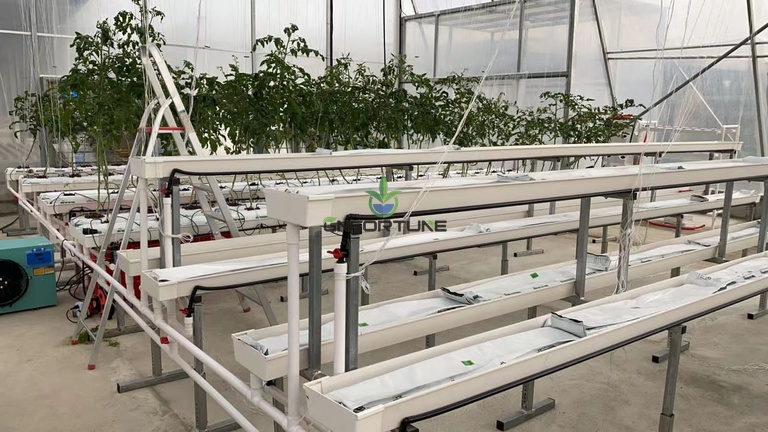
Greenhouse NFT double-row channels running lengthwise, illustrating continuous slope for gravity flowNutrient film technique works on a narrow target: a film of solution roughly 2–3 mm deep moving continuously along the channel base, with the root mat partly in the film and partly in the air above it. Flow sets the film depth, slope keeps the film moving, and length determines how much oxygen and nutrients are left when the water reaches the bottom of the run. The three are not independent — a slightly higher flow can partly compensate a flatter slope — but push two at once and the system leaves its safe zone.
All three are fixed at installation: flow can be trimmed with valves, but slope and run length are decided the day the channels are mounted and are expensive to correct afterward. A primer on how NFT hydroponics works covers the film and root-zone concept if the technique is new to your team.
Flow Rate per Channel: 0.5–2 L/min Is the Working Range
Flow is specified per channel and measured at the channel inlet — not at the pump. After filters, manifolds, and meters of pipe, the flow arriving at the last channel in a bay is always lower than the flow arriving at the first. The working ranges by crop and stage:
| Crop / stage | Flow per channel | Notes |
|---|---|---|
| Leafy greens, first 2 weeks after transplant | 0.5–1.0 L/min | A light film is enough; excess flow displaces young roots |
| Head lettuce, mature herbs (basil, cilantro) | 1.0–1.5 L/min | The default range for most commercial lettuce lines |
| Bok choy, kale, heavier feeders at maturity | 1.5–2.0 L/min | Dense root mats raise flow resistance; the film needs more driving force |
| Strawberries in gutters or wide NFT channels | 0.5–1.0 L/min | Lower density per meter; root zone must not sit flooded |
Raise flow slightly in hot weather — higher transpiration thins the film, and the bottom of the channel can run nearly dry on a 35°C afternoon if the flow was tuned in winter. And raise flow as the root mat develops: a mature lettuce mat acts like a dam, so a valve setting that gave a good film at week two can leave the channel half-empty at week five. Above roughly 2.5–3 L/min the film just gets deeper rather than faster, and the pump is sized for nothing.
Slope Percentage: 1–2% Is Safe, 3%+ Washes Roots
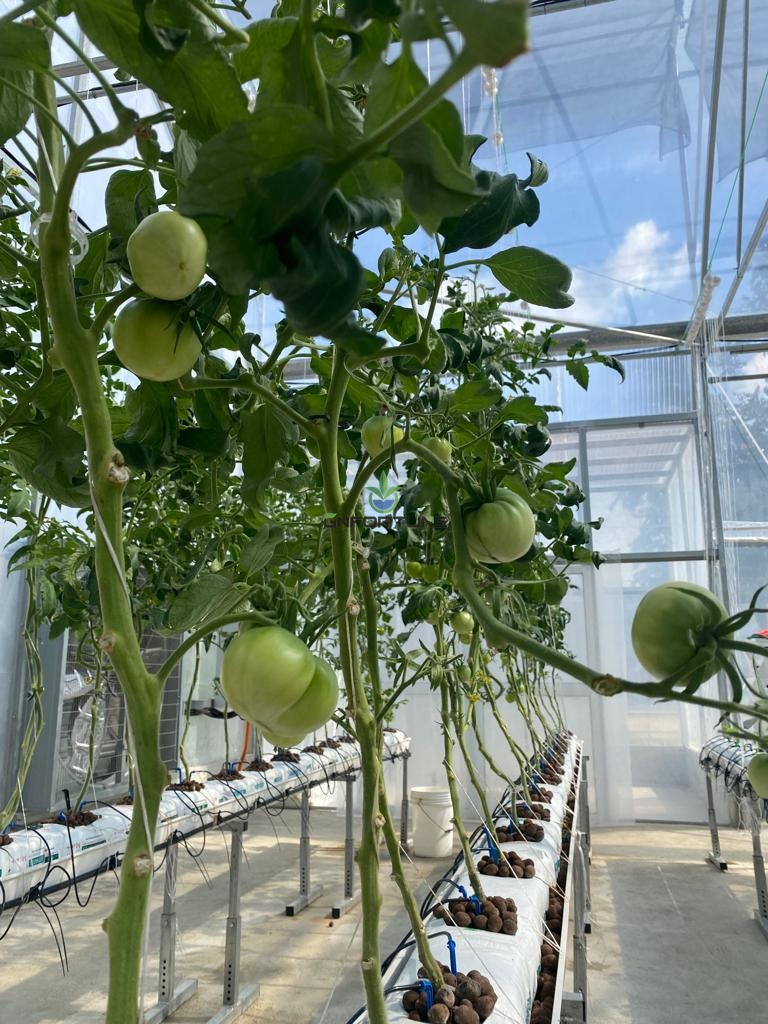
Tomato plants growing along a long nutrient film run, showing how channel length affects root mass and flowThe nft channel slope percent controls two opposite failure modes. Below roughly 1%, water pools in low spots, stagnant zones grow biofilm and algae, and root disease follows in a recirculating line. Above roughly 3%, the upstream end runs almost dry, fine roots are torn off against the channel base, and the support stands become a leveling headache across a bay.
The practical guidance:
- 1–2% is the safe range and the target on the layout drawing; many growers default to 1.5% because it tolerates minor settling of supports.
- Set support spacing at 1.5–2 m or closer. On long unsupported spans, plastic channels sag between stands, and a 2% slope on paper becomes a 0% slope mid-span.
- Level with a laser or digital level, not by eye. A 1.5% slope is a 15 mm drop per meter — hard to judge visually on a 10 m run.
- Re-check after the first crop cycle. Stands settle, benches walk, and substrates get stacked against frames.
The field mistake we see on almost every audit: slope is measured once, at installation, then never again. Six months later the stands mid-bay have settled a few millimeters, the film pools mid-run, and the farm sees “mystery” root rot in one section only. Re-leveling with a laser takes an hour; finding the problem through the crop costs a harvest.
Channel Run Length: 6–12 m Depending on Crop
Every meter of channel consumes dissolved oxygen and adds a little temperature. By the end of a 12 m run in warm weather the solution can arrive several degrees warmer and measurably lower in oxygen than it left the reservoir — and dissolved oxygen below roughly 5 mg/L at the root zone is where growth slows and disease pressure rises. The working ranges:
| Crop | Practical single run | Limiting factor |
|---|---|---|
| Lettuce and delicate leafy greens | 6–8 m | Dissolved oxygen and temperature gain at the outlet |
| Bok choy, kale, asian greens | 8–10 m | Thicker root mats raise flow resistance |
| Herbs (basil, mint, chives) | 6–10 m | Lighter mats tolerate length; harvest traffic sets the limit |
| Strawberries at low density | up to 12 m | Fewer plants per meter leaves oxygen in the film for the full run |
If a layout needs longer runs, there are two honest options: verify with a dissolved oxygen meter at the outlet under worst-case summer conditions, or split the run and feed from the middle, which resets the film and the oxygen budget halfway along. Copying a 6 m design onto a 15 m run at the same flow is not one of them. Channel cross-section matters too — the NFT channel size comparison covers how width and profile change the safe run length.
Stagnation Zones and Why Channel Shape Matters
Stagnant water collects in predictable places: the flat corners of square-profile channels, the last few centimeters before an end cap, and any span where a support has sagged. A rounded or slightly V-shaped base concentrates the film into a narrow, deeper stream that keeps moving even at modest flow — forgiving of slope errors but holding a smaller root zone. A flat-bottomed channel spreads the film wide and shallow, giving good root contact but needing a truer slope to avoid pooling. Internal ribs help roots grip but create slow zones behind each rib, where fine-rooted crops collect dead tissue that no rinse removes. And end caps deserve a check: a well-made cap drains at the true low point of the base, while a poor one leaves a shallow puddle behind the outlet — on a recirculating farm, a permanent reservoir of spores between cycles.
Pump Duty Cycle and Reserve Capacity
An NFT line runs its pump for extended periods during light hours — on many farms, 24 hours a day — so the pump is a wear item, not install-and-forget. Specify a pump rated for continuous duty at your operating point, and size the head at the end of the manifold, where the last channel sees the least pressure; the reservoir and pump sizing worksheet covers the full method. Two reserve rules from commissioning: leave 20–30% spare capacity at the duty point, because root mats grow and filters clog; and keep a standby pump on the shelf — a spare the crew can swap in twenty minutes turns a summer-day failure into a non-event.
On-Site Audit: Measuring Real Flow in Five Minutes
A field check needs no specialized instruments — a 2 L graduated vessel and a phone timer will do. Run it at commissioning and repeat it quarterly:
- Catch the outlet of one channel for 60 seconds and read the volume — that is your per-channel flow in L/min, to compare against the crop table above.
- Repeat at the first and last channel of the manifold. A deviation larger than about 15% means the manifold is unbalanced — usually an undersized header or missing regulation valves, not a pump problem.
- Walk the run and look for shine. Dry patches on the channel base mid-run indicate sagging supports or a slope below 1%.
- Measure slope at three points — top, middle, bottom — with a digital level. All three should read within the 1–2% band, not just the average.
- Record the numbers with a date and compare quarter to quarter — drift tells you which components are aging before the crop does.
Installing to these numbers the first time is far cheaper than auditing your way out of a bad one. Support spacing, anchoring, and manifold layout are covered in the NFT channel installation guide, and the channel profiles on the NFT channel product page.
FAQ
What flow rate should NFT channels run?
A: Between 0.5 and 2 L/min per channel depending on crop and maturity — 1.0–1.5 L/min is the default for head lettuce. Measure at the inlet, not the pump: manifold losses always reduce what arrives.
What slope percentage is right for NFT channels?
A: 1–2% is the safe range. Below about 1% the film pools and stagnates; above about 3% the top of the run dries out. Support stands every 1.5–2 m keep the slope true along the run.
How long can an NFT channel run be?
A: 6–12 m by crop, with 6–8 m the conservative choice for lettuce. Longer runs lose dissolved oxygen and gain temperature; verify with a DO meter at the outlet or split the run and feed from the middle.
Can NFT flow be too high?
A: Yes. Above roughly 2.5–3 L/min the film gets deeper rather than faster and the root mat floods. If the bottom end of a channel is starved, the answer is usually slope or manifold balance, not more flow.
Get Your NFT Flow and Slope Calculated Before You Order
Send your NFT channel layout — bay dimensions, channel count, crop, and target run length — through the quote form, and the engineering team will return the calculated flow rate, slope, and pump duty point for the whole line before you commit to hardware.
— G&N Fortune Limited · hydroponic equipment manufacturer since 1996 · Reviewed by the engineering team