

For a greenhouse with more crop plan than floor space, a hydroponic rack system is the standard answer: planting surfaces stacked as shelves, tiers, or beds, so one square meter of floor grows two or three square meters of crop. This guide covers the rack families, the crops that pay for stacking, the engineering checks, and the questions to put to a supplier before you commit a floor plan.
Hydroponic Rack System Types: Benches, Shelves, and Vertical Racks
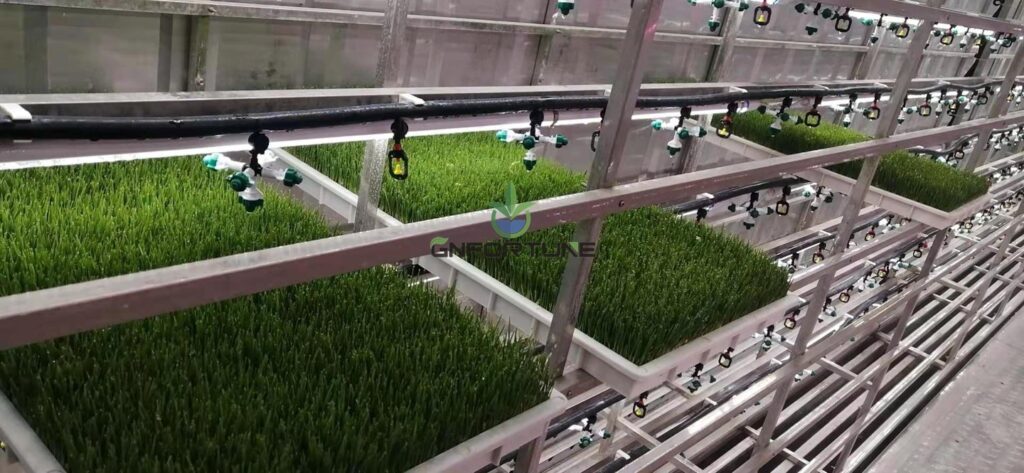
Multi-layer metal rack holding hydroponic fodder traysMost “rack systems” belong to one of three families, and they suit different jobs:
- Bench and flood-table racks. Horizontal trays or gutters on a frame, sometimes with a second level; the workhorse for propagation and potted crops, with trays that slide out and clean easily.
- Shelf racks. Fixed horizontal levels, each carrying a shallow gutter, tray, or NFT shelf; three to six levels, best for short crops that fit the available light and headroom.
- Vertical and stepped racks. Levels offset in height and depth so lower tiers catch more natural light than a flat stack of shelves.
For true vertical growing — towers rather than tiered beds — the commercial vertical growing systems comparison covers that separate family; factory-built multi-tier configurations appear in our vertical hydroponic system product line, with the rack geometries and load ratings we quote.
| Rack family | Typical levels | Best-fit crop stage | Main advantage | Main limitation |
|---|---|---|---|---|
| Flood-table bench rack | 1–2 | Propagation, potted herbs, short cycles | Easy access, clean drainage, flexible layout | Lowest area gain per floor meter |
| Fixed shelf rack (NFT or tray shelves) | 3–6 | Leafy greens, herbs, transplants | Highest planted area per footprint | Light and headroom limit the crop |
| Vertical/stepped rack | 2–4 effective light tiers | Leafy greens in stepped layouts | Better light reach to lower tiers | More structure and plumbing per tier |
Crop Fit: Propagation Racks vs Full-Cycle Multi-Layer
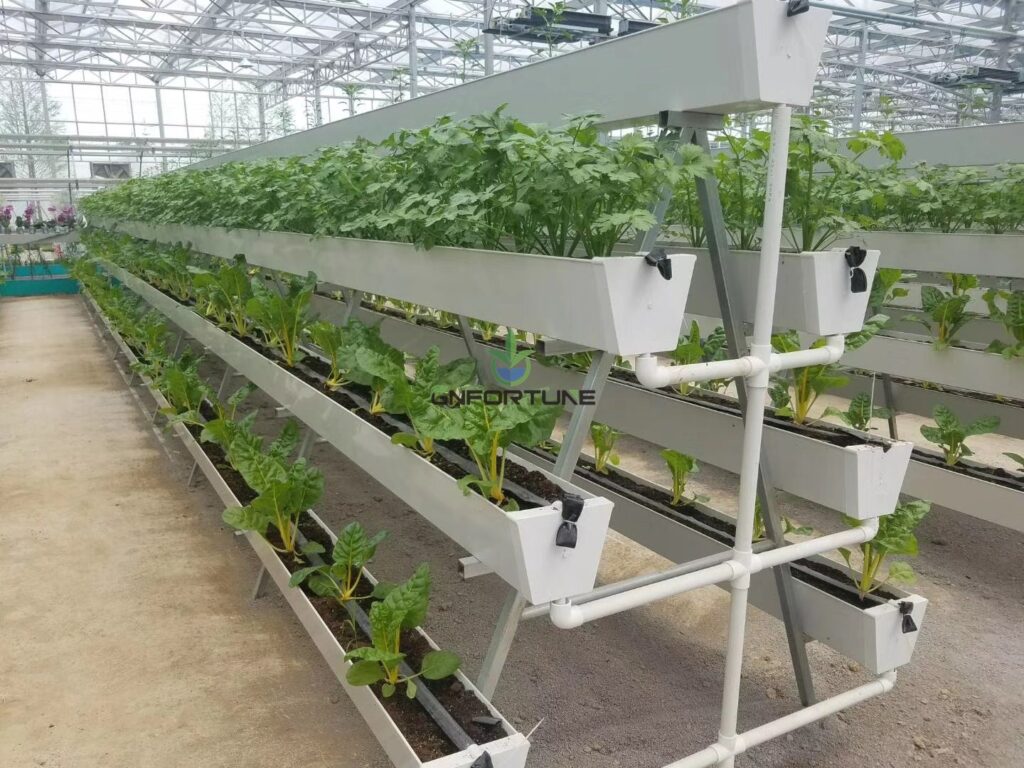
A-frame multi-level rack with white growing guttersStacking pays when the crop is short and the cycle is quick, which is why propagation racks are the safest first use: young plants are small, need less light, and turn over quickly, so a five- or six-level rack stays busy without light disputes.
Full-cycle leafy greens — lettuce, herbs, chard — finish on three- or four-level racks when each level gets enough light and the variety fits the layer height; add a level beyond that and the lowest ones shade out unless you buy light. Fruiting crops rarely earn their keep stacked, so they stay on the single-level rows the table below shows. Short, low-light crops such as microgreens and fodder are the exception, which is why hydroponic fodder systems stack trays by default.
| Crop scenario | Workable levels | Why it works | When stacking does not pay |
|---|---|---|---|
| Propagation (plugs, cuttings, transplants) | 5–6 | Short plants, fast turnover, low light need | Rarely — best rack use on most farms |
| Full-cycle leafy greens | 3–4 | Even light with supplemental lighting on low tiers | When top levels idle between batches |
| Microgreens and fodder | 4–8 | Very short crops, uniform trays | High labor for harvest at very small scale |
| Tall fruiting crops | 1 (top level) | Light and air at full height | Multi-level geometry for tall vines |
Load, Drainage, and Light Access: The Engineering Checks
Three checks decide whether a brochure rack is right for your building. Load. Water is heavy: a flood tray with 3–5 cm of standing solution holds 30–50 kg per square meter, saturated media adds more, and the frame must carry that wet and dry for years. Ask for the rated load per level and check it against your deepest tray plus media plus crop — a rack rated for empty trays is not one rated for full beds.
Drainage. Every level has to drain on its own, because gravity does not move water up between shelves. Each tier needs a fall toward its drain (1–2% is practical), a return line that runs level by level, and drains that media and roots cannot block. A stacked rack concentrates three or four times as many drain points over the same floor, so the plumbing plan matters more than on single-level benches.
Light access. Natural light reaching the lowest shelf of a tall stack is the silent budget killer. If lower levels cannot reach the crop’s daily light target, you either run fewer effective levels or pay for supplementary lighting — and that cost can erase the rent saved by stacking. Match level spacing to mature crop height and place racks to shade as little as possible.
Two operating details matter: level height should suit your staff as well as your crop, and aisles must stay wide enough for carts and cleaning. For the floor-plan math before any hardware is ordered, see the hydroponic system design guide.
A rack is a building decision, not a shelf decision: stacking only pays if every level stays lit, drained, and reachable for years. We have seen operators add a third level to “double” capacity, then find the bottom shelf at half light and the aisle too narrow. Verify light reach, drain access, and aisle width on paper before you order the steel.
Cost per Layer and Payback of Stacking
Compare cost per planted square meter, not per rack. Stacking trades a bigger structure bill for a smaller footprint and only wins when floor is the scarce, expensive input; the ranges below are illustrative — your greenhouse, climate, and crop set the real numbers:
| Configuration | Planted area per 100 m² of floor (after aisles) | Structure cost vs single-layer benches | Where the payback comes from |
|---|---|---|---|
| Single-layer flood benches | Roughly 70–80 m² | Baseline | Simple, flexible, lowest structure cost |
| 3-level NFT shelf racks | Roughly 200–230 m² | About 1.7–2.3× the single-layer structure | More planted area on the same heated, covered floor |
| Propagation shelf racks (5 levels) | Roughly 300–350 m² of tray space | Lighter trays keep structure moderate | Fast turnover amortizes the stack quickly |
Stacking pays when floor and climate envelope are expensive, the crop is short and fast, and the rack stays full; it stops paying when levels sit idle, when light must be bought for shaded tiers, or when harvest labor offsets the gain. Weighing a rack against an extension? Run both through the hydroponic farm ROI guide — how many weeks a year the system is full, not the price of steel, decides.
What to Verify with the Supplier Before Ordering
Before a floor plan becomes a purchase order, put these questions in writing:
- Rated load per level in kilograms per square meter, stated for wet trays, not dry ones.
- Materials and corrosion protection for frames, fasteners, and tray supports in a humid greenhouse.
- Drainage design per level, including fall, drain size, and how each tier connects to the return line.
- Level geometry — spacing, height, and footprint — matched to your crop height and your building’s light.
- Spare parts and freight. End caps, fittings, and spare trays are cheap to add to the original shipment; the container loading and MOQ guide explains how spares ride along without wrecking the freight math.
- A layout drawing. A supplier who quotes racks without asking for your floor plan is quoting shelves, not a system.
Walk the same checks as for any long-life purchase: stated service life, spare-part availability, and references running the same crop. The supplier who asks about your crop, light, and aisles first is the one who will send a rack that fits your building rather than its catalog.
FAQ
What is the difference between a hydroponic rack and a vertical tower system?
A: A rack stacks horizontal beds, trays, or gutters on levels; a tower system plants around vertical columns. Racks suit leafy greens and propagation with easy tray access; towers fit very light crops where you accept less access per plant.
How many levels are practical for lettuce on a rack?
A: Three to four levels for full-cycle leafy greens in a greenhouse, with light checked on every tier. Propagation runs can use five or six because young plants need less light.
Do multi-layer racks need grow lights?
A: Only when natural light on the lower tiers falls below the crop’s daily target; if you must light three levels, add that energy cost before you order.
What do you need to quote a rack system?
A: A floor plan or bay dimensions, the crop and target batch size, and your preferred rack family. With those, our team returns a level-by-level layout, per-plant spacing, and pricing — see the quote form below.
Send Your Floor Plan for a Rack Layout and Quote
A hydroponic rack system earns its keep only when the layout, crop, and light plan agree, so start the conversation with your building rather than a model number. Send your floor plan, bay dimensions, and crop plan through the quote form, and our team will return a level-by-level rack layout with drainage and light notes — sized to the footprint you actually have.