

Ask five greenhouse operators what a commercial vertical hydroponic system is and you will get five different pictures: NFT walls carrying lettuce channels, aeroponic towers packed with herbs, and multi-tier benches of seedling flats. All stack growing area above the greenhouse floor so that more crop is produced per square meter of building. Choosing between them is not about which is newest; it is about crop fit, light, labor, airflow, and cost per square meter of usable growing area. This overview maps the three main families, the floor-space math behind each, and where the real costs hide.
Vertical Systems, Defined: Racks, Walls, and Towers
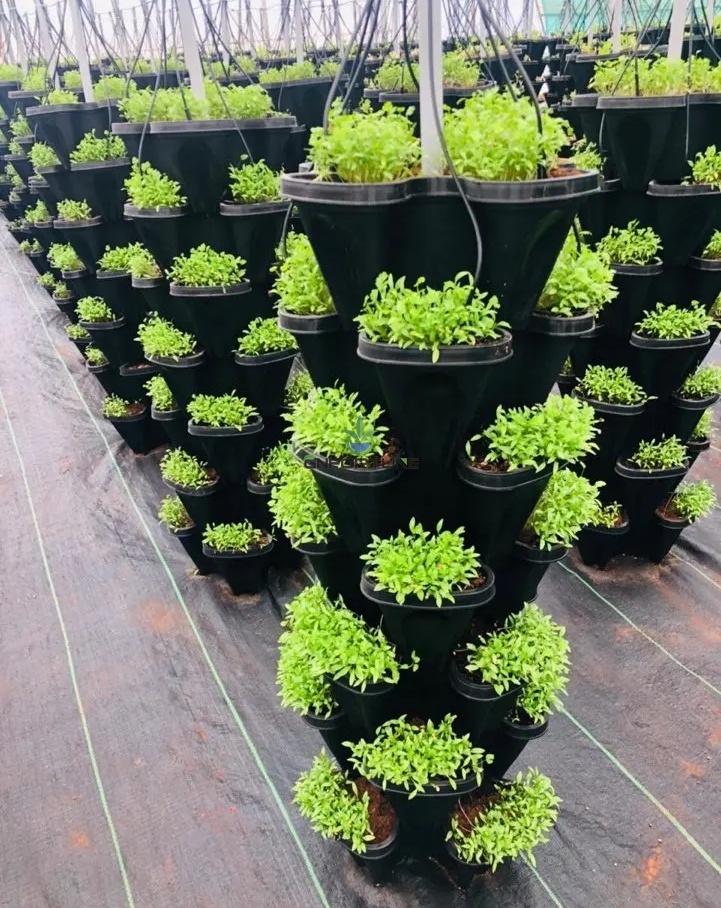
Stacked pots vertical growing system in a greenhouseThe industry bundles nearly everything that stacks plants under the label “vertical farming,” which makes comparisons difficult. For planning purposes it helps to split commercial vertical layouts into three families:
- Multi-layer racks. Horizontal gutters, troughs, or trays stacked two to four levels high, usually with LED fixtures between levels. This is the family used for seedling racks, microgreens, and low-light leafy greens. Each level is its own growing plane, and the crop is handled one level at a time.
- Vertical NFT walls. Channels mounted at an angle on a supporting frame, stacked in several tiers facing the aisle. Nutrient solution is pumped to the top tier and falls through the system by gravity. Because a 10 m wall run can hold four to eight tiers of channels, the same footprint that grows one NFT table can grow several. The vertical hydroponic system range we build is configured this way.
- Aeroponic and NFT towers. Freestanding columns with planting sites around the circumference. Towers make the most of floor area — a few towers occupy the ground of one bench — but they are suited to short, lightweight crops and need reliable misting or a pressurized header. The mechanics of spray delivery are covered in our article on how aeroponic towers work.
The families can be mixed, and mature operations usually run more than one — such as a rack-based propagation room feeding a wall of NFT lettuce.
Floor-Space Math: How Vertical Really Multiplies Area
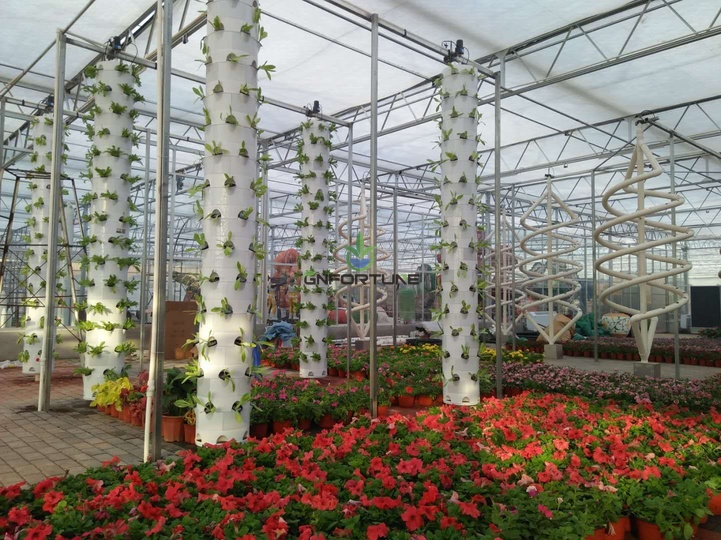
White vertical growing towers arranged in a commercial greenhouseVertical systems multiply usable area, but never by the simple ratio of levels. Three deductions always apply:
- Aisles. Every tier needs access for planting, harvesting, and cleaning. A single-level bay may lose 20–30% of floor area to aisles; a tall wall pays for its aisle by serving many tiers at once.
- Light gaps. Unless every level has its own lamp, the upper tiers shade the ones below. In a passively lit greenhouse, vertical stacking multiplies floor area but divides the light each plant receives.
- Handling zones. Tall systems need carts, platforms, or hydraulic lifters for the top tiers. That equipment sits somewhere, and it is not a trivial line in the budget.
A useful planning number is usable growing area per 100 m² of greenhouse bay:
| Layout | Growing levels | Usable area per 100 m² bay | What makes the number drop |
|---|---|---|---|
| Single-level NFT tables | 1 | 55–70 m² | Aisles and table gaps |
| Vertical NFT walls | 4–8 tiers of channels | 120–180 m² of channel surface | Frame structure and access space between walls |
| Multi-layer racks with LED | 2–4 levels | 100–160 m² | Fixtures take vertical space; heat adds cooling load |
| Aeroponic towers | Many plant sites per tower | Highest planting density | Crop height and harvest reach limit tower height |
Note that usable area is not the same as harvestable yield. A stack that doubles area at the cost of 40% lower light per plant may not double revenue. Run these numbers through a proper layout before ordering hardware — the hydroponic system design guide walks through aisle width, drain runs, and reservoir placement in one pass.
Light and Airflow in a Vertical Layout
Every extra layer changes the greenhouse climate, and this is the section where consultant budgets most often disagree with vendor brochures:
- Light per plant falls. A crop bred for full sun cannot go three levels deep without supplemental light, and the LED purchase is usually the single largest equipment line in a vertical room.
- Heat becomes an indoor problem. Fixtures dump heat into a space with less volume per square meter of crop; sealed rooms need real conditioning, and passive greenhouses develop warm pockets at the top.
- Airflow is uneven between levels. Horizontal airflow fans help, but the lower tiers of a stacked rack are always the stillest. High humidity there invites botrytis, and treating mold across stacked trays is harder than treating one bench.
- Water delivery has more failure points. Every tier needs even flow. Emitter blockage that starves a single table is inconvenient; the same blockage in a vertical system can dry an entire tower before the next check.
Advisor’s note on stacking economics: When a supplier quotes “three times the yield,” ask which input tripled. If the answer is racks but not light, not labor, and not cooling, the honest gain may be closer to 1.5 times. Price the environment around the stack before you celebrate the stack.
Indoor nurseries, propagation, and young-plant finishing rooms adapt to vertical layouts more cheaply than passive greenhouses, because the environment is already engineered.
Crop Fit: Leafy Greens Up High, Fruiting Crops on Benches
Vertical systems are not crop-neutral. The practical split looks like this:
- Leafy greens and herbs — lettuce, baby leaf, basil, mint, and other short crops — are the natural fit for NFT walls and towers: harvested young, kept small, and tolerant of dense spacing.
- Strawberries grow in stacked gutter systems, but runner management and picking labor rise with every level — which is why most operations keep to one or two.
- Fruiting crops — tomatoes, cucumbers, peppers — need root zone volume, tall support, and regular pruning at the top of the plant. They belong on single-level benches or Dutch buckets, not stacked three high. Putting a trellised crop in a tower is usually a trial, not a plan.
- Seedlings and microgreens are the best commercial fit for tight multi-layer racks: short cycles, uniform batches, and crops that do not fight for height.
When the crop plan is fixed, the layout follows. The complementary post on hydroponic rack systems covers the stacking side of the decision in more depth.
Cost per Square Meter Across the Three Types
Cost per usable square meter — not per floor square meter — is the honest comparator, because a wall and a rack occupy different footprints for the same usable area. The indicative picture:
| System family | Usable area gain | Indicative equipment cost per usable m² | Main cost driver | Best-fit crop |
|---|---|---|---|---|
| Multi-layer racks with LED | 2–4 levels | Highest — LED lighting dominates | Lighting and cooling | Seedlings, microgreens, low-light greens |
| Vertical NFT walls | 4–8 tiers | Mid range; plumbing and frames | Channel stock, frames, pump sizing | Lettuce, herbs, baby leaf |
| Aeroponic towers | Highest planting density | Low-to-mid; but nozzle maintenance is recurring | Misting components and pressure control | Short-cycle herbs and greens |
Treat those bands as planning ranges, not quotes: prices vary by material grade, volume, and supplier. A rule of thumb that survives contact with real projects: if the crop grows acceptably on one level, prove on paper why the next levels earn their lighting, labor, and cleaning cost before you build them. For leafy greens the math usually works; for tall fruiting crops it does not — which is why the industry keeps gravitating back to the crops that fit the stack. Run the revenue side through our hydroponic farm ROI guide before committing.
FAQ
What is a commercial vertical growing system?
A: Any layout that stacks growing area above the greenhouse floor — multi-layer racks, vertical NFT walls, or aeroponic towers — so that more crop is produced per square meter of building footprint.
How much more area does a vertical system give you?
A: Indicatively, a vertical NFT wall returns roughly 1.2–1.8 m² of usable channel surface per square meter of bay after aisles and structure, while multi-layer LED racks range higher but carry the highest lighting cost. Actual numbers depend on the crop and layout.
Are vertical systems worth the cost in a greenhouse?
A: For short, low-light crops like lettuce and herbs, yes — the stack multiplies area the crop can tolerate. For tall fruiting crops, usually no; they need root volume and headroom that stacking does not provide.
Do vertical growing systems need special greenhouses?
A: Walls and towers work inside standard greenhouses when airflow is managed. Sealed multi-layer rooms with LED are a different building class with higher equipment and cooling cost per square meter.
What is the most common mistake when planning a vertical layout?
A: Budgeting for racks and channels but not for the lighting, cooling, and cleaning labor the extra layers require. The environment around the stack, not the stack itself, decides whether the project pays.
Send Your Footprint, Match the System to the Economics
Planning a vertical build-out or re-layouting an existing bay is a geometry problem with a budget attached. Send your greenhouse dimensions, target crop, and plant count through the quote form below — send your footprint — we will show which vertical system fits the economics. The useful related reading: