

The best crops for aquaponics are not the highest-value crops on paper — they are the crops that match what the fish actually supply. In an aquaponics greenhouse, plants grow on the nutrients the fish waste produces, and that supply is steady, moderate, and nitrate-rich rather than aggressive and perfectly balanced. That is why lettuce and herbs dominate working systems, why strawberries have carved out a premium niche, and why tomatoes and peppers succeed only when the operator manages the gap between what they demand and what the fish provide. This guide compares the main crop families by pH tolerance, nutrient demand, and revenue per square meter of grow space, so the crop mix fits the system rather than fighting it.
The Nitrogen Appetite of Different Crops
Every plant in an aquaponics loop eats from the same menu — the breakdown products of fish feed — but appetites differ sharply. Understanding that appetite is the first step in choosing plants for aquaponics, because a crop that asks for more than the fish produce will starve unless you supplement, and a crop that asks for less will leave nitrate climbing.
- Light feeders: most leafy greens and herbs grow steadily on a moderate nitrate supply and tolerate the near-neutral pH (around 6.8–7.2) that fish prefer. They are the natural baseline.
- Medium feeders: strawberries and some brassicas need more potassium and respond to slightly richer water; they still sit comfortably inside an aquaponics range.
- Heavy feeders: tomatoes, peppers, and cucumbers draw heavily on potassium and phosphorus during fruiting. Fish waste alone often runs short, so growers supplement to keep fruiting crops productive.
The supply side of that matching — how feed becomes ammonia, then nitrate, and how much your fish load generates — is covered in our nitrogen cycle in aquaponics guide. The short version for crop choice: start with crops whose appetite matches the feed rate, then push toward heavier feeders only as water tests and supplementation allow.
Fast Leafy Greens: Lettuce and Herbs — the Reliable Baseline
Lettuce is the default crop in commercial aquaponics for three operational reasons. It cycles in four to six weeks from transplant, which turns over the grow space quickly and smooths cash flow; it grows at the pH fish are happy with; and it converts moderate nitrate into saleable biomass with no heavy-feeder complications. Butterhead and loose-leaf types perform better in near-neutral aquaponics water than some crisphead varieties, which prefer a lower pH they will not get when tilapia or perch share the loop.
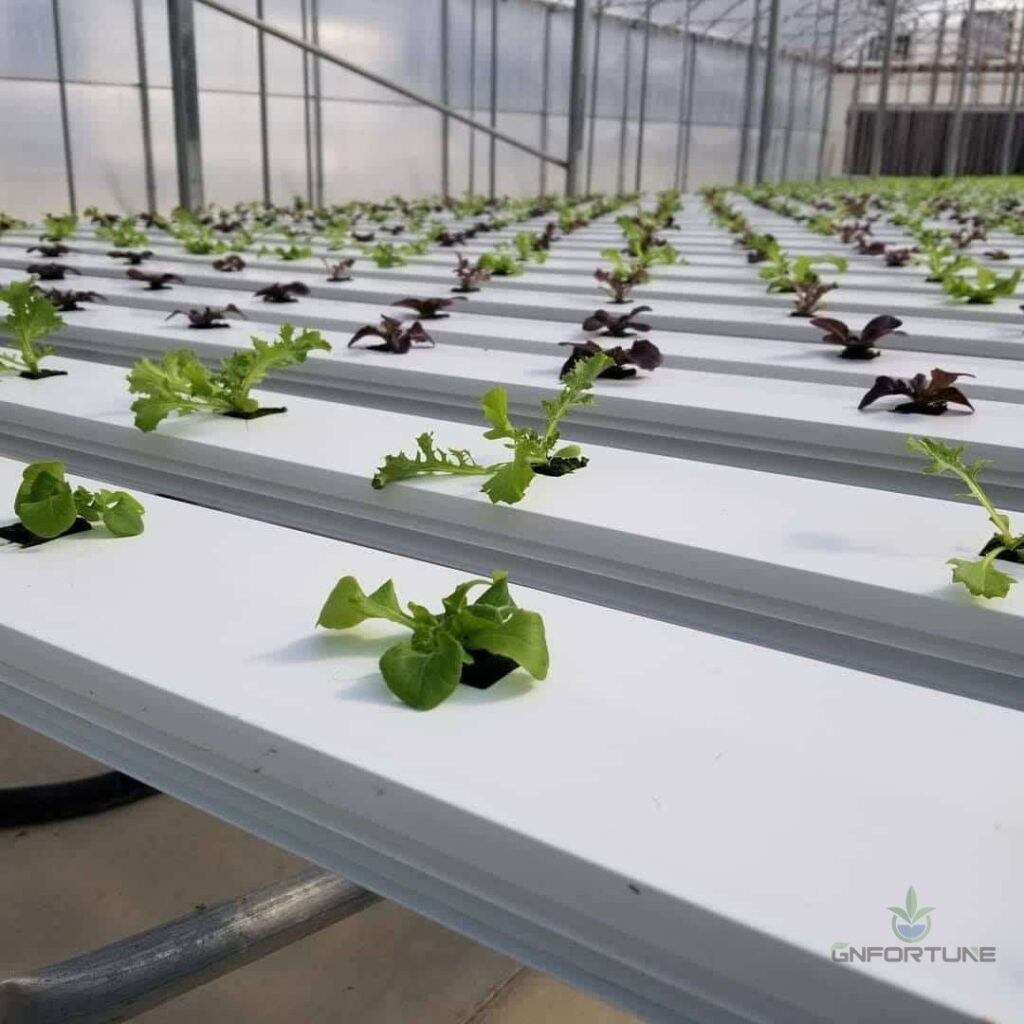
Colorful lettuce growing in greenhouse NFT channelsHerbs sit beside lettuce as the second reliable tier. Basil, mint, chives, and parsley grow fast in warm aquaponics water, and culinary herbs command higher prices per square meter than lettuce in most wholesale markets — often the strongest margin of any aquaponics crop family. The trade-off is perishability and labor: herbs are picked and bunched by hand, and buyers expect consistent supply, so schedule plantings in waves rather than one big block. Spacing, transplant, and harvest guidance for the lettuce side is laid out in our commercial lettuce in NFT guide — the crop math transfers directly to aquaponics raft and channel growing.
Fruiting Crops: Tomatoes, Peppers, and Cucumbers — Higher Risk, Higher Value
Tomatoes, peppers, and cucumbers are the crops growers are usually most excited about, because their revenue per plant is high. The honest framing is that they are also the crops most likely to disappoint in an aquaponics system, for reasons that have nothing to do with yield potential:
- Nutrient gaps. Fruiting crops drain potassium during fruit set. Fish waste is comparatively lean on potassium, so a fruiting block in aquaponics almost always needs a separate potassium supplement, monitored against plant tissue or leaf symptoms.
- pH compromise. Tomatoes prefer a pH near 5.8–6.5 for best uptake of several nutrients, while the fish prefer 6.8–7.2. The system runs at one number; crops that tolerate the compromise do better than crops that resent it.
- Long cycles tie up space. A tomato plant occupies its square meter for months. One failed crop cycle in a fruiting block costs more than several missed lettuce cycles, because the space, trellis, and labor were committed for a season.
- Labor and support. Trellising, pruning, and pollination (by bumblebees or vibration) add a management layer that leafy greens simply do not have.
None of this makes fruiting crops wrong — many mixed aquaponics farms run a leafy baseline plus a tomato or cucumber bay to lift average revenue. It makes them a second-stage decision: add fruiting crops after the leafy baseline is reliable, never instead of it.
Strawberries in Aquaponics: The Premium Niche
Strawberries are the crop where aquaponics genuinely shines, because the system removes the two classic soil problems: soil-borne disease and the labor of weeding and mulching. Day-neutral varieties fruit over a long season under protection, and berries command premium prices out of season — which is exactly when a heated aquaponics greenhouse can produce them.
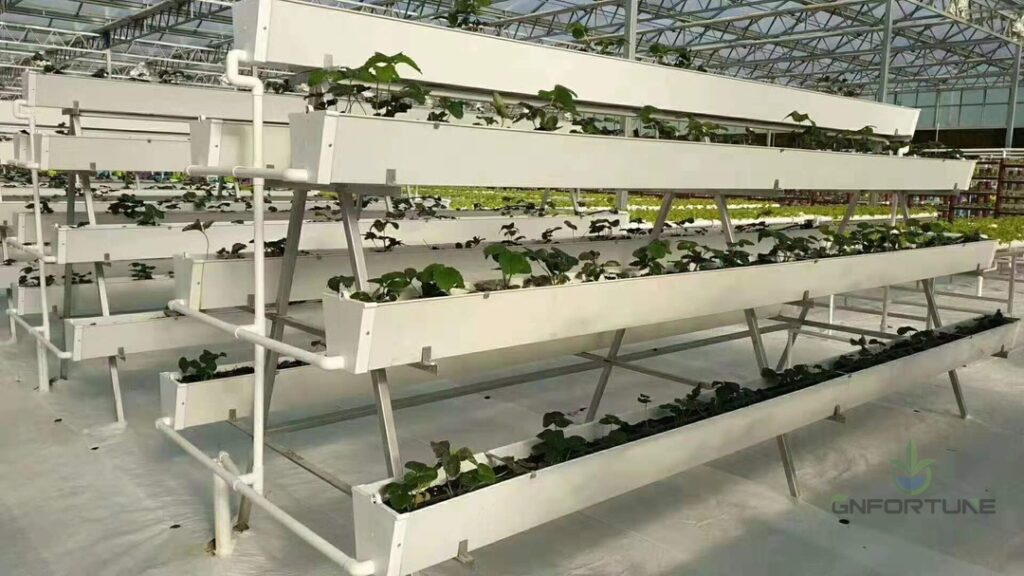
Strawberry plants in elevated white gutters in a greenhouseThe economics work at density: strawberries are planted at eight to twelve crowns per square meter in gutters or channels, so revenue per square meter stacks up from a high-value, fast-turning crop rather than a few big plants. The drawbacks are the ones common to all premium produce — harvest labor is intensive, berries are perishable, and buyers must be secured before you scale. But for a farm that already runs leafy greens as a base, a strawberry bay is the most proven way to lift the average value of the grow space. Planting, spacing, and gutter layout for protected strawberries are covered in our strawberry gutter growing guide.
Best Crops for Aquaponics: The Crop-to-System Revenue Table
Comparing crops on revenue per square meter requires a caveat first: the figures below are indicative planning ranges for wholesale markets, and actual results vary by region, market channel, season, and your local prices. Use them to rank crop families, not to forecast a P&L.
| Crop family | Nutrient demand | Typical cycle | Indicative gross revenue per m² | Main risk |
|---|---|---|---|---|
| Lettuce and leafy greens | Light–medium | 4–6 weeks | Baseline (index 1.0) | Low — the reliable base load |
| Culinary herbs (basil, mint, chives) | Light–medium | 4–8 weeks | Roughly 1.5–2.5× lettuce per m² | Harvest labor; consistent supply |
| Strawberries | Medium | Long season, multiple flushes | Roughly 2–4× lettuce per m² in season | Labor, perishability, off-season pricing |
| Tomatoes, peppers, cucumbers | Heavy | 3–6 months | Potentially high per m², with higher inputs | Nutrient gaps, pH compromise, long space commitment |
Read the table as an operator would: the leafy baseline pays steadily and keeps the system running; herbs lift revenue with modest effort; strawberries and fruiting crops add the top end but pull in risk and labor. A commercial mix uses the baseline to cover costs and one premium crop to build margin — the split depends on your market.
An advisor’s reminder on crop mix: “Choose the crop that your market buys every week, then add the crop you dream about.” We have seen aquaponics farms fail by filling the greenhouse with heirloom tomatoes nobody had agreed to buy, and we have seen modest lettuce-and-basil operations grow steadily because every tray had a standing order. The revenue table ranks crops; your buyer list ranks them better.
Putting the Crop Choice with the Fish and the Greenhouse
Crop choice is the last link in a chain that starts with the fish. A tilapia system running warm water suits basil, strawberries, and heat-tolerant greens; a trout system at cooler temperatures narrows the crop list to cold-tolerant greens and herbs. The fish side of that pairing is covered in our best fish for aquaponics guide, and the full building — fish tanks, filtration, and crop area sized together — is what our aquaponics greenhouse solutions cover as a single designed project.
FAQ
What is the best crop for an aquaponics system?
A: Lettuce and culinary herbs are the reliable baseline — they grow at the pH fish prefer, turn over in weeks, and need only moderate nitrate. Strawberries add a proven premium tier once the baseline is stable.
Can tomatoes grow in aquaponics?
A: Yes, with management. Tomatoes need a potassium supplement, tolerate the near-neutral fish pH less happily than leafy greens, and occupy space for months, so treat them as a second-stage crop behind a leafy baseline.
Do strawberries grow well in aquaponics?
A: Very well — aquaponics removes soil-borne disease and weeding, and day-neutral varieties fruit over a long season under protection. Berries also command out-of-season prices, which is where the margin comes from.
Why do my plants show yellow leaves even though nitrate is high?
A: Nitrate is not the whole diet. Yellowing in aquaponics is usually potassium, iron, or another micronutrient shortfall that fish waste does not fully supply — test and supplement rather than adding more fish.
Which crops should I avoid in aquaponics?
A: Avoid heavy feeders that hate the fish pH, plus long-cycle crops you have not secured buyers for. Blueberries, for example, want a low pH and fight every aquaponics parameter; root crops grow but use space inefficiently.
Can I grow different crops in the same aquaponics loop?
A: Yes, if they share the same pH, temperature, and nutrient range. Mixing a trout loop at 14 °C with basil that wants 24 °C water is the mistake to avoid; matching crops within one temperature zone is normal.
Plan Your Crop Mix with Us
Send your fish species, water temperature, and target market through the quote form, and our consulting team will plan a commercial aquaponics layout matched to your nutrient supply — tell us the best crops for aquaponics you want to sell and we will return the greenhouse, tank, and crop-area design together.