

Aquaponics stocking density links everything in a system: it sets feed input, biofilter load, oxygen demand, and the nutrient supply the crop must absorb. Most projects start from a simple rule — about 10 liters of tank water per fish — but it is a planning placeholder, not a law of biology. Ten liters that is right for a 150 g tilapia in a 2,000 L tank is wrong for a 1 kg broodstock, and far too generous for fingerlings in a nursery. This guide explains where the rule comes from, where it breaks, and how to convert it into a density matched to your species, biofilter, and crop area.
Why the 10-Liter Rule Exists and Where It Breaks
The 10-liter-per-fish rule exists for a good reason: it is easy to count, and it keeps a mixed warm-water system in a safe zone. If a fish in the grow-out averages around 0.1 kg across its time in the system, 10 liters per fish works out to roughly 10 kg of fish per cubic meter — the conservative end of published aquaponics density guidance, comfortable for beginner media-based systems that have no dedicated solids removal.
The rule breaks in four places we see on real projects:
- Small fish. A 20 g fingerling does not need 10 liters. Holding it at that allowance wastes tank volume when 1–3 L/fish is workable in a dedicated nursery tank.
- Big fish. A 1 kg tilapia at 10 L/fish means 100 kg/m³ — a professional RAS density that needs pure oxygen, not an aquaponics loop. As fish grow, liters per fish must grow with them.
- Species. Trout are oxygen-hungry and need more volume per fish than a robust warm-water fish at the same weight; catfish tolerate more crowding than either.
- System hardware. A system with a settling tank, a real biofilter, and supplementary aeration carries two to three times the biomass of a plain media bed at the same water quality.
Treat the rule as a sizing starting point, and let water tests referee. Density is what your ammonia, oxygen, and nitrate readings say you can hold.
Stocking Density by Species and Growth Stage
Work in liters per fish at each stage, because head count is what you can actually count on a farm. The planning allowances below are starting windows for aquaponics loops without dedicated solids removal; a well-filtered system can move toward the upper end, always confirmed by testing.
| Species | Nursery (10–30 g) | Grow-out (100–300 g) | Pre-harvest (400 g+) | Notes |
|---|---|---|---|---|
| Tilapia | 1–3 L/fish | 10 L/fish | 15–20 L/fish | The species the 10-L rule was written for |
| Trout | 2–4 L/fish | 15–25 L/fish | 25–35 L/fish | High oxygen demand at cool temperatures |
| Yellow perch | 1–3 L/fish | 10–15 L/fish | 15–20 L/fish | Middle ground; slower growth, cleaner habits |
| Channel catfish | 1–2 L/fish | 8–12 L/fish | 12–15 L/fish | Tolerates crowding and lower oxygen |
Convert liters per fish to biomass when needed: multiply head count by average weight. A 2,000 L tank at 10 L/fish holds 200 fish; at a 150 g average that is 30 kg, or 15 kg/m³ — an honest commercial figure for a filtered warm-water system. When you read “high density” claims elsewhere, the number means nothing until you know the average fish weight behind it.
Matching Fish Load to Biofilter and Crop Area
The fish do not set the real limit — the feed does. Feed is what becomes ammonia, and ammonia is what the biofilter must process before it reaches the plants as nitrate. The coupling math we use on site is a feed budget, not a fish budget:
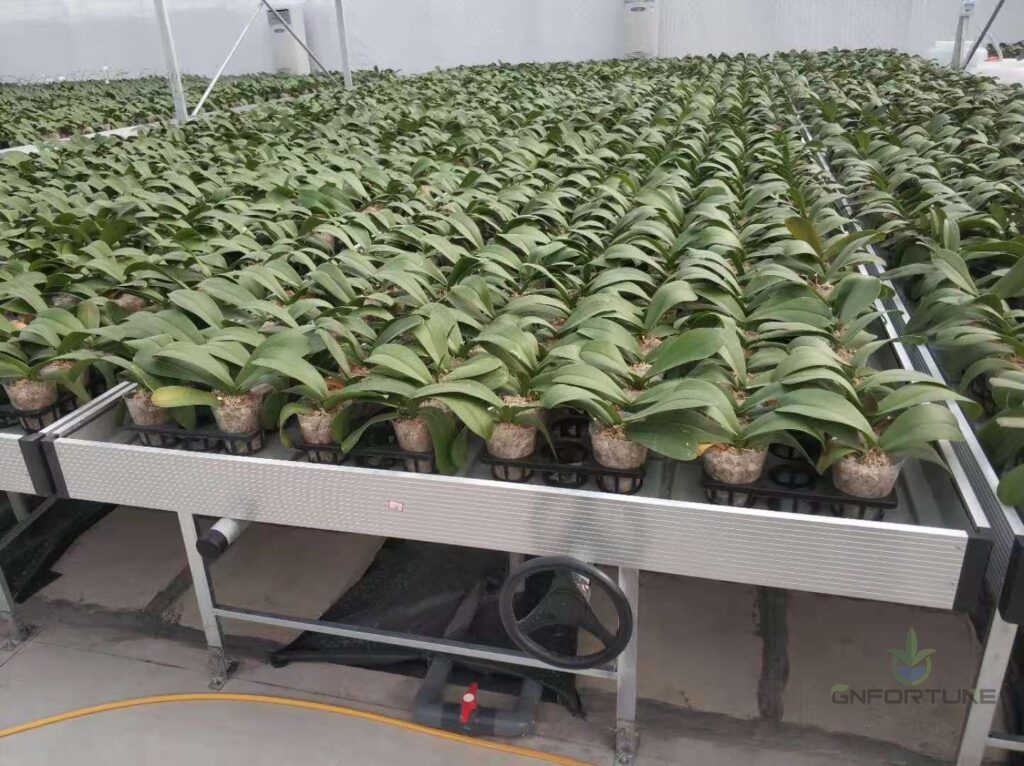
Large commercial grow beds in an aquaponics greenhouse- Daily feed input: fish biomass (kg) × feeding rate. Warm-water fish at 24–28 °C typically eat 1–2% of body weight per day; feed rates fall toward the lower end as fish grow and as temperature drops.
- Biofilter load: the filter must convert the ammonia from that daily feed. A rough planning figure used across the industry is that each kilogram of daily feed needs a healthy, mature biofilter surface — which is why biofilter volume, not tank volume, is the real ceiling in many systems.
- Crop area: the plants must absorb the nitrate the feed generates, or it accumulates. For leafy crops, a common starting window is roughly 1 m² of grow space per 15–30 g of daily feed, verified by watching nitrate.
Run the numbers forward for the example above: 200 tilapia at a 150 g average is 30 kg of biomass feeding near 1.5% per day — about 450 g of feed daily. That feed level points to 15–30 m² of leafy greens to keep nitrate in balance, and a biofilter sized for the ammonia from that 450 g. If your crop area is 8 m², the fish load is already too high for the plants, whatever the tank volume allows. The ammonia-to-nitrate pathway is explained in our nitrogen cycle in aquaponics guide; the hardware side of balancing tanks, filters, and crop area sits in the aquaponics greenhouse solutions overview.
Signs Your System Is Overstocked
Water tests lag behind reality by a day, so we read the fish as well as the numbers. These are the field signs of an overcrowded tank we check for on site:
| Sign | What it usually means | First action |
|---|---|---|
| Fish at the surface gulping in the early morning | Oxygen low before lights and plant photosynthesis start | Add aeration now; test dissolved oxygen through a 24 h cycle |
| Ammonia or nitrite climbing despite a mature filter | Filter surface outgrown by feed load | Cut feed by a third and expand biofilter before restocking |
| Fish stop eating or spit feed | Stress from crowding, oxygen, or water quality | Test all three before assuming disease |
| Uneven sizes and clamped fins | Competition and stress in a crowded tank | Grade by size; check the density table above |
| Cloudy water and foam on the surface | Solids outrunning the settling and filtration stage | Increase solids removal; reduce feeding until water clears |
The morning test we run on every stocked system: walk the tanks before sunrise, before the plants have started adding oxygen. If fish are at the surface in warm water, the overnight oxygen sag is already too deep — and the cause is almost always density, not the pump. We have rebalanced more tanks on this one observation than on any water test, because by the time ammonia shows up on a strip, the fish have been stressed for days.
How to Scale Up Density Gradually
Density is added, not jumped. The biofilter bacteria population grows to match the feed load on its own timescale, so the feed — not the fish count — is the lever you pull gradually:
- Stage the stocking. Add fish in batches: stock a third of the target, then add thirds as water tests confirm the filter keeps up.
- Ramp feed slowly. Increase daily feed by roughly 5–10% every few days, and hold when ammonia or nitrite rises above near-zero readings.
- Test daily during each ramp. Ammonia and nitrite should return to near zero within 24 hours of a feed increase; if not, the filter has not caught up.
- Separate the nursery. Grow fingerlings in a small dedicated tank before moving them into the main loop at a size the rule expects.
Where the ramp is automated, tie the feeding schedule to water-quality inputs rather than a fixed calendar — our automation and control guide shows how dissolved oxygen, pH, and temperature sensors feed that logic. Species choice changes the whole calculation as well: the density windows above assume the fish in our best fish for aquaponics guide, and that decision comes first.
FAQ
What is the 10-liter-per-fish rule?
A: A planning allowance of about 10 liters of tank water per fish during grow-out, which keeps a warm-water system near 10–15 kg/m³ — a conservative, beginner-safe density a media bed and biofilter can support.
How many tilapia can I put in a 1,000 L tank?
A: At the 10-L rule, about 100 grow-out tilapia, which is roughly 10–15 kg/m³ at typical weights. Nursery fingerlings can start denser in a separate tank; pre-harvest fish need more volume each.
Can trout be stocked as densely as tilapia?
A: No. Trout need more dissolved oxygen and more volume per fish at the same weight — plan roughly 15–25 L per grow-out fish instead of 10, and add aeration capacity.
What happens if I overstock my aquaponics tank?
A: Ammonia and nitrite rise, oxygen sags overnight, fish stress and stop eating, and the crop receives an ammonia shock instead of steady nitrate. The fix is to reduce feed, expand biofiltration, and restock gradually.
How do I size the crop area for my fish load?
A: Work from daily feed: start near 1 m² of leafy grow space per 15–30 g of feed per day, then confirm with nitrate readings. Fruiting crops need more nutrients but less nitrate-tolerance in some stages, so test rather than assume.
Send Your Tank Volume and Crop Area for a Stocking Plan
Send your tank volume, species, target fish size, and crop area through the quote form, and our engineering team will return a stocking plan with staged stocking dates, feed ramp, and biofilter sizing matched to your layout.