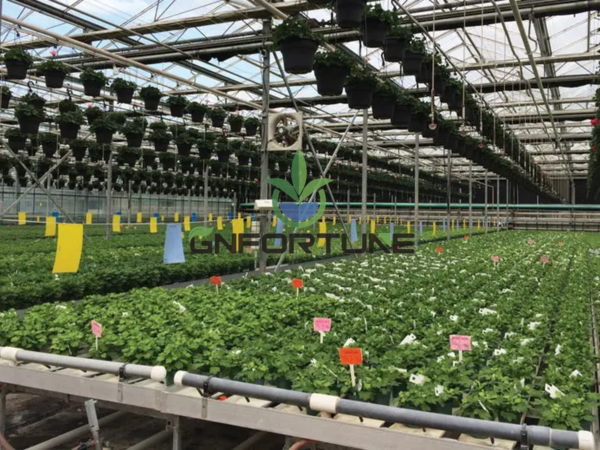
Ventilation is one of the largest continuous electrical loads on a greenhouse farm, and most of the year the fans are bigger than the weather requires. That gap is the whole pitch behind VFD fan speed control: slow a fan down and its power draw falls steeply — the affinity laws promise roughly cubic behaviour, so 80% speed needs around half the power of full speed. The savings are real, but they depend on which fans, which control signal and which minimum speed, and buyers who skip those three questions routinely buy drives that save less than the brochure.
Pump-side variable speed is a separate discipline with its own guide to the variable speed drive on the hydroponic pump; this one stays on air-moving fans.
What the Affinity Laws Promise — and What They Assume
The affinity laws for fans state that flow scales with speed, pressure with speed squared, and power with speed cubed. On that arithmetic, dropping a fan from 100% to 70% speed cuts flow by 30% but power by roughly two-thirds — a 60–70% energy reduction for a third less air. These figures assume a fan operating on a stable system curve, a motor and drive sized for the duty, and a control loop that actually holds the reduced speed rather than hunting around setpoint.
Three practical corrections apply on real houses:
- Fan curve shape: the cubic relationship is exact for ideal conditions. Axial fans near their stall region, and mixed-flow fans with steep curve sections, deliver less saving than the law suggests. Ask for the fan curve and check where your planned operating band sits.
- Static pressure matters: fans pushing air through screens, pads or long ducts run against system pressure that also changes with speed. The saving shrinks as system pressure share grows.
- Motor efficiency at low speed: standard motors cooled by their own shaft fans overheat at sustained low speed unless separately cooled or derated — a real constraint on retrofits.
As a planning range, well-matched installations commonly see total fan-energy reductions in the order of 20–50% across a season, with the higher end where fans previously ran on-off against oversized capacity and electricity is expensive. Sites with mild climates and modest fan hours see the lower end or worse — the payback is an arithmetic of running hours first.
Which Fans Suit a VFD — and Which Do Not
The drive only pays where the fan spends long hours above what the house needs. Suitability by fan duty:
| Fan duty | VFD fit | Why |
|---|---|---|
| Main extraction fans, large houses | Good fit | Long hours, capacity set by worst-case summer; most of the year needs far less |
| Pad-cooling system fans | Good fit with limits | Evaporative efficiency changes with face velocity; re-check pad performance at reduced speed |
| HAF circulation fans | Situational | Continuous duty suits drives, but many small fans cost less than one big VFD; often better bought as multi-speed units |
| Small single-phase exhaust fans | Poor fit | Drive cost per motor is prohibitive; single-phase motors are not designed for VFD control |
| Jet fans or ducted distribution | Good fit | Speed becomes a distribution tuning tool, not just an energy measure |
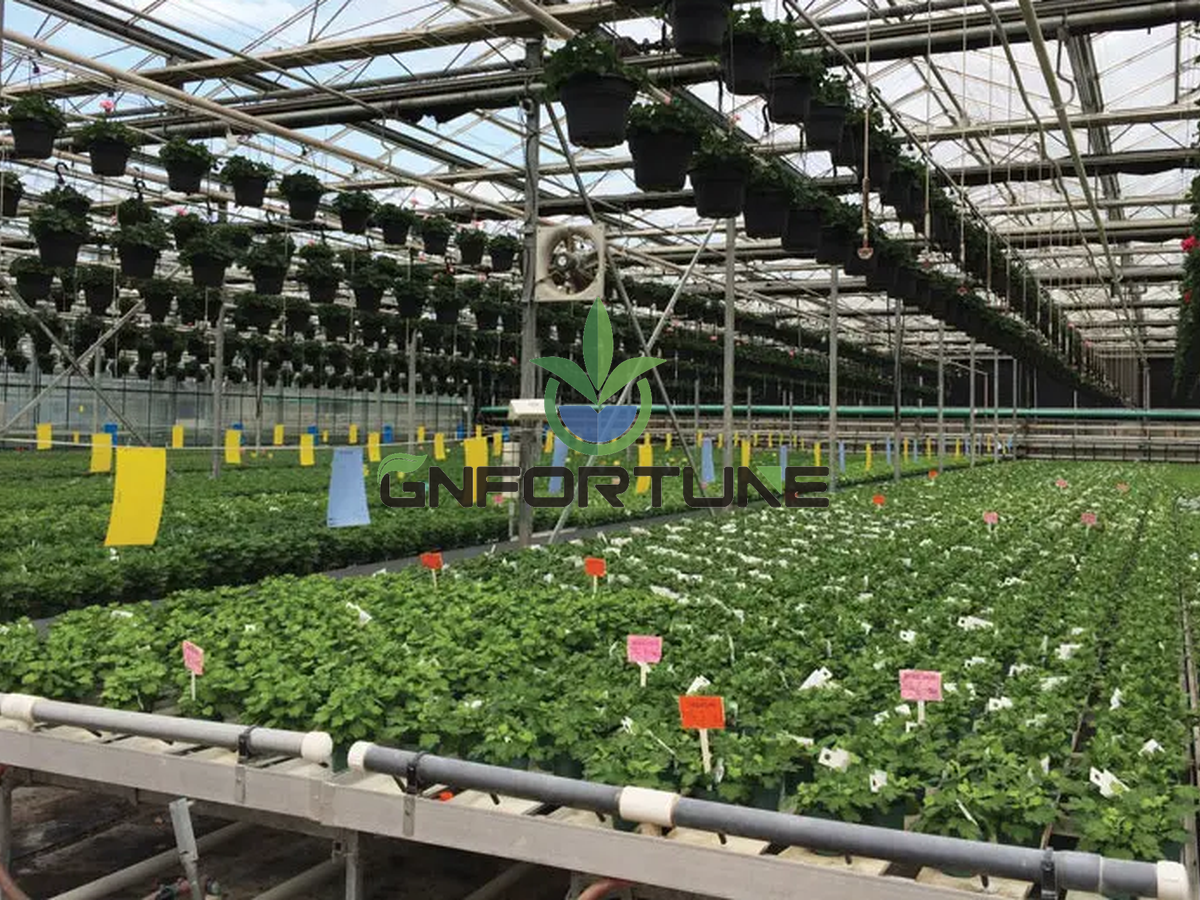
The ventilation design that sets how many fans a house needs in the first place is covered in the guide to greenhouse ventilation design, vents and HAF fans; a VFD optimises that design, it does not rescue an undersized or badly laid out one.
Minimum Speed, Stall and Other Limits
Every fan has a floor below which reduced speed stops being safe or useful. Axial fans stall at low speed against high static pressure — airflow collapses unevenly, vibration rises and the saving becomes damage. As a working rule, plan a minimum speed of 30–50% of rated speed for axial fans depending on the curve, and confirm the floor with the fan supplier’s curve rather than the drive’s keypad default. The assumption is a fan on a normal greenhouse system; fans with unusual duct resistance need their own check.
Other limits buyers meet in practice:
- Motor cabling and filters: long cable runs from drive to motor stress motor insulation; chokes or filters are cheap insurance specified at order time.
- Harmonics: a cabinet full of drives without line filters can upset other electronics on the farm supply. Farms running controllers and sensors should budget for input filters and clean earthing.
- Condensation: slow-running fans move less air, and in humid climates low night airflow can let moisture settle. The control logic needs a minimum-airflow floor, not just a temperature setpoint.
Control Signals: What Speed Follows
A drive is only as smart as its setpoint source. Three schemes cover most farms, in rising sophistication: temperature-proportional control, where fan speed follows a house sensor and a dead-band; staged control, where multiple fans follow one drive or a group pattern matched to the ventilation stages; and coordinated control, where fans follow the same climate computer that manages vents and screens, so air speed, humidity and temperature move together. The climate computer integration route is the strongest, and it is also where surge protection and clean wiring for controllers matter most — the monitoring and alarm side of that setup is described in the nights-and-weekends monitoring article.
Estimating Your Own Payback
The estimation is short enough to do on paper before any quote. Steps:
- List the fans: rated power, count, and whether they run on-off or throttled today.
- Estimate current running hours per season, from the climate log rather than from memory.
- Apply a saving factor in the 20–50% planning band, choosing low where hours are short and high where fans are oversized and expensive to run.
- Price the hardware honestly: drives, filters, chokes, motor replacements if needed, and installation.
- Divide cost by annual saving. Paybacks under roughly three years are typical for large extraction fans on expensive tariffs; beyond five years, sub-meter the fans first and revisit.
Sub-metering the ventilation circuit before buying drives sounds like a delay, but it converts the whole decision from a sales promise into a measured baseline, and farms that already have per-zone electricity metering can pull the number from their existing data. Energy loads and the solar option that sits beside this decision are covered in the guide to hydroponic farm energy costs and solar options.
Where fan hours are long and capacity is oversized, VFD fan speed control pays steadily and quietly — provided the fan curves, minimum speeds and control signals were written into the specification before the purchase order, not after the first season’s disappointment.
FAQs About VFD Fan Speed Control
How much energy do VFDs actually save on greenhouse fans?
A planning range of 20–50% of fan energy across a season for well-matched installations, with the high end on oversized fans with long running hours and expensive tariffs. Short-hour, mild-climate sites see less — run the hours math first.
Can any fan be fitted with a VFD?
No. Three-phase motors suit drives; small single-phase fans generally do not, and drive cost per small motor rarely pays. Axial fans also have a stall floor, typically around 30–50% speed, that the curve must confirm.
Do slow-running fans cause humidity problems?
They can. Reduced night airflow lets moisture settle in humid climates, so control logic needs a minimum-airflow floor alongside the temperature setpoint — speed should follow both, not temperature alone.
What is the most common VFD installation mistake?
Underspecified electrical detail: missing chokes or filters on long motor cables, and no input filters where several drives share a supply. Both cost little at order time and cause failures the drive gets blamed for.
How do we estimate payback before buying?
Measured fan hours, rated power, a saving factor from the 20–50% band, honest hardware and installation cost. Sub-meter the ventilation circuit if hours are unknown — it turns the quote comparison into a measured decision.
Related Reading
- Variable Speed Drive on the Hydroponic Pump — The pump-side twin of this decision
- Sub-Metering Electricity by Zone — Measuring the baseline before the purchase
- Dehumidification in Sealed Plant Rooms — The moisture limit behind minimum airflow
- Greenhouse Monitoring: Nights and Weekends — Watching a fan programme fail safely
- Surge Protection and UPS for Controllers — Protecting the electronics a drive cabinet shares supply with
Next Step: What to Send for a Quotation
Drive packages are quoted from the fan schedule, not from house area. For an RFQ or project consultation, send: the fan list with rated power, phase and quantity; current running hours or your climate log; whether fans are on-off or throttled today; supply voltage and frequency at the site; control intent (temperature-proportional, staged, or climate-computer coordinated); distance from drive locations to motors; desired spares ratio; delivery schedule; and the budget band. G AND N FORTUNE LIMITED supplies ventilation, drives and automation quoted to those parameters within complete greenhouse packages.