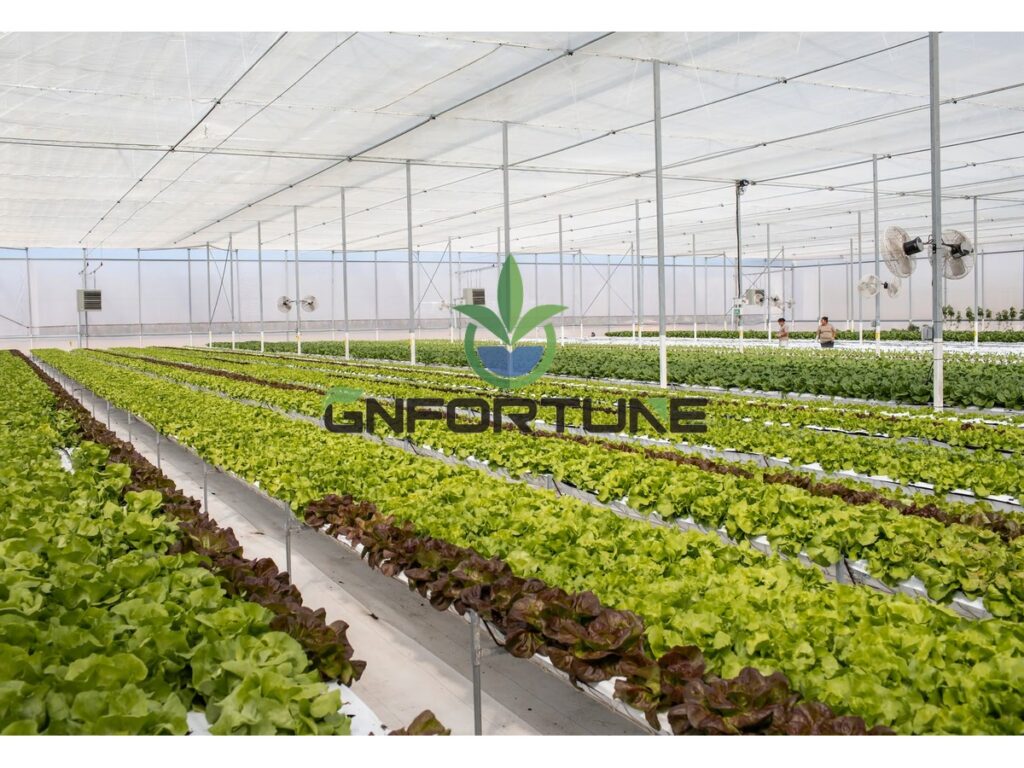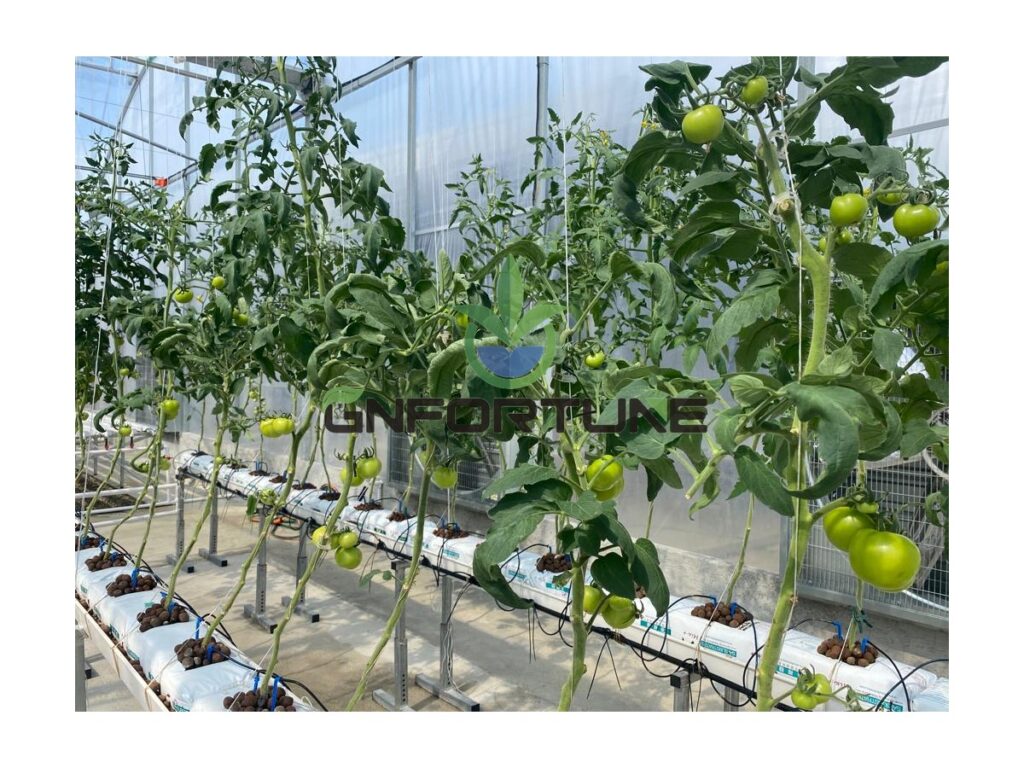
Ask most growers why their cost per plant creeps up, and the answer usually sits at one of two places: too much floor spent on seedlings, or seedlings moved into grow-out before they were ready. Staged hydroponic production is the standard answer to both. The young plant phase and the finishing phase want opposite things from the same square metre, and trying to satisfy both in one system leaves one of them chronically compromised.
What follows is written from installation and commissioning work, where the layout has to survive contact with a real crop calendar rather than a spreadsheet.
What Staged Hydroponic Production Means
Staged production splits the crop cycle into two physically separate zones. A nursery raises seedlings from seed or plug to transplantable size at high density. A grow-out area then carries those plants to harvest at final spacing, with its own irrigation programme and structural batch.
The split is not only about space. Each stage gets its own solution recipe, its own flow rate, its own light environment and its own labour calendar. That independence is the actual benefit — you can adjust one without destabilising the other.
Why One System Cannot Run Both Stages Well
A seedling needs low light intensity, tight spacing and shallow root volume. A finishing lettuce or tomato needs full light, wide spacing and substantial solution delivery. Those are conflicting hardware requirements, not preferences.
- Spacing: nursery grids can be several times denser than final spacing; a system built for final spacing wastes most of its area during the first weeks.
- Irrigation volume: young plants need frequent, small applications; mature plants need fewer, larger events. One pump programme serving both stages inevitably under-serves one.
- Solution demand: seedlings run a milder recipe. Running them on finisher-strength solution to save plumbing is a common cause of early tip burn and stretch.
- Light: nursery benches often sit under shade or supplemental-lighting regimes that would be wasteful across a whole production bay.
When one zone has to do both jobs, the compromise usually lands on the seedling, which is the worst place to lose quality — every downstream miss traces back to it.
Nursery: Density, Light and Cycle Time
Hydroponic nursery design starts from how many plugs leave per week, because that number drives everything else. Work backwards from the transplant schedule, add a germination and establishment window, then size the bench area that has to stand at any one time.
Cycle time in the nursery is the variable most often underestimated. Germination, cotyledon expansion and true-leaf development each have their own duration, and cool seasons stretch all of them. Sites that plan only to the warm-season number hit a seasonal plug shortage in their first winter.
Light is the second lever. Excess intensity early produces leggy, soft transplants; too little produces slow, poorly rooted plugs that stall after transplant. Most designs keep nursery lighting independent so intensity and photoperiod can be tuned without touching the production bay.
Environmental control and bench hardware matter more than any single device here. Practical detail on room-level setup sits in the propagation room guide, and tray and media choices are covered under tray cell counts and specifications and propagation media.
Grow-Out: Spacing, Irrigation Volume and Crop Load

The grow-out system receives plants at a defined size and carries them to specification. Once transplants arrive weaker or uneven than planned, the finishing stage cannot recover the lost weeks — it can only deliver a smaller or later harvest.
Spacing here is set by target plant size, not by seedling size. In practice that means one plug can occupy several times the area it had in the nursery, and the pipeline has to release plants in the order the finishing bays were cleaned.
Irrigation scales with canopy. Peak demand late in the cycle can be several times demand in week one, so pump duty and tank volume are specified against the last week rather than the first. Long-cycle crops such as tomato or cucumber commonly finish in Dutch bucket rows for exactly this reason.
Area Ratio and Transplant Scheduling
The question every project meeting asks is how much nursery area is enough. There is no universal constant, because the ratio depends on nursery cycle time, final spacing and harvest frequency.
The relationship is straightforward arithmetic rather than a rule of thumb:
- Nursery cycle time (days) divided by grow-out cycle time (days) gives the fraction of the finishing population that must be standing as seedlings at any moment.
- Multiply that fraction by the ratio of nursery density to final density to get area as a percentage of grow-out area.
- Add contingency for seasonal slowdown, germination losses and the fact that transplant labour is not available every calendar day.
In many leafy operations the resulting figure lands in a band rather than a single number, and short cycles with dense nursery grids sit at the low end. Buyers should treat any supplier quoting a fixed universal ratio as a red flag.
Scheduling is then a weekly rhythm: sow, germinate, harden, transplant, clean, repeat. Once that cadence slips, finishing bays sit empty or plugs get held too long, and both cost money. Hardening and handling are dealt with in the transplant shock guide.
An NFT nursery system is often used for the early phase because it handles plugs cleanly and turns over fast, before plants move to their finishing system. The deciding factor is plug size at handover, not fashion.
When a Single-Stage Layout Still Wins
Staging is not always the right answer. It adds a second set of systems, a second sanitation routine and a second skill requirement, and small operations sometimes pay more for that than they gain.
Single-stage layouts tend to make sense when:
- The crop is direct-seeded and never moved, removing the handover step entirely.
- Farm size is small enough that duplicating filtration and dosing outweighs the area saving.
- Labour is scarce and skilled propagation staff are harder to find than general crew.
- Plug supply is reliable locally — the buy plugs or run your own nursery decision should be settled before any nursery bench is ordered.
Plant site planning should test both options against the same crop calendar. If a single-stage layout delivers the same weekly output with less equipment, staging is an expense rather than an improvement.
FAQs About Staged Hydroponic Production
How much nursery area do we actually need?
Calculate it from your own cycle times rather than adopting a standard figure. Nursery days divided by grow-out days, adjusted for the density ratio, plus contingency for winter performance and transplant labour gaps.
Can the nursery and grow-out share one nutrient tank?
Rarely advisable. Seedlings need a milder recipe than finishing plants, and shared plumbing means one adjustment affects the stage that has least tolerance for it. Separate small tanks cost little and prevent that class of problem.
What is the most common staging mistake?
Under-sizing the nursery against the winter calendar. Summers produce enough plugs to hide the shortfall, then output drops in the first cool months and the finishing bays cannot be filled on schedule.
Should we use NFT channels in the nursery?
Often yes, for crops destined for NFT finishing, because plugs transfer cleanly and the nursery turns over fast. The deciding factor is the plug size at handover, so confirm it before choosing profile width.
Is staging worth it below a small scale?
Sometimes not. Duplicating filtration, dosing and sanitation has a fixed cost, so very small sites can be better served by one well-run system and bought-in plugs.
Next Step: What to Send for a Quotation
Nursery and grow-out are quoted as two scopes, and the handover point between them is where specifications most often diverge. Staged hydroponic production only pays when that interface is drawn before equipment is priced, so settle it first.
Planning a staged layout? For RFQ or project consultation, send: greenhouse dimensions for both zones; crop list with final spacing per crop; target weekly transplant count and harvest output; whether plugs are produced on site or purchased; local climate range and raw water analysis; requested automation level; desired delivery schedule; and the budget band. G AND N FORTUNE LIMITED supplies nursery and grow-out systems as matched, quoted-to-parameter scopes.