Commercial farms rarely pick a channel layout because it looks modern. They pick it because the crop mix leaves little choice. An NFT vs substrate gutter system decision starts with what you plan to sell in month six — leafy greens cut at four to six weeks, or vine and berry crops that need anchoring and months of support.
Everything downstream follows from that choice: tank volume, filtration class, pump redundancy, floor drainage and bench height. Getting it wrong at layout stage costs far more than any single line in the equipment budget.
What an NFT Channel System Actually Is
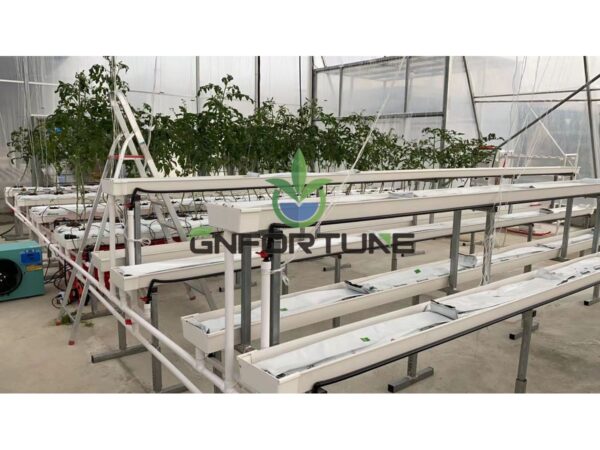
An NFT channel system runs a shallow film of nutrient solution along the base of a sloped, closed trough. There is no growing medium; plugs sit in holes in the lid and roots spread into a mat touching both the film and the humid air above it.
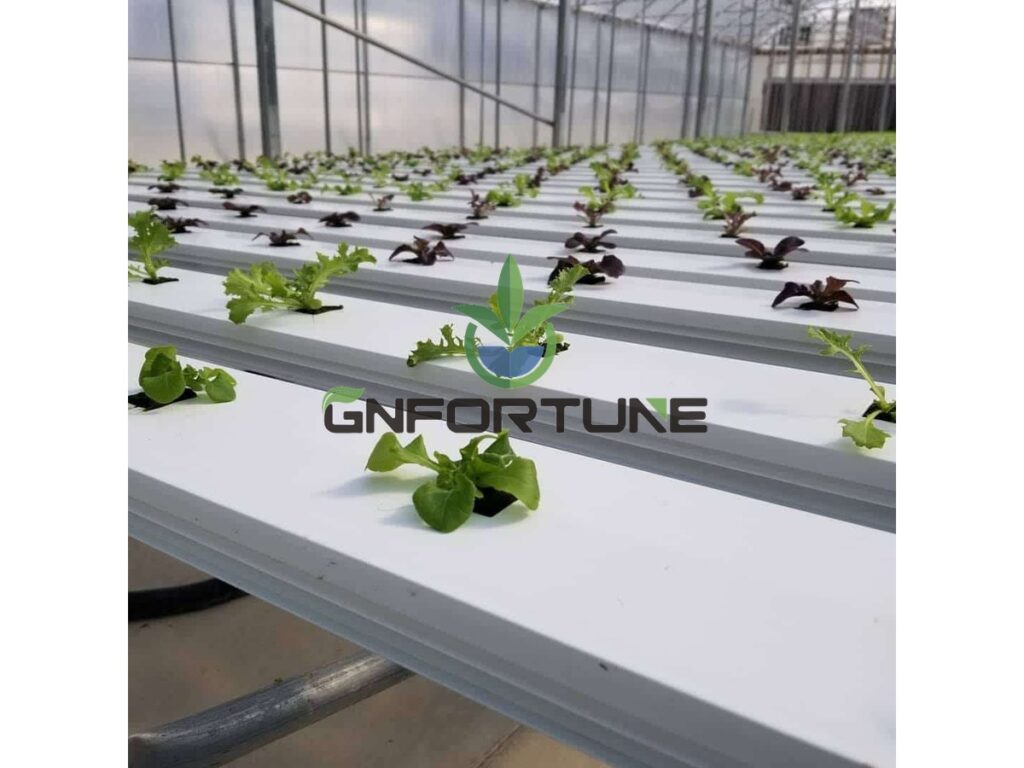
That air gap is the working principle rather than a side effect — most oxygen exchange happens there. Lose it and the crop behaves like a poorly drained pot.
In commercial projects the profile does much of the specification work. Typical choices are 100×50 mm sections for high-density leafy work and the wider 73×62 mm MGS profile where root mass is larger or access matters. Openable-lid designs exist specifically to make clean-out between cycles practical.
Two engineering constraints come up on nearly every site visit. The first is slope and level: supports must hold a consistent gradient along the whole run, or solution ponds in low spots and starves high ones.
The second is effective run length. Beyond roughly 10–15 m per run — depending on flow rate, temperature and crop load — dissolved oxygen and root-zone temperature drift enough to show as uneven growth at the outlet end. Larger sites usually respond with short runs and re-aeration rather than one long slope.
What a Substrate Gutter Hydroponic System Does Differently
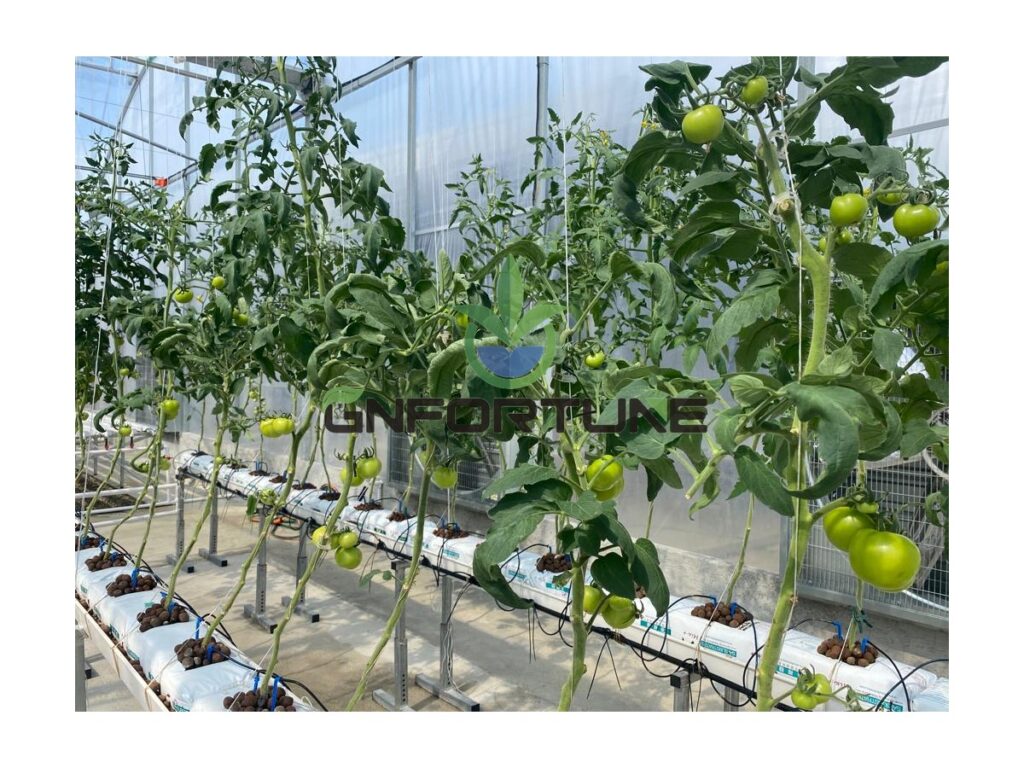
A substrate gutter is a trough holding a medium — coir, coir/perlite blends or rockwool slabs — fed by drip or short ebb cycles that drain back through the channel or a separate return line. Plant weight is carried by something solid, not by a plastic lid.
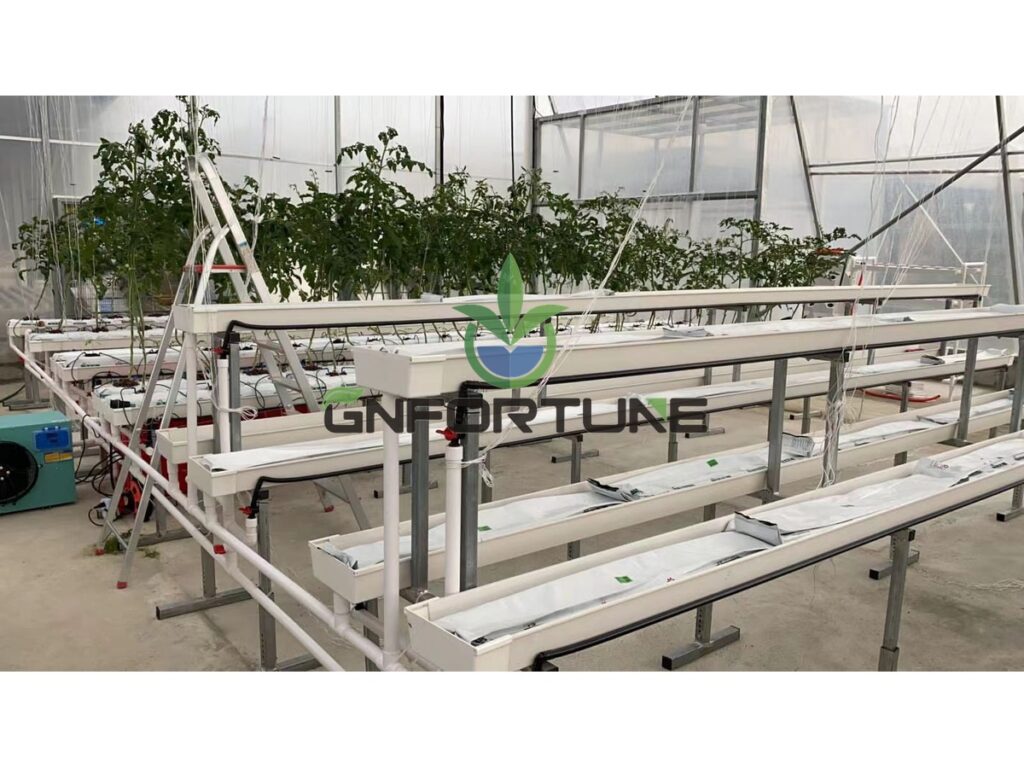
The medium also buffers water and nutrients. A pump failure becomes an incident rather than an emergency, because the root zone holds reserve solution for hours.
Crop Fit: Which Crops Each System Handles
Crop fit decides the purchase more often than price does. Short, light, single-harvest crops suit channels; tall, heavy, repeatedly harvested crops suit gutters. Everything in between is a judgement call about labour rather than about yield.
| Factor | NFT channel system | Substrate gutter system |
|---|---|---|
| Typical crops | Lettuce, basil, Asian greens, arugula, herbs | Tomato, cucumber, pepper, strawberry, melon, eggplant |
| Cycle length | Short (4–8 weeks typical planning assumption) | Long (4–10 months on the same plant) |
| Plant anchoring | Lid hole only; limited support | Medium mass plus trellis hardware |
| Turnover style | Whole block replanted frequently | Continuous harvest from standing plants |
| Root disease exposure | Spreads fast once established | Slower spread, harder to fully sanitise |
| Buffer against pump failure | Very low | Moderate to high, depending on media volume |
Two related routes often sit in the same shortlist. Commercial DWC raft bed design suits farms wanting a larger solution buffer for fast-turning leafy crops, and the NFT channel wholesale buying guide covers profile selection for bulk orders.
Root Zone and Irrigation Behaviour
In NFT the root zone is thin, fast-moving and sensitive to any flow interruption. Solution temperature follows the tank closely, which helps in cool seasons and hurts in hot ones; warm-climate projects often add tank chilling or shorten runs.
Standing volume is minimal, so EC climbs quickly under high transpiration. Monitoring resolution matters more here than in buffered systems.
A substrate gutter holds far more solution per metre of trough, and considerably more per plant once the crop is large. Irrigation is scheduled in events, with pulse frequency adjusted to crop stage, weather and medium type.
Over-irrigation is the usual failure rather than under-irrigation: a permanently saturated slab loses air space, and root health declines quietly until the canopy stalls.
Filtration and return-line hygiene apply to both routes. Recirculating designs need filters sized to the emitter orifice — drip emitters clog, channels have none — and drain-to-waste changes both cost and permitting. Confirm local discharge rules early.
Labour, Cycle Turnover and Sanitation
Channel systems reward disciplined turnover: a block comes out, the trough is cleaned, biofilm is removed, and new plugs go in within hours. Turnaround slips if bench height and aisle width were not designed for that job.
- Channel route: fast, repeatable sanitation; high sensitivity to labour scheduling; no medium to dispose of.
- Gutter route: fewer turnovers, but each one involves moving out spent media, which carries handling, transport and disposal cost that buyers routinely under-budget.
- Long-cycle labour: trellising, pruning, leaf removal and harvest dominate gutter systems, so labour planning shifts from weekly peaks to daily routine.
Media then becomes a recurring line rather than a one-off purchase. Pallet volumes, MOQ and freight economics are covered in the growing media wholesale guide, and belong in first-season cost modelling.
Capex and Running Cost Drivers
Per square metre of growing area, channels are usually the lower-hardware option, and that is where comparisons go wrong. They demand tighter levelling, finer filtration, generous pump redundancy and often backup power or automatic failover, all of which belong on the same page as the trough price.
Substrate gutters cost more per trough and add media, drip lines, emitters and larger return tanks, but tolerate rougher floor tolerances and longer pump outage windows. Their recurring cost is media replacement and disposal; their recurring saving is outage forgiveness.
Scope discipline matters here. Two quotations can differ by whole subsystems, so what a complete hydroponic system package includes is worth reading before comparing numbers.
The useful metric is cost per sellable kilogram, not cost per installed square metre. A slightly dearer system that holds specification through a pump fault usually recovers the difference within a few cycles.
NFT vs Substrate Gutter System: How to Decide for a Mixed Crop Farm
Mixed operations should stop looking for one answer and instead split the site into blocks by crop family. The decision sequence below is the one most engineering teams converge on.
- List every crop with its forecast revenue share. Include planned lines, not only the launch crop.
- Sort by harvest pattern. Single-harvest and light crops move toward channels; continuous-harvest and heavy crops move toward gutters.
- Check the shared infrastructure penalty. Two systems mean two sets of filtration, spare parts and spare labour skills. Below roughly 2,000–3,000 m² of growing area that duplication often outweighs the agronomic benefit.
- Allocate area by revenue, not by enthusiasm. If 70% of planned revenue is leafy, channels take most of the floor; the fruiting block gets the bay it needs, not the bay that photographs well.
- Confirm the interface early. Common tank room, separate feed recipes, and independent valve groups prevent cross-contamination between blocks.
Layout geometry then meets building shape. Clear spans suit long rows, while constrained multi-span sites often favour compact blocks; the horizontal NFT vs A-type layout comparison covers that trade-off.
Commercial hydroponic system selection is also a supply question. Suppliers that extrude their own profiles and mould their own fittings generally hold tighter tolerances on lid closure, which matters over ten years of washing far more than in week one.
FAQs About NFT Channels and Substrate Gutters
Can one greenhouse run both systems at once?
Yes, on separate valve groups fed from independent recipe tanks. Keep the shared items — filtration, chilling, dosing — separately sized per loop, and expect two sets of labour skills and spare parts.
Which system uses less water?
NFT generally has lower standing volume and can be run with less total solution, but it recirculates continuously and heats faster. Real water consumption depends more on climate, screen strategy and whether the design recirculates or drains to waste than on trough type.
Is a channel system always cheaper to build?
Usually per linear metre, not always per installed square metre. Levelling structure, filtration class, pump redundancy and backup power frequently close part of the gap.
How long do channels and gutters last?
Both are typically specified as multi-year assets in UV-stabilised material, and actual service life depends much more on cleaning practice and water chemistry than on the extrusion itself. Buyers should confirm warranty terms and UV package in writing.
What should we install first if the future crop mix is uncertain?
Build the bay that serves committed demand, and leave valve and tank capacity for a second loop rather than oversizing one system. Adding a second block later is cheaper than retrofitting the first.
Next Step: What to Send for a Quotation
Both routes can be quoted to project parameters, and numbers are only comparable when every bidder prices the same input list. Send one identical package to each supplier and require scope boundaries in writing. An NFT vs substrate gutter system decision reached before that stage rarely needs revisiting during installation.
Ready to shortlist one hydroponic system? For RFQ or project consultation, send: growing area and greenhouse dimensions; target crop mix with revenue split per crop; daily or annual output target; local climate range and raw water analysis; required automation level; preferred delivery window; and the budget band you are working to. G AND N FORTUNE LIMITED manufactures NFT channels, gutters and complete system packages and quotes against those parameters.