
Seed Trays and Plug Trays: Cell Counts, Specs
Seed starting trays are specified by cell count and bought by the pallet, and those two decisions are usually made months apart by different people. Cell count decides how long a seedling can stay in the plug before it roots out; pallet quantity decides whether the propagation room runs short in week three. For a buyer, the useful question is not which tray is cheapest but which tray keeps its dimensions through a wash cycle and through a denesting machine.
Cell Count Sets Your Transplant Timing
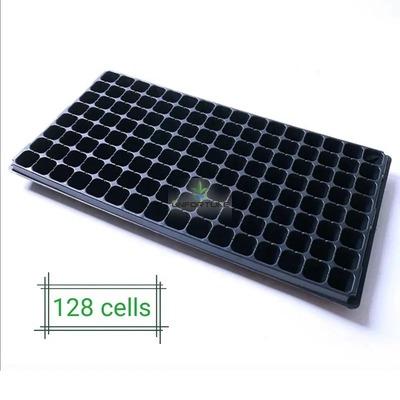
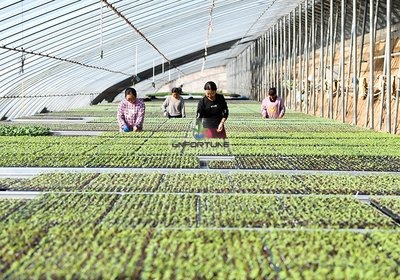
Cell count is a calendar decision. More cells per tray means less media volume per seedling, and less root volume means fewer days before the plant roots out and growth checks. Propagation rooms running lettuce and herbs typically use 200 to 288 cells; tomato, cucumber and pepper programs more often run 72 to 128 cells, because the crop is held longer before transplant.
| Cell count | Cell volume | Typical plug dwell | Common crop |
|---|---|---|---|
| 288 | 10 to 14 mL | 14 to 21 days | Lettuce, herbs, fast turns |
| 200 | 14 to 20 mL | 18 to 25 days | Leafy greens, Asian greens |
| 128 | 22 to 30 mL | 25 to 35 days | General vegetable transplants |
| 72 | 40 to 55 mL | 30 to 45 days | Tomato, cucumber, pepper |
| 50 | 70 to 90 mL | 40 to 55 days | Long-hold and grafted plants |
| 32 | 110 to 150 mL | 50 to 70 days | Large vine starts |
The scheduling effect is easy to underestimate. A room that turns 288-cell trays every three weeks needs seeding slots booked to the day, because a plug held a week past its window loses quality that no amount of transplant care recovers. Lower cell counts buy schedule slack, and that slack is worth more in a busy season than the extra trays cost.
Two checks belong in every enquiry. Ask for cell volume in millilitres rather than cell count alone, because two 128-cell trays from different tools differ in volume by a wide margin. And confirm the drainage hole diameter, commonly 3 to 6 mm, since an oversized hole loses media and an undersized one holds water at the base of the plug.
Tray Depth and Root Volume
Depth matters as much as footprint. Plug trays in the 40 to 50 mm range suit short-turn crops; deep trays at 60 to 75 mm are used where roots need to run before transplant, and for grafted seedlings that need room for the union and for healing. Media consumption scales with depth rather than with tray count, so a change in depth changes the media order.
The media consequence is worth pricing before the tray order is signed. Filling 1,000 trays of 128 cells at about 25 mL per cell uses roughly 3.2 m³ of propagation media, while 1,000 trays of 72 cells at 45 mL per cell uses a similar volume but carries far fewer plants. Media cost per seedling is therefore the number to compare, not media cost per tray.
Footprint should follow the equipment you already own. The 540 by 280 mm format is the common denominator across benches, propagation racks and seeding lines, and anything outside it needs a machine specification to justify it. Where propagation is automated, the tray is the interface between the seeding machine and the transplant crew, and the automated seeding line guide sets out the dimensional checks that matter.
Plug Trays and Seed Starting Trays: Materials Compared
Plug trays are usually thinner and lighter, built for one or two cycles. Seed starting trays intended for a propagation room are heavier and expected to be washed and reused. The difference sits in the polymer and the forming process, and it shows up in the wash more than in the first cycle.
| Material and process | Wall thickness | Service life | Note |
|---|---|---|---|
| HIPS, vacuum-formed | 0.6 to 1.0 mm | 1 to 3 cycles | Cheapest; deforms in hot wash |
| PP, vacuum-formed | 0.7 to 1.2 mm | 3 to 5 cycles | Better crack resistance |
| PP, injection moulded | 0.9 to 1.6 mm | 5 to 8 cycles | Highest unit cost, longest life |
| rPET or bio-based | Varies | 1 to 3 cycles | Check heat tolerance and compost claim |
Specify three numbers in writing: the polymer by name, the wall thickness measured at the cell base rather than at the rim, and the tray weight in grams. Weight per tray is the fastest way to compare two quotes that look identical on paper, because a tray that is 30 percent lighter is a thinner tray.
Nesting, Stacking and Denesting Machines
Nesting pitch is the height one tray adds to a stack, and it drives freight and machine compatibility together. Vacuum-formed trays commonly nest at 8 to 12 mm per tray, while injection-moulded trays with a steeper draft can nest at 5 to 8 mm. Across a container, that gap is the difference between a full pallet plan and a half-empty one.
How to read a tray quote: the price per tray is the least informative number in it. Ask for tray weight in grams and nesting pitch in millimetres, and the cheapest quote usually turns out to be a lighter tray shipped in fewer units per container.
Denesting is where automation projects stall. Mechanical and vacuum denesters need a consistent rim, an anti-nesting lug and a wall thickness that survives the pulling force, and a tray that nests too tightly will double-feed. If a seeding line is inside the project scope, get the tray approved by the machine supplier before the tray order is placed rather than after.
Storage on site follows the same dimension. A stack of nested trays grows by the nesting pitch per tray, so 100 trays at 10 mm add about a metre of height, and the empty-tray store needs rack spacing planned around that rather than discovered later.
Washing, Sterilising and Service Life
Reuse is a cleaning problem before it is a material problem, and wash temperature is the binding limit. PS trays begin to deform as wash water approaches 70 °C, while PP trays tolerate 80 to 90 °C. Where hot water is not available, chemical disinfection with peracetic acid or hydrogen peroxide at supplier-recommended rates, followed by a rinse and a drying cycle, is the alternative.
Drying and quarantine are the steps most programs skip. Trays coming out of a wash still carrying free water carry pathogens into the propagation room, so a drying or forced-air stage before stacking is part of the cycle time, and washed trays should be held away from used trays awaiting cleaning. In a room running continuous seeding, that quarantine area needs floor space in the layout.
In practice, service life is decided by handling between cycles, since cracking starts at the rim during stacking and denesting more often than in the wash. Budget an annual replacement of 5 to 10 percent of the tray population and treat the broken-tray count as the signal that a spec is wrong. The rockwool plug sizes a nursery runs also set a floor on cell diameter, and grafted seedling programs need the depth that healing requires.
Ordering: Cases, Pallets, Spares and Red Flags
Confirm the commercial terms before the technical ones are finalised, because they change the landed number:
- Selling unit. Cartons of 50 to 100 trays, pallets of 1,000 to 2,000.
- Container plan. A 40 ft high-cube commonly takes 15,000 to 40,000 nested trays depending on nesting pitch and cartoning.
- Spares. Plan 5 to 10 percent of the tray population per year for breakage and loss.
- Custom work. A new cell geometry needs tooling; colour and a moulded logo usually carry a minimum of one production run.
Red flags in a tray quotation are consistent across suppliers. A price with no tray weight, no material declaration and no wall thickness cannot be compared with anything. Samples that are not from production tooling tell you nothing about the delivered tray. A recycled content claim without a percentage, and a compostable claim without the standard it meets, belong in the same category. Where the tray feeds a machine, a supplier who will not send a nesting sample is telling you they have not run that interface before.
Frequently Asked Questions
Which cell count suits lettuce plugs?
A: 200 to 288 cells, with roughly 14 to 25 days in the plug depending on season and light.
Can PS trays be washed at 80 °C?
A: No. PS begins to deform near 70 °C, so a hot-wash program needs PP trays.
How many trays fit in a container?
A: Commonly 15,000 to 40,000 nested trays in a 40 ft high-cube, depending on nesting pitch and whether trays are cartoned.
Are injection moulded trays worth the premium?
A: Only if trays are washed and reused over five or more cycles; for one- or two-cycle programs, vacuum-formed trays are cheaper per seedling produced.
What is the biggest red flag in a tray quote?
A: A price per tray with no weight in grams, no polymer named and no nesting pitch declared.
Seed starting trays and plug trays cost little per unit and a great deal per mistake, so the specification belongs in the enquiry rather than in the packing list. Ask for the numbers above and compare every supplier on the same basis.
Put Tray Specs in the Enquiry
Send cell count, cell volume, footprint, depth, material, tray weight and annual volume, and ask for nesting pitch and wash temperature in writing. Plug trays that survive the wash and the denester are worth more than the cheapest unit price, and request a tray program quote with every one of those numbers declared before you compare suppliers.


