

Walk a large commercial NFT farm almost anywhere and you are walking a horizontal layout: single-level channels in rows, lettuce to the horizon, sun doing the lighting work. This 3,000 m² base in Dongguan is a working example of why the horizontal NFT system remains the default for large-scale growing — and what a big layout gets right that a small one can ignore.
What Was Built at the Dongguan Site?
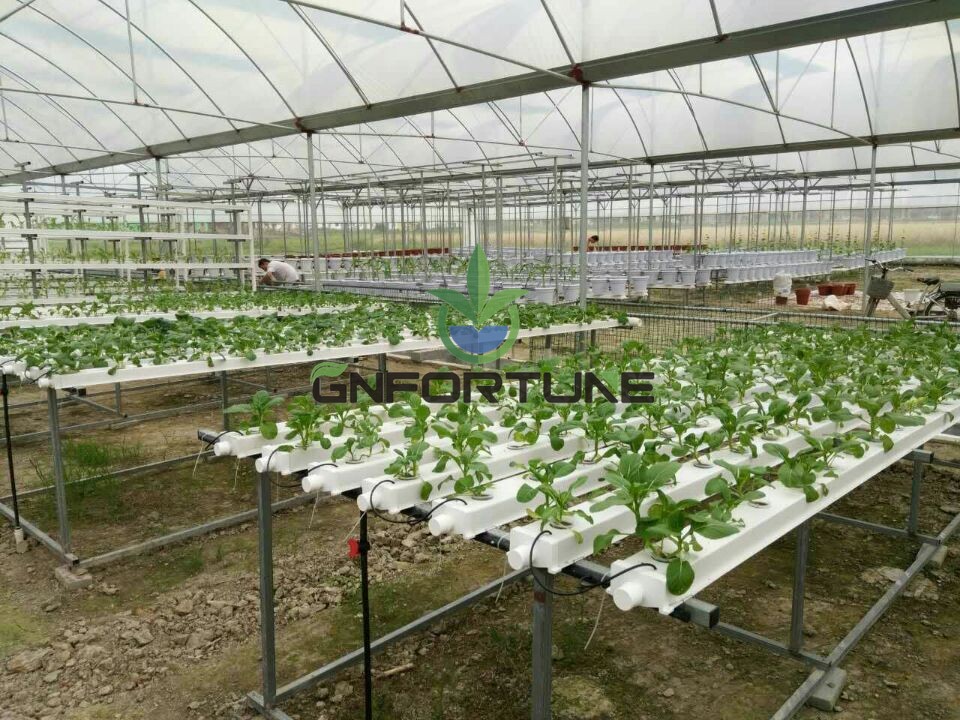
The project is a 3,000 m² greenhouse base running our horizontal NFT system for leaf vegetables: single-level rows of channels on supports, nutrient supply and return along the rows, planted to lettuce in continuous cycles. The design brief was scale economics — maximum output per unit of capital, with labour and operations kept simple enough to run every day without specialists on site.
Horizontal is the most commonly used NFT design, and the reasons are visible in this house: sunlight reaches the crop without obstruction, there is no directional constraint from the rack, and air moves freely down the rows. Installation is straightforward, cost per square metre is the lowest of the layouts we build, and planting and picking are ergonomic single-level work.
Why Does Horizontal Keep Winning for Large Farms?
| Factor | Horizontal NFT | Why it matters at scale |
|---|---|---|
| Sunlight | Full, unrestricted exposure | No lighting capex or electricity; the sun is the cheapest lamp |
| Air circulation | Free flow along and across rows | Lower disease pressure; fewer microclimate pockets to manage |
| Installation | Simple, fast, low-cost per m² | A 3,000 m² build completes in weeks, not months |
| Daily operation | Planting and picking at one ergonomic height | Labour stays simple and trainable at crew scale |
| Management | Every plant visible from the aisle | Scouting, grading and replacement happen in real time |
The trade-off is land: horizontal uses more ground per kilogram than any stacked layout. Where land is the scarce input, that trade flips — which is exactly when we steer buyers toward “A” type or multi-tier instead.
How Was the Layout Planned?
- Row orientation set against the sun: rows run so no crop shades the next; orientation was fixed before any structure was quoted.
- Aisle width set by the trolley, not the minimum: every row is reachable for planting, scouting and harvest with the carts the crew actually uses.
- Slope and flow verified per block: the site is level enough for consistent fall along channel runs, and flow was balanced per irrigation block, not per house.
- Head-end sized for the whole area: tank, dosing and filtration specified once for the full 3,000 m², with expansion stubbed in rather than retrofitted.
None of these decisions is exotic — which is the point. Large horizontal farms succeed on unglamorous discipline: level racks, consistent slope, clean flow, and a layout the crew can work at pace.
What Has Operation Shown Since Planting?
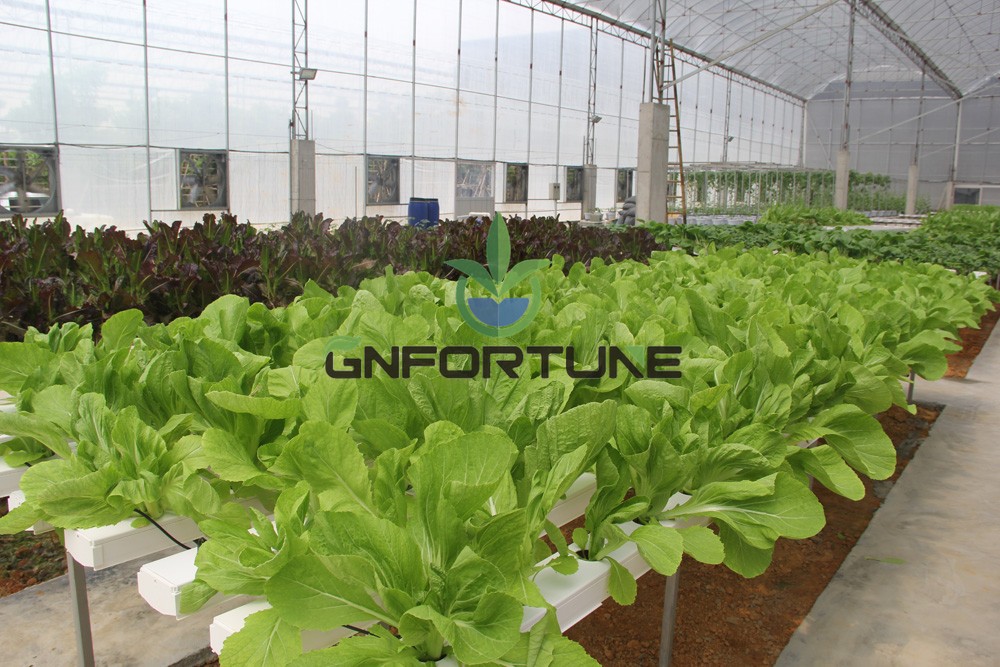
The house runs continuous lettuce cycles, and the operational lessons are the ones experienced growers expect. Labour per kilogram stays low because every task happens at aisle level. Air movement keeps disease pressure manageable in the humid season, helped by spacing rows for ventilation rather than squeezing the maximum channel count into the footprint. And because the layout is uniform, problems found in one row are fixed the same afternoon across the house — the operational simplicity that makes horizontal the design we recommend for large-scale planting.
For buyers planning a first large greenhouse, this project is one of the sites we reference: it shows the layout at working scale, with the crew routines and the harvest rhythm that only months of operation demonstrate.
FAQs About Horizontal NFT Systems
Why is horizontal NFT the default for large farms?
Because it minimises cost per square metre while keeping every agronomic factor simple: unrestricted sunlight, natural airflow, fast installation and ergonomic one-level work. At large scale, that simplicity compounds — training, maintenance and harvest all stay routine. Stacked layouts only win when land, not capital, is the binding constraint.
How much land does a horizontal NFT farm need?
A horizontal layout needs roughly the full footprint as growing area, plus aisles and the head-end. For leafy greens at commercial density, a useful planning figure is output per square metre of greenhouse floor rather than per hectare of land. Where land is expensive, “A” type or multi-tier systems trade structure cost for footprint.
Does row orientation matter in a horizontal NFT house?
Yes. Rows should run so plants do not shade their neighbours through the day, and the greenhouse axis should suit your latitude’s sun path. Orientation is fixed before structure is quoted, because it affects rack layout, aisle position and ventilation opening all at once — it is cheap to decide early and expensive to fix later.
Is horizontal NFT compatible with strawberry or vine crops?
Leaf vegetables are the natural fit for standard horizontal NFT. Strawberry production usually runs a dedicated gutter profile with drainage, and vine crops such as tomato and cucumber normally use substrate gutters or Dutch buckets instead. The horizontal principle extends, but the channel and spacing change with the crop.
Can a horizontal farm expand later?
Yes, and it should be planned to. Sizing the nutrient, dosing and filtration head-end for the full eventual area — with distribution stubbed for future blocks — turns expansion into a channel-and-rack order rather than a redesign. The alternative, retrofitting a bigger head-end mid-production, is the most common and most avoidable expansion mistake.
What to Send When You Request a Quotation
For a large horizontal project, send: greenhouse dimensions or land availability, target crop and volume, location, and your phase-one versus total target. We will return a layout with block planning and a head-end sized for the whole site: contact our team.
Related reading: run the crop with the commercial lettuce production guide, plan the install with the layout, slope and flow guide, and compare with the 1-hectare herb farm case study.