Fodder Units Sell on Vision, Survive on Arithmetic
Hydroponic fodder has the best demonstration videos in agriculture: seven days from grain to green mat, cattle eating it like candy. The technology is real and the biology is real. What varies enormously is the business — the same 6-day cycle is a profitable feed line on one farm and an expensive hobby on the next. The difference is never the tray. It is the arithmetic around the tray.
This guide is about hydroponic fodder economics: conversion ratios, cost per kilogram of dry matter, and the three customer situations in which the model genuinely pays.
The Conversion Facts First
| Parameter | Typical figure | What it means |
|---|---|---|
| Grain to fresh fodder (6–7 days) | 1 kg grain → 5–7 kg fresh mat | The headline number buyers quote |
| Dry matter of fresh fodder | 12–18% | The number that decides feed value |
| Dry matter recovery | 80–90% of grain DM | Some DM is spent on respiration |
| Protein uplift | Modest, digestibility improves | Fodder is not a protein concentrate |
| Water per kg grain | 1.5–2 L | Far below pasture or forage crops |
| Land per unit | Tens of m² vs hectares | The real argument is land, not feed cost |
Read the second row carefully. A tonne of fresh fodder contains roughly 150 kg of dry matter. Anyone comparing “fodder at $X/t versus hay at $Y/t” without adjusting for dry matter is comparing lettuce with hay.
Cost Per Kilogram, Honestly
Build the daily cost of one tray cycle:
- Grain: barley or maize at local price — usually 70–85% of total cost
- Labour: sowing, harvest, washing — target under 10 minutes per tray, all-in
- Power: pumps, lights in closed rooms, climate control — modest but climate-dependent
- Water and seed treatment: small
- Depreciation: unit cost ÷ design life — the line vendors leave out
Then divide by dry matter, not fresh weight. On most grain prices, fodder dry matter costs more than the same grain fed directly. That is expected — you are buying digestibility, palatability and freshness, not cheap calories. The farm that understands it is buying a premium functional feed prices and uses it correctly. The farm chasing cheap feed is disappointed within a season.
Where the Model Genuinely Pays
- Dairy and showstock — the digestibility and intake response supports measurable milk or conditioning value per head
- Drought and land-constrained operations — where forage cannot be grown or trucked economically, a unit is a forage factory in 30 m²
- Islands and high-freight regions — where imported hay carries shipping that fodder grain does not (grain is denser and cheaper to freight)
What does not pay: replacing concentrate for beef finishing on cheap grain, or buying a unit “to try” without a livestock budget that assigns value to the output.
Sizing to the Herd, Not the Brochure
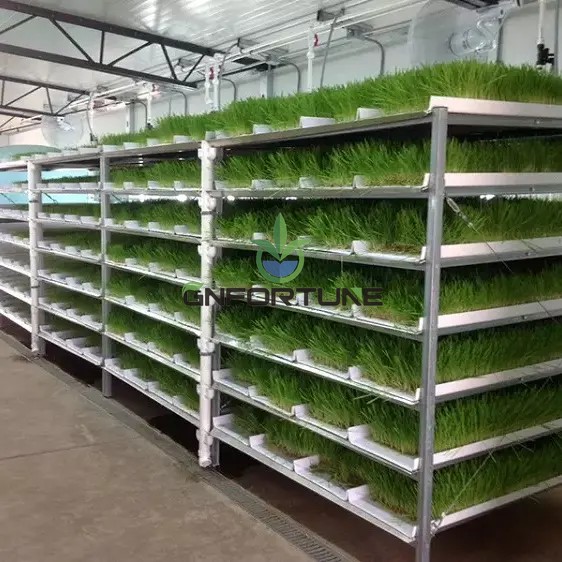
Work backwards: animals fed × kg fresh fodder per head per day ÷ kg per tray × cycle days = trays in production. Add 10–15% spare trays for washing and scheduling slack. Then check the room: one tonne of daily fodder needs a serious grain store, a wash-and-soak line, and about 100+ m² of racks with access both sides. Undersized washing capacity is the most common bottleneck — trays must wash as fast as they harvest.
Plan the hygiene regime from day one: mould is the failure mode of every neglected unit. Daily inspection, wash-water sanitation, air movement and discarding any tray with visible mould beats any treatment after the fact.
FAQ
Is hydroponic fodder cheaper than hay?
Usually not on a dry-matter basis where hay is locally available. It wins where hay is expensive, imported or unreliable — and where its digestibility and intake benefits convert to production.
How much fodder per cow per day?
Typical inclusion is 8–15 kg fresh fodder per head as part of a balanced ration, replacing a slice of forage — not the whole forage base. Ask a nutritionist to place it in your ration before you buy.
What grain works best?
Barley is the standard for sprout reliability and mat structure; maize and sorghum work in hot climates. Clean, high-germination grain is non-negotiable — the fodder unit amplifies grain quality, good or bad.
How long does a cycle take?
Six to seven days from soak to feed. That means seven days of trays in the room at all times and a strict daily rhythm — the unit is a commitment, not a weekend device.
Is mould controllable?
Yes, with clean grain, sanitized trays, good airflow and fast disposal of any suspect mat. Units fail from skipped hygiene, not from the technology.
Can I sell fodder to other farms?
Sometimes, near cities with horse, dairy or show livestock. But fresh fodder is perishable and daily — you are selling a service with a delivery route, not a product. Model it as a route business or not at all.
Price the Tray, Not the Dream
If you have a herd, a grain price and a target inclusion rate, we will run the tray numbers for your operation before you buy anything. Start with the quote form.
Related reading: the growing side is covered separately — see how hydroponic fodder systems work, plus the commercial context in, crop and product economics, the KPIs that run a business and realistic project sizing.