

Every channel supplier claims a better profile. Very few can point at a registered design and say what it changes in the field. Our third-generation channel carries design patent ZL 2015 3 0540157.9, and the feature it protects — the curved base — is not styling. It changes how the nutrient film behaves, and that is where the reported savings come from.
This guide explains what the curved base does to the film flow, why the water and fertiliser saving is claimed at around 50%, how the material package supports a service life beyond 10 years, and where the patent’s limits are — honestly stated.
What Is the Patented Curved-Base Design?
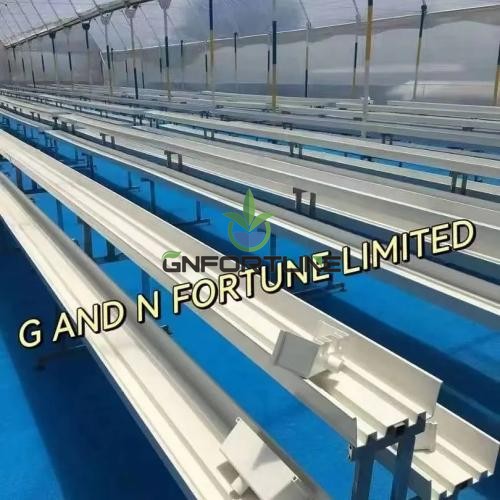
A conventional NFT channel has a flat base: the nutrient film spreads as a wide, shallow sheet, and flow behaviour depends heavily on how level the installation is. The patented third-generation profile shapes the base as a curve instead, so the film is guided rather than spread.
The curve does three jobs at once. It concentrates the solution into a more consistent film that keeps contact with the root zone along the channel length. It tolerates minor installation imperfection better, because the geometry self-centres the flow instead of letting it wander to one side. And it stabilises the path of the solution past every planting site, so roots along the whole length see comparable conditions — not lush at the head of the channel and starved at the tail.
How Does a Curved Base Save Water and Fertiliser?
The claim attached to the design is roughly 50% saving on water and fertiliser, and the mechanism is worth understanding before believing any number. Flat-base channels compensate for uneven distribution with generous flow rates: more solution is pumped to make sure the far end gets enough, and the surplus drains away to be replaced. The curve removes the need for that insurance flow — the guided film reaches the end of the channel at adequate rate with a lower supply volume.
| Design factor | Flat base | Curved base |
|---|---|---|
| Film behaviour | Spreads wide, sensitive to level | Guided, self-centring film |
| Flow rate needed | Higher, to cover distribution error | Lower, geometry does the distributing |
| Root contact along length | Varies head to tail | More uniform along the run |
| Recirculation load | Larger volume pumped and returned | Smaller volume, same crop |
A smaller pumped volume means proportionally smaller electricity for pumps, smaller tank turnover, and less nutrient dosed to achieve the same crop — the compound effect behind the saving figure. Your own validation block is the place to confirm the percentage for your crop and layout; the design explains why the direction of the saving is consistent.
What Does the Material Package Contribute?
The profile is half the story; the compound is the other half. The third-generation channel is specified with an anti-UV, environmentally friendly material package, heavy-metal free and RoHS-certified — a formulation decision that matters as much as the geometry for a channel whose service life is stated at more than 10 years.
- UV stabilisation built into the compound: the protection does not wear off, because it is the material, not a coating.
- Heavy-metal free, RoHS-certified: relevant for food-adjacent production and for the compliance paperwork your market may require.
- Service life beyond 10 years: the design life the compound is formulated — and warranted — for.
- Suitable for leaf vegetables: the profile and compound pair is tuned for lettuce and various leafy greens, the main commercial NFT crops.
Buyers comparing channels should weight these two halves equally: an excellent geometry in an under-stabilised compound fails at year three, and a durable compound in a flat-base profile pays forever in pumping.
What Does the Design Patent Actually Protect — and What Not?
Honestly stated: a design patent protects the appearance of the product — the specific shape as registered — not the abstract idea of a curved channel base, and not every curve a competitor might draw. Its value to a buyer is indirect but real. It is dated, verifiable evidence that this profile is our own development rather than a copied shape, it anchors the generation numbering in something checkable, and it tells you the maker invests in design at all — with eight national patents across the range as the wider pattern.
What proves the channel in the end is not the certificate but the crop: the profile ran full production cycles in our own trial greenhouse before commercial release. The patent identifies whose design you are buying; the growing validates it.
FAQs About the Patented NFT Channel
What is patent ZL 2015 3 0540157.9?
It is the design patent registered for our third-generation NFT channel, covering the profile’s specific curved-base shape. It is verifiable evidence that the geometry is our own development, dated and on public record. For buyers, it distinguishes an original design from a copy — one practical check when comparing suppliers who all claim “improved” profiles.
How does the curved base save water and fertiliser?
The curve guides the nutrient film into a consistent, self-centring flow, so channels reach the far end at adequate flow without the insurance surplus that flat-base layouts pump. Less solution pumped and dosed for the same crop is the saving — reported at around 50% on water and fertiliser. A validation block on your own site will confirm the figure for your conditions.
How long does the channel last outdoors?
The compound is formulated for a service life of more than 10 years, with UV stabilisation built into the material rather than applied as a coating. Resistance to UV degradation is a formulation property you verify through the datasheet, samples and the written service life, not through appearance on delivery day.
Is the channel material food-safe?
The compound is heavy-metal free and RoHS-certified, which addresses the materials side of food-adjacent compliance. Which documentation your specific market requires for import and food safety varies, so confirm the declarations you need at order time — the compliance certificates are supplied with the goods.
Which crops is the patented profile for?
The profile is designed for leaf vegetables — lettuce and various leafy greens — where film-flow NFT is the commercial standard. Vine crops and strawberries use different geometries: substrate gutters, strawberry gutters or Dutch buckets, each with its own design logic. Matching profile to crop is part of the quotation, not an afterthought.
What to Send When You Request a Quotation
Send your crop, channel length and total metres, and whether the installation is indoor or greenhouse. We will confirm the profile, the compound specification in writing, and the savings logic for your layout: contact our team.
Related reading: see how certifications translate to buyer value in patents and certifications explained, check the materials side in food-safe materials and RoHS, and compare profiles in 100×50mm vs 73×62mm.