

Hydroponic peppers are the second classic Dutch bucket crop after tomatoes: heavy, long-cycle, and picked for months. A well-managed block returns roughly 12–20 kg of marketable fruit per m² over a 30-week cycle, and prices hold steadier than leafy greens because peppers ship well. This guide covers spacing and drainage, EC and pH by stage, pruning and trellising, climate targets, pests, the 30-week timeline, and the mistakes that surface in a first season.
Why Hydroponic Peppers Are the Second Classic Dutch Bucket Crop
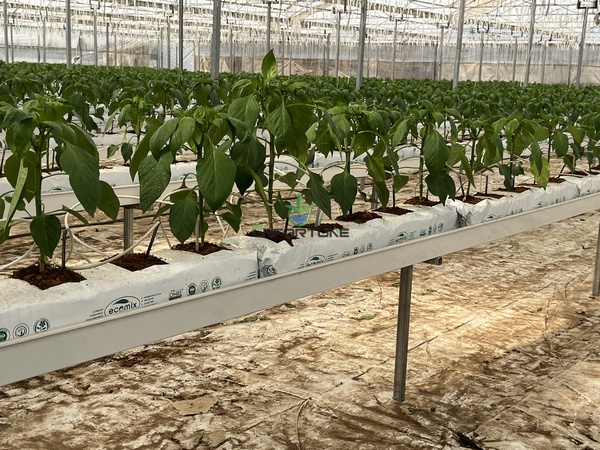
Young pepper seedlings on white growing channels with drip arrows in a commercial hydroponic greenhouseccPeppers turn a Dutch bucket line from a single-crop bet into a two-crop rotation. Tomatoes and peppers share the hardware — bucket, media, drip stake, return channel — but not the market window or the disease profile.
- Fruit weight rides the trellis, not the stem. A two-stem plant carries fruit for twenty weeks without stem collapse.
- The EC window is wide. 1.2–3.0 mS/cm across the cycle, so a drifting recipe costs yield slowly.
- Harvest is continuous. Eight to fourteen picks spread revenue across weeks instead of one cut.
Marketable yield typically lands between 12 and 20 kg/m²; figures vary by region and season, and cultivar choice moves the number more than most growers expect.
System Setup: Bucket Spacing, Drainage, and Media
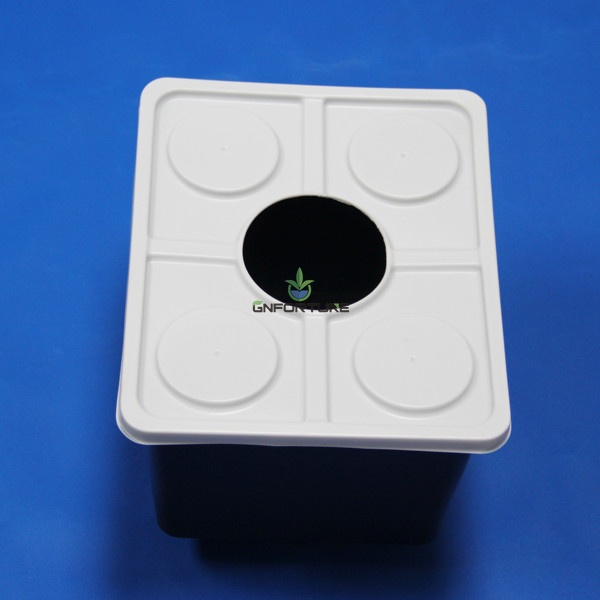
Close-up of a commercial Dutch bucket with a white lid and planting openings, showing the top-feed structureLayout decisions made in week one cannot be changed later. The working pattern is a double row with a shared drainage channel between the rows:
- Spacing: 25–35 cm between buckets, 1.4–1.6 m between row centres — 2.5–3.5 plants per m².
- Media: 8–11 L per bucket of perlite, coir, or a blend; pre-rinse coir that arrives saline.
- Emitters: one or two drip stakes per bucket at 2–4 L/h, 3–6 events per day at peak load.
- Drainage: 1–2% fall to the return line, a mesh screen at the outlet, a filter before the tank.
A mature plant pushes 2–3 L of drain per day at peak, so a channel that runs half-full in week 4 overflows by mid-season. Compare substrates in the growing media comparison; bucket dimensions are on the Dutch bucket system page and line design in the drip irrigation guide for Dutch buckets.
EC and pH by Stage
| Stage | EC (mS/cm) | pH | What changes |
|---|---|---|---|
| Propagation to transplant | 1.2–1.6 | 5.5–6.0 | Lower potassium, moderate nitrogen |
| Vegetative (weeks 1–4) | 1.8–2.2 | 5.6–6.2 | Nitrogen and calcium rise |
| Flowering and first set | 2.2–2.8 | 5.6–6.2 | Potassium rises sharply |
| Peak harvest | 2.4–3.0 | 5.8–6.2 | Check drain EC twice weekly |
| Late season flush | 2.0–2.6 | 5.8–6.2 | Reduce nitrogen, hold potassium |
Keep the Ca:Mg ratio near 3:1 to 4:1 and pH below 6.2. Blossom-end rot is a calcium transport failure, not a mixing failure, and it appears when the plant stops transpiring on humid nights or in a concentrated root zone. Watch calibration too: a meter drifting by 0.2 mS/cm moves the whole block, so follow EC and pH measurement and mix from stock rather than topping up salts by eye (nutrient solution mixing).
Pruning and Trellising: The Two-Stem System
The two-stem system balances fruit count against leaf area. The sequence:
- Remove the first flower. Pinch the king flower before it sets; it costs one fruit and buys a larger plant.
- Select two leaders. Keep the main stem plus one strong shoot from node 2 or 3.
- Strip side shoots weekly. Peppers push a shoot from almost every leaf axil.
- Clear lower leaves. Remove leaves below the ripening truss for colour and airflow.
- Support the fruit. Clip each cluster to the wire; four fruits will pull a leader over.
Single stemming fruits earlier but yields less per m². Three stems need wider spacing and a higher EC, and the extra foliage raises grey mould risk. Two stems is where labour and yield balance.
Climate Targets: Day/Night Temperature and VPD
Fruit set is decided by temperature before anything else. Pollen viability falls once canopy temperature passes roughly 30–32 °C by day or drops below 15 °C at night, and the symptom is flower drop.
- Day: 22–26 °C, with a 5–6 K night drop to 18–20 °C.
- VPD: 0.8–1.2 kPa in vegetative growth, 1.0–1.5 kPa once fruit load builds.
- Humidity: 60–75% RH. Above 80% at night, calcium transport slows and grey mould pressure climbs.
In hot, humid climates the limiting factor is night humidity, not day heat. Heat slightly and vent rather than vent alone, and run horizontal airflow to break the canopy boundary layer, as described in greenhouse humidity and VPD control.
Pest and Disease Watch List
- Thrips. The priority pest: western flower thrips vectors tomato spotted wilt virus. Blue sticky cards, checked weekly.
- Aphids and whitefly. Honeydew and sooty mould on fruit; yellow cards plus early biological control.
- Spider mite. Worst in hot, dry weeks; stippling shows on upper leaves before webbing.
- Powdery mildew and botrytis. Mildew follows poor air movement; botrytis enters pruning wounds on humid nights.
- Pythium root rot. In buckets this is a drainage problem before it is a pathogen problem.
Escalate in order: environment and sanitation, then biologicals, then chemistry with a rotation plan. Thresholds are compared in fungal diseases in hydroponics; the weekly routine is in the hydroponic IPM checklist.
The 30-Week Cycle: From Transplant to Final Harvest
The timeline below is the planning frame for labour, nutrients, and market commitments; figures vary by region and season.
| Phase | Weeks | What happens | Decision point |
|---|---|---|---|
| Propagation | −4 to 0 | Seedlings at EC 1.2–1.6 | Confirm cultivar and date |
| Establishment | 0–2 | Buckets filled, drip running, 2.5–3.5 plants/m² | Lock the irrigation schedule |
| Vegetative | 2–6 | Two leaders kept, first flower removed | Install trellis twine and clips |
| Flowering and first set | 6–9 | Fruit sets, potassium rises, EC 2.2–2.8 | Support the first clusters |
| First harvest | 9–11 | Four to six picks per week | First delivery to market |
| Peak production | 12–24 | Highest daily volume; picking and pruning overlap | Weekly EC and pH checks |
| Late flush | 24–28 | Fruit size eases, colour holds, EC 2.0–2.6 | Second flush or tear-down |
| Tear-down | 28–30 | Final pick, media disposal, channel cleaning | Sanitation before next crop |
Peak labour sits between weeks 14 and 22. Planning that window before transplant separates a full 30-week cycle from one that ends early.
Mistakes We Fix on Site
The same four problems appear in almost every pepper block in its first season, and all four are cheap to fix in month one:
- A channel sized for week 4. Adding a second return line mid-cycle costs more than sizing it right at install.
- Drip stakes pushed too deep. Water bypasses the upper root zone, the bucket top dries, and fruit size varies along the row.
- Pruning on a wet afternoon. Botrytis enters cuts into wet tissue; prune at the end of a dry morning.
- EC raised before fruit set. Pushing past 2.8 mS/cm early produces blossom-end rot that gets blamed on calcium.
What we see on site more than anything else: operators treat the irrigation schedule as fixed and the EC as the variable. It should be the reverse. Emitter output and events per day keep the root zone stable; EC moves slowly with fruit load. Nearly every root-zone problem we fix on site traces back to that inversion.
Commissioning therefore starts with irrigation: flow checks at every stake, a drain-volume reading per zone, and a written schedule the site team can adjust alone.
FAQ
Q: How long from transplant to first harvest?
A: Nine to eleven weeks in most climates, with peak volume from roughly week 14.
Q: What EC should a bell pepper hydroponic system run?
A: 1.8–2.2 mS/cm in vegetative growth, 2.2–2.8 during fruit set, up to 3.0 at peak. Measure at the dripper and in the drain.
Q: How many plants per square metre?
A: 2.5–3.5 with two stems each. Higher densities rarely recover the yield lost per plant.
Q: Why are flowers dropping instead of setting fruit?
A: Climate, not nutrition. Days above 30–32 °C, nights below 15 °C, or VPD above 1.5 kPa abort pollen.
Q: Can peppers share a Dutch bucket line with tomatoes?
A: Physically yes — same bucket, media, and drip hardware. Block them apart operationally, since peppers want a lower EC and a different picking rhythm; hydroponic peppers suit a dedicated bay.
Request a Dutch Bucket Layout for Your Pepper Line
Send the climate data, target market window, and weekly volume to /quote/, and G&N Fortune will return a bucket layout, an EC and pH schedule matched to your cultivar, and a 30-week labour forecast. The company has manufactured Dutch bucket and commercial hydroponic hardware in Huizhou, China since 1996.
- Dutch bucket cucumber case study — the same hardware on a different fruit cycle.
- Southeast Asia herb farm case study — how a tropical mixed-crop build was commissioned.
- Hydroponic farm ROI framework — turn the yield range into a payback number.
- Commercial hydroponic systems — the range for a mixed fruit and herb operation.