

A commercial leafy-green operation typically spends 40–60% of its controllable cost on harvest and packing, which is why hydroponic harvesting equipment is usually the second capital decision a grower faces, after the growing system itself. The options run from a knife and a stainless table to a semi-automatic weigh-bag line to a full harvester feeding a chilled packing room.
Why Harvest and Packing Carry the Labor Bill
Everything upstream of harvest is already mechanized: irrigation, dosing, and climate control consume well under 10% of staff time in most facilities. Harvest, trim, weigh, pack, and clean is the opposite. It scales almost linearly with output, resists night-shift scheduling, and is the part of the business most exposed to wage inflation and turnover.
Three consequences follow: labor is the largest controllable cost, harvest work is the hardest to recruit, and the workload concentrates into a two-to-four hour window each day, so machines are sized for the peak rather than the average day. All figures here are planning ranges; figures vary by region and season.
Where the Labor Actually Goes
Before pricing any machine, time each task in the shift for a normal week. The split below is a planning baseline for cut leafy greens and herbs at wholesale grade.
| Task | Share of harvest and pack hours | Where it breaks |
|---|---|---|
| Cutting or pulling | 25–35% | Rate drifts across a shift |
| Trimming and grading | 10–20% | Criteria drift without a photo standard |
| Weighing | 5–10% | Over-fill of 2–5% is invisible in the accounts |
| Bagging or filling | 15–25% | Wet product jams sealers |
| Coding and labeling | 5–10% | Retail needs batch and date codes |
| Case packing and palletizing | 10–15% | Least automated step; strain injuries |
| Wash-down of tools and tables | 5–10% | Rarely counted, tied to food-safety audits |
Two patterns repeat: packing tasks add up to more hours than cutting and are easier to automate, and the hidden hours of rework and wash-down disappear first when the line is designed properly.
Cutting Options: Manual, Semi-Auto, and Full Harvester
Cutting is the most crop-sensitive step, so it carries the strictest preconditions. Manual cutting suits loose-leaf crops where the picker selects. A semi-automatic assist pairs a reciprocating blade with a conveyor, so the operator presents the channel while the belt carries product away. A full harvester takes the whole channel, gutter, or raft in one pass.
| Method | Throughput vs manual | Person-hours per tonne | Fits at |
|---|---|---|---|
| Manual hand cutting | 1× | 20–35 | Under 1 t/week, mixed crop lists |
| Semi-automatic assist | 2–3× | 10–18 | 1–5 t/week, single format |
| Full harvester | 4–8× | 4–10 | 5 t/week and above |
Full harvesters need gutters, channels, or rafts at a uniform height, so they suit NFT and floating-raft houses and suit Dutch bucket fruit crops poorly; where a facility runs both, use two harvest points rather than one machine doing two jobs badly. Layout matters as much as the machine: the speed gain is lost if the channel is lifted by hand and carried to a table. For the upstream hardware, see the NFT channel specifications and the channel size comparison.
The Throughput Math: When Does a Machine Pay Back
The payback question has one formula and four inputs: capex, hours saved, wage rate, and utilization.
Payback period = capex ÷ (hours saved per month × loaded wage rate).
Worked assumption example, deliberately generic. A facility cutting 5 t of leafy greens and herbs per week runs manual harvest and packing at roughly 30 person-hours per tonne, so the load is about 150 person-hours weekly. A semi-automatic cut, weigh, and bag line removes 50–65% of those hours, or 75–95 hours per week. At a loaded wage of USD 3–12 per hour, the weekly saving is USD 225–1,140, or USD 12,000–59,000 a year. Against a hypothetical capex of USD 80,000, the payback is about 1.5 years at the top of the wage range and more than six years at the bottom.
In high-wage markets the machine pays back on labor alone. In low-wage markets the saving may never cover the capex, and the honest justification becomes consistent cut quality, documented food safety, or the difficulty of hiring enough people at peak. A vendor that sells only the labor case is not giving a full picture.
A consultant’s reminder: automation multiplies whatever process it is bolted onto. If pack size, case count, and grade standards are still decided verbally on the floor each morning, a new machine only makes that inconsistency faster and more expensive.
Washing, Chilling, and the Cold-Chain Handoff
Cut leafy greens respire hard after harvest, and every hour at ambient temperature costs shelf life. The target is a core temperature of 1–4 °C within 30–60 minutes of the cut, held without a gap through packing and dispatch.
- Hydrocooling — chilled water or an ice bank. Fast and cheap to run, but it wets the product, so it needs a spin dryer and strict water sanitation.
- Forced-air cooling — a cold room with a pressure wall and airflow through the packs. Slower and gentler, and the standard for bagged retail product.
- Vacuum cooling — fastest for high-surface-area leafy crops and the highest capex; rarely justified below a few tonnes per day.
Wash water is a food-safety control point: change it on a schedule, dose a validated sanitizer at a monitored concentration, and log pH and turbidity. A spin at 280–340 rpm for 8–12 seconds leaves product dry enough for a sealer.
Weighing, Bagging, and Labeling
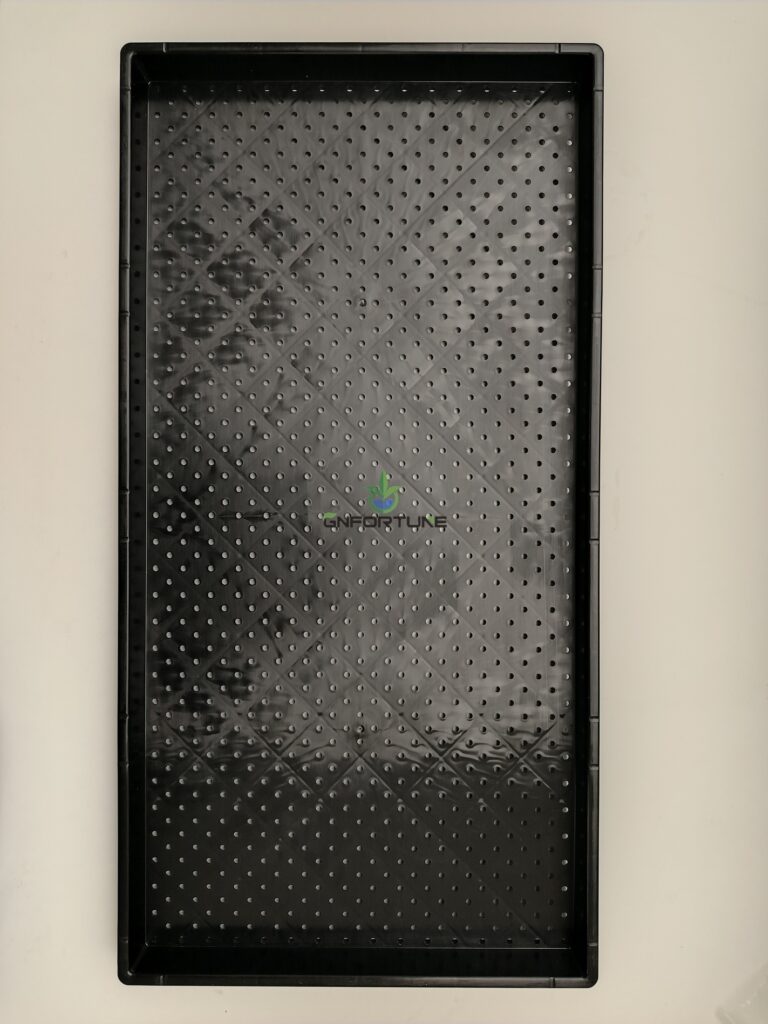
Stacked vented harvest crates used to move cut greens from the cutting line into washing, chilling, and packingThis is the most standardized part of the line and the easiest to justify. Three tiers exist:
- Manual fill with a bench scale — 2–4 packs per minute per operator; acceptable under 1 t/week.
- Semi-automatic weigh-bagger — one operator loads, the scale dispenses to target, the pack is sealed. 10–20 packs per minute.
- Automatic form-fill-seal line — 40–60 packs per minute with inline checkweighing, gas flush, and an integrated labeler. It demands uniform product length and moisture; wet or oversized product stops the line.
Two cost lines are chronically underestimated. Film consumption rises with over-fill and with machine stops, and weight give-away on a 150 g pack, held at 2–5%, is a margin loss that only an inline checkweigher will surface. The seven-day microgreens cycle is a crop where pack format, not pack speed, sets the price.
Packing for Retail vs Food Service
Retail means 100–250 g branded bags or clamshells, batch codes and barcodes, and an unbroken 1–4 °C chain, driven by packs per minute. Food service means 1–5 kg crates or bulk bags with a delivery label only, driven by tonnes per hour.
Where a grower serves both, share the wash-and-chill front end and keep two finishing stations, with retail runs in a fixed daily window rather than interleaved with bulk orders. A line switching between a 150 g bag and a 5 kg crate four times a shift loses more in changeover than it saves in equipment.
A Staged Plan for Hydroponic Harvesting Equipment
Buy automation in phases, and let each phase prove itself before the next is ordered.
- Phase 1, under 1 t/week: harvest table, wash tanks, spin dryer, bench scale, semi-automatic sealer. Measure person-hours per tonne; payback is usually immediate.
- Phase 2, 1 to 5 t/week: conveyor harvest assist, forced-air or hydrocooling room, inline checkweigher, label applicator, cold-room racking. KPIs: person-hours per tonne and packs per minute.
- Phase 3, above 5 t/week: full harvester matched to the channel format, form-fill-seal line, automatic case packing, and monitoring tied into the irrigation controller. KPIs shift to uptime and weight give-away.
Phase 2 is where most projects find their money: it costs a fraction of a full harvester and removes the packing bottleneck, which is the largest share of the hours. A full harvester bought first only moves the queue from the field to the packing room. The same trade-off appears in other crop lines, such as the hydroponic fodder systems guide, and the leafy greens program built for salad processors separates the few formats that carry most of the volume from the long tail that stays manual.
FAQ
Q: Can one line handle retail bags and food-service crates?
A: Physically yes, but not efficiently if either channel runs more than a few hours a day. Share the wash-and-chill front end and keep two finishing stations.
Q: Does automation reduce headcount?
A: It usually redeploys rather than removes. Two or three people typically move from packing into grading and sanitation.
Q: What is the biggest hidden cost after the machine?
A: Film and over-fill. Film plus 2–5% weight give-away can add a meaningful percentage to cost per pack, and neither shows up until an inline checkweigher and a film record are in place.
Q: What volume justifies full hydroponic harvesting equipment?
A: In most leafy-green operations, roughly 5 t/week of a single uniform format; below that, a semi-automatic assist delivers most of the saving for far less capex.
Send Your Volume and Labor Rate — We Run the Payback Math With You
Share your weekly output, crop and pack formats, shift structure, and wage rate, and we will model the hours saved, the phased capex, and the payback period, then specify the hydroponic harvesting equipment to match. Send the numbers to /quote/ with the subject line “harvest and packing payback” and we will return a layout, a capacity calculation, and a BOM.
- Hydroponic farm ROI model — put the saving into a full-project payback.
- Automation and control solutions — how far climate, dosing, and monitoring can be automated.
- Commercial hydroponic systems — the growing hardware behind the line.