

Greenhouse cooling is the first engineering decision a buyer makes for any tropical, subtropical, or Mediterranean hydroponic project, and it is the one most often undersized. A glasshouse or poly house in 38 to 45 degree C ambient can build internal temperatures past 55 degree C within minutes if vents are open and no active cooling runs. The job is to hold the crop inside its thermal band — leafy greens 22 to 26 degree C, fruiting crops 24 to 28 degree C — while keeping relative humidity below the leaf wetness threshold where fungal disease takes off. Three technologies dominate: evaporative cooling pads with exhaust fans, high-pressure fog, and retractable shade screens. They are usually combined.
What “Cool Enough” Means in a Hydroponic Greenhouse
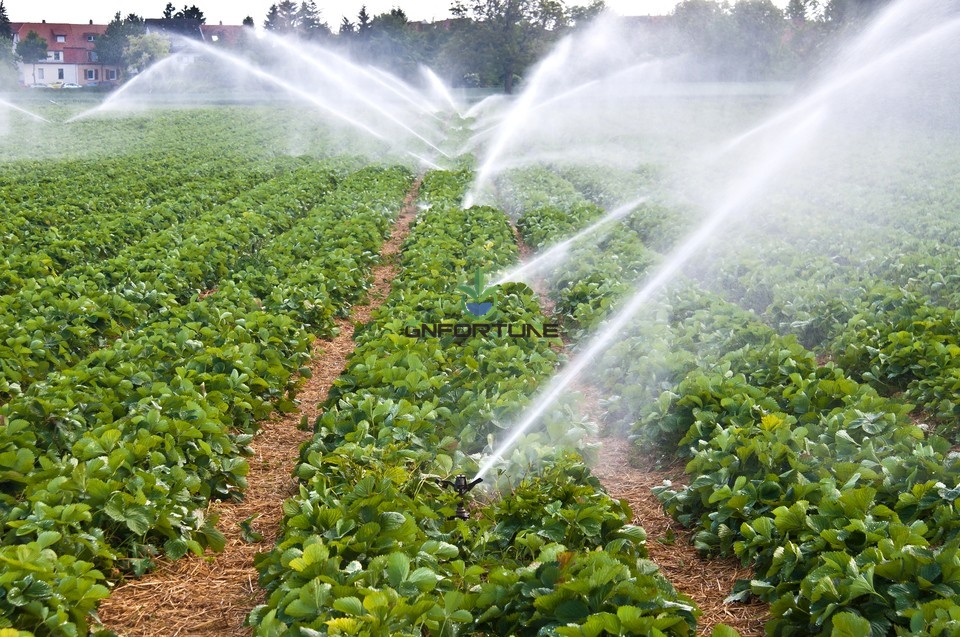
High-pressure fog system spraying over a strawberry greenhouse for evaporative coolingBefore sizing any equipment, fix the design numbers in writing so the suppliers you talk to are bidding the same scope:
- Daytime air temperature. Lettuce and basil: 22 to 26 degree C day, 18 to 22 degree C night. Tomato, cucumber, pepper: 24 to 28 degree C day, with a 5 to 7 degree C day-night differential.
- Relative humidity. Aim for 55 to 75 percent. Above 85 percent for more than four hours, expect botrytis on tomato and downy mildew on lettuce.
- Inlet-to-outlet delta T. A well-sized evaporative system pulls 4 to 6 degree C. If your climate needs more, look at chilled water or hybrid systems, not a bigger pad.
- Canopy air speed. 0.3 to 0.7 m/s is comfortable. Above 1 m/s, plants close stomata and stop cooling themselves.
These are the same numbers we run on the design side of a project, and why a cooling retrofit always starts with measurement. Spend a week logging dry-bulb and wet-bulb at canopy height before signing a pad-and-fan order. The hydroponic system design guide makes the same point: cooling design needs climate data before quoting equipment.
Evaporative Cooling Pads: Sizing and Humidity Limits
An greenhouse evaporative cooling pad is a cellulose or engineered media wall, 100 mm or 150 mm thick, on the windward side, with exhaust fans on the leeward side pulling outside air through the wet pad. The air leaves cooler but more humid. Pad-and-fan systems are the workhorse because the components are simple and runtime is well understood.
The numbers that decide whether a pad-and-fan system will cool your house or just humidify it:
| Design parameter | Typical range | Edge failure |
|---|---|---|
| Pad thickness | 100 mm (arid) to 150 mm (humid) | Thin pads cool less; thick pads need slower face velocity |
| Face velocity | 0.75 to 1.5 m/s | Too fast: water carries off; too slow: dry top, uneven cooling |
| Pad-to-fan distance | 30 to 50 m | Beyond 50 m the airstream warms before the fan end |
| Exhaust fan airflow | Matched to pad area | Undersized fans starve the pad; oversized fans waste water |
| Humidity ceiling | Stops cooling above ~70% RH | Pair with fog or chilled water on coastal sites |
Water quality is the unglamorous failure mode of pad systems. Hard water with calcium above 150 mg/L scales the pad media within a season; the pad goes white, the air channel narrows, and the cooling delta falls by 2 to 3 degree C. Bleed-off helps; the better fix is to feed the pad loop with the same water you use for the rest of the greenhouse — segregated loops almost always cause scaling downstream.
High-Pressure Fog Systems: Nozzles and Water Quality
A high-pressure fog system pushes water at 70 to 100 bar through small-orifice nozzles, breaking it into droplets under 50 microns. Droplets that small flash-evaporate inside the greenhouse, cooling the air without wetting the leaves the way a misting line does. That is the difference between fog and a cheap “mister” — a mister at 4 to 6 bar makes droplets of 100 microns and wets the canopy, which often does more harm than the cooling it provides.
The reasons we often see buyers struggle with fog systems on first installation:
- Hard water destroys nozzles. Calcium and silica precipitate inside the 0.2 to 0.4 mm orifice. A reverse-osmosis pre-filter is not optional above 100 mg/L hardness.
- Booster pump sizing. A 70 bar pump with a 5 to 10 liter per minute flow covers roughly 1,000 m². Going to 100 bar costs more but produces finer droplets and a couple of degrees of additional cooling.
- Nozzle spacing and height. 1.5 to 3 m above the canopy, 2 to 3 m on center. Mounted too low, droplets fall before evaporating; too close to a vent, the fog goes outside.
- Humidity cut-off. A fog system without an RH sensor is a liability. Lock the solenoid out above 80 percent RH so you do not stack humidity on a humid afternoon.
The on-site failure we see most often in hot-climate projects: the buyer installed fog because the pad system was not enough, did not add a humidity cut-out, the fog ran during a humid afternoon, RH climbed past 90 percent, and within two weeks botrytis showed up on the tomato block. Fog is a humidity add-on, not a stand-alone cure. The RH sensor must cut it off before the leaf wetness line.
If your project is a sealed greenhouse with roof vents closed for CO₂, fog becomes more attractive because you are not fighting humidity escape. The ventilation design guide covers how vent closure and fog interact; fog and venting have to be sequenced.
Retractable Shade Screens vs Fixed Whitewash
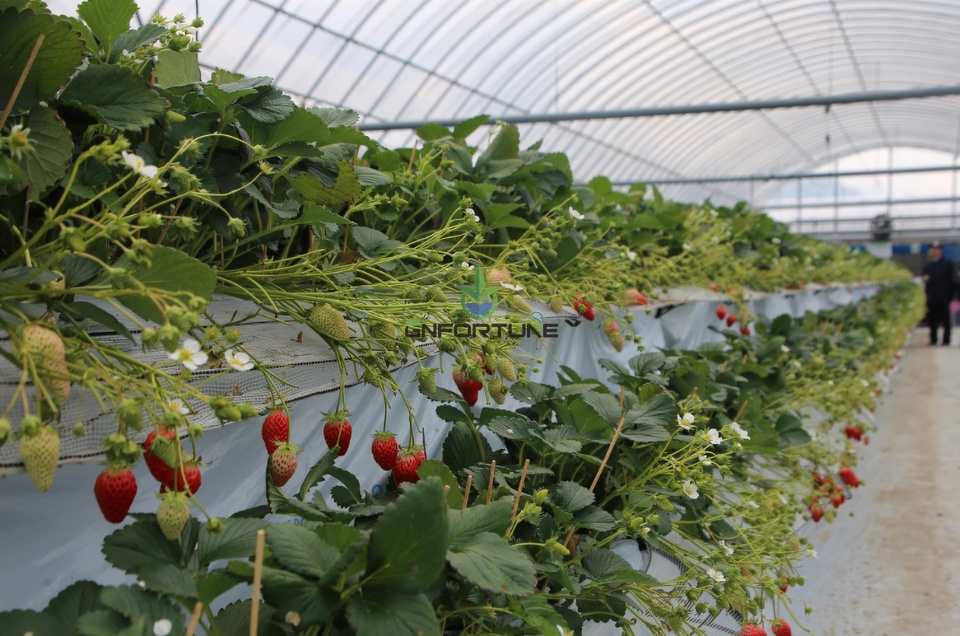
Arched poly greenhouse interior with overhead retractable shade and roof ventsShade is the cheapest degree Celsius you will ever buy. Cutting solar load at the cover reduces the temperature the cooling system has to fight, with no electricity and no water. The decision is between retractable internal screens, retractable external screens, and fixed whitewash applied directly to the cover.
Each has a real-world trade-off, not a marketing one:
| Shade method | Solar load cut | Trade-off |
|---|---|---|
| External retractable 30-50% | 25 to 35 percent | Stops heat at the cover; highest upfront, longest life |
| Internal retractable 30-60% | 15 to 25 percent | Opens on cloudy days; convective heat still enters |
| Fixed whitewash | 20 to 35 percent | Cheap retrofit; cannot remove in winter, lowers DLI |
| Aluminized thermal screen | 15 to 25 percent | Saves fuel at night; longest payback in hot-only climate |
The mistake buyers make with shade is treating it as either/or with active cooling. The cheapest stack is shade + pad-and-fan, with fog added only on the hottest 30 days. Fixed whitewash that cannot be removed on cloudy days is the most common cause of “we have plenty of cooling, why is our lettuce bolting” — DLI drops under 12 mol/m²/d and the crop never sizes up. DLI targets are in the supplemental lighting guide.
Hybrid Setups Installed in the Middle East
Most commercial greenhouses in the Gulf, North Africa, and hot inland sites run a three-stage cooling stack rather than a single system, because each technology has a different climate band where it pays back:
- External retractable shade (30 to 50 percent) cuts peak solar load before it crosses the cover.
- Evaporative pad-and-fan on the windward wall plus exhaust fans on the leeward wall delivers the baseline cooling delta during the bulk of the day.
- High-pressure fog engages only when dry-bulb exceeds roughly 32 degree C or RH drops below 55 percent.
The energy comparison looks like this for a 1 hectare greenhouse in a 40 degree C ambient climate:
| Cooling stage | Electrical load (1 ha) | Water use (1 ha / day) | Effective when |
|---|---|---|---|
| External shade | ~0.5 kW | None | Ambient 30 to 38 degree C |
| Pad-and-fan | 25 to 45 kW | 8 to 15 m³ | RH below 65 percent |
| High-pressure fog | 8 to 15 kW | 2 to 6 m³ | RH below 55 percent, T above 32 degree C |
| Full hybrid stack | ~50 kW peak | 10 to 21 m³ | 38 to 45 degree C ambient |
The numbers shift with house height and crop, but the pattern holds: external shade + pad-and-fan handles 80 percent of the year, and fog runs only on the worst 20 percent of days. That ratio is the difference between a system whose booster pump pays back in three years and one that pays back only on a high-margin crop.
Is This Retrofit Worth It for Your Project?
The honest answer depends on three numbers: ambient summer temperature, midday RH, and the value of the crop you are losing on hot days. A leafy-greens farm in a 38 degree C humid coastal climate cannot make the numbers work without a hybrid stack; a tomato farm in a 32 degree C dry climate can hold crop with pad-and-fan alone, with fog as insurance.
Three buying rules we apply on our own cooling retrofits:
- Size the pad to the floor area first. A common shortcut is to size the pad to the fan CFM, but the floor area sets the sensible cooling load.
- Specify the nozzles. Do not accept “fog system” as a line item. Specify 70 to 100 bar pump pressure, anti-drip nozzle bodies, and stainless steel orifices.
- Plan the controls before you buy the equipment. Climate automation logic is covered in the controller and automation page; the same controllers that stage fans and vents also stage fog pumps and shade drives.
FAQ
What is the cheapest greenhouse cooling method for a small farm?
A: External retractable shade plus a correctly sized pad-and-fan system is the lowest-cost-per-degree stack for most climates. Fog only pays back on hot, dry sites or as a supplement to pad-and-fan on the worst days of the year.
How much water does an evaporative cooling pad consume?
A: A 1,000 m² greenhouse running pad-and-fan in a hot dry climate uses roughly 0.8 to 1.5 m³ per hour. Bleed-off and drift add another 10 to 20 percent. Budget extra for descaling in hard-water areas.
Can I cool a poly tunnel with the same pad-and-fan system as a glass greenhouse?
A: Yes, but air leakage is much higher through single-layer poly. Plan for 10 to 15 percent more fan capacity than on an equivalent glass floor area.
Do greenhouse fog systems wet the leaves?
A: A correctly designed high-pressure fog system (70 to 100 bar, under 50 micron droplets) flash-evaporates before reaching the canopy, so leaves stay dry. Low-pressure misters at 4 to 6 bar do wet the leaves.
When does fog NOT make sense?
A: In climates where midday RH already runs above 70 percent, fog adds humidity without adding much cooling. In those sites the cooling stack should rely on shade plus pad-and-fan with venting, not fog.
Get a Cooling Layout for Your Greenhouse
Send your greenhouse dimensions, crop, and climate zone through the quote form and our engineering team will return a cooling layout with pad sizing, fan CFM, fog pump capacity, and shade screen specification, sized against the targets in this article. If you are at the early layout stage, the commercial hydroponic system cost guide is the place to start, and the ventilation design guide covers the vent and HAF fan side of the same climate stack.