

An ebb and flow table is the workhorse of commercial propagation and container growing: a flood tray, usually on a steel or aluminum frame, that fills with nutrient solution for a few minutes and then drains by gravity. Buyers call them flood tables, grow tables, flood-and-drain tables, or simply flood trays — and the naming differences hide real differences in load capacity, materials, and long-term maintenance cost. This guide walks a buyer through sizing, materials, fittings, and budget so the tables you order still look like a good decision in year five.
What Size Ebb and Flow Table Do You Need?
Start from the crop plan, not from a catalog. The number of tables is a function of how many pots, trays, or flats you must hold at one time, and that is a plant-spacing decision. The quick version of the math:
- Work out plants per table. A standard 4×8 ft flood tray is 1.22 × 2.44 m, roughly 3 m² of usable area. Six-inch nursery pots at an 8-inch spacing fit about 72 pots on one tray; 6-inch flats (1020 trays) fit about 16.
- Divide your total pot count by that number. A 1,000-pot nursery needs about 14 tables at 72 pots each.
- Add 10–15% spare. You will always need space for staggered batches, culls, and the week when a customer doubles an order.
Table count is not the whole story. The layout must leave working aisles, and each table needs a fall toward its drain. Tables on the same drain line also need to stay within the pump’s lift range. If you are starting from a greenhouse floor plan, run the hydroponic system design guide before you commit to a count — it is cheaper to re-draw the room than to re-plumb it.
| Common table size | Approx. area | 6-inch pots (8″ spacing) | 1020 flats | Typical use |
|---|---|---|---|---|
| 4 × 8 ft tray / table | ≈ 3 m² | ~72 | ~16 | The default for nurseries; easy to move and clean |
| 4 × 10 ft table | ≈ 3.7 m² | ~90 | ~20 | Longer bays; needs a straighter, level bench run |
| Multi-bay bench (several tables, one drain line) | Per bay | Scales by section | Scales by section | Whole-bay propagation or full-cycle growing |
Do not under-spec working height. Tables at 85–90 cm are comfortable for potting and trimming but make gravity drain returns awkward if your reservoir sits on the floor. Plan the reservoir position when you plan the table height — this single detail causes more retrofits than any other.
Flood Tray Materials: PP, ABS, and Steel-Framed Options
The tray is what touches your crop, and the frame is what carries wet weight for years. They should be chosen together:
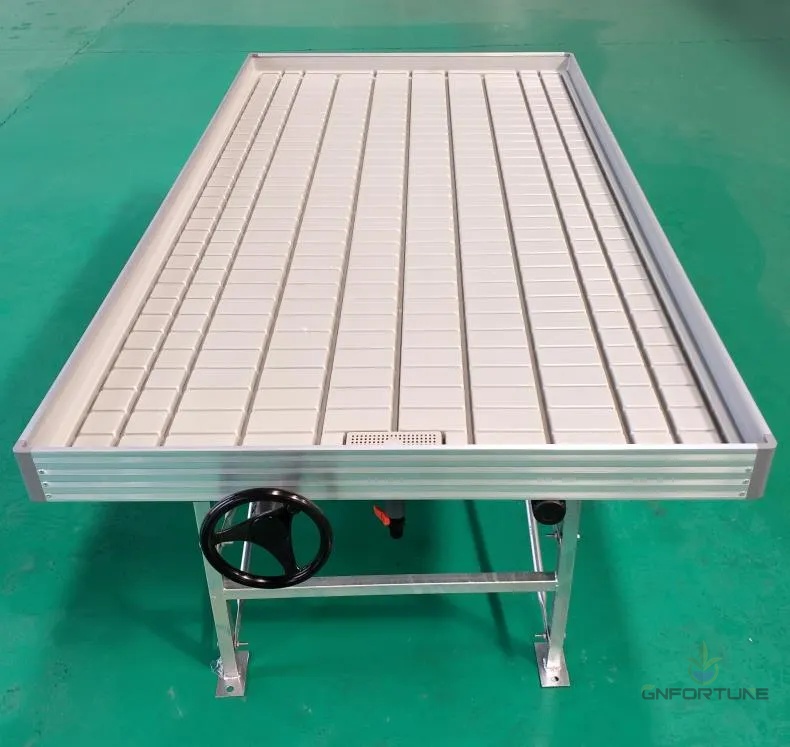
ABS plastic ebb and flow tray with drain fittings on white background- Polypropylene (PP) flood trays: light, food-safe, and low-cost per square meter. PP flexes, so long unsupported trays sag in the middle and the center never drains fully. PP trays are a good value when they sit on a solid, level bench or a frame with close cross-supports.
- ABS trays: stiffer and more impact-resistant than PP at a slightly higher price. ABS is the practical choice where trays are handled, washed, and moved between bays regularly.
- Steel- or aluminum-framed tables: the frame, not the plastic, decides how much wet weight a table can carry. Hot-dip galvanized steel is the long-life option for fixed benches; aluminum suits operations that re-layout bays. Ask the supplier for the frame’s rated load per linear meter — a table rated for dry flats may not be rated for 3 m² of saturated media.
| Option | Relative cost | Load behavior | Realistic life | Best for |
|---|---|---|---|---|
| PP tray on existing bench | Low | Needs close support; can sag | 5–8 years with UV-stabilized resin | Budget nurseries, propagation |
| ABS tray on bench | Medium | Stiff; shrugs off handling | 8–10 years | High-turnover operations |
| PP/ABS tray on galvanized steel table | Medium-high | High — frame carries wet weight | 10–15 years (frame) | Commercial nurseries, full-cycle growing |
| Multi-bay galvanized benches | Highest | Highest; engineered per bay | 15+ years | Whole greenhouse bays |
Two details buyers skip: edge height and UV stabilization. Shallow trays (5 cm edges) hold less solution and drain cleaner for propagation; deeper trays (7–10 cm) buffer the crop through longer cycles and hot afternoons. And cheap resin without UV stabilizers turns chalky and brittle within two seasons in a greenhouse — ask explicitly whether the tray compound is UV-stabilized.
Flood and Drain Fittings: Bulkhead, Standpipe, and Drain Placement
Fittings are where a flood table project either gets boring or gets expensive. The three parts that matter:
Close-up of flood table drain and overflow port detail- Bulkhead fitting: the sealed hole where water leaves the tray. Moulded-in bulkhead seats beat drilled-and-sealed ones for long-term reliability. Check the bulkhead position — corner exits drain more reliably than center exits, and a center exit makes the space under the table unusable.
- Standpipe (overflow): sets your maximum flood depth. On a good table it is adjustable so you can tune water level as the crop and medium change. A fixed standpipe means a fixed flood depth forever.
- Drain line and fall: the return line from tray to reservoir needs continuous fall — 1–2% is the number we use — with no sags that trap water and airlock the drain. Undersized drains are the most common cause of “my flood tray won’t empty” calls in the field.
The maintenance question most buyers never ask at purchase time: “What breaks on this table after three years, and can I replace it without replacing the tray?” Look for a table where the standpipe, bulkhead gasket, and drain valve are standard parts you can buy again next season. Proprietary fittings that only one supplier stocks turn a routine repair into a forced re-order.
If you are speccing dozens of tables on shared drain lines, the fitting details belong in the layout drawing, not the order form. That is exactly the stage where our design and specification service saves the most money.
Tables for Propagation vs Full-Cycle Growing
The same table family is sold for two very different jobs, and buying the wrong configuration is a common budget leak:
| Use | What changes | Why |
|---|---|---|
| Propagation (cuttings, plugs, seedlings) | Lighter trays, tighter spacing, mobility | Young plants move through in days to weeks; you re-layout bays often and want to move batches to hardening-off areas |
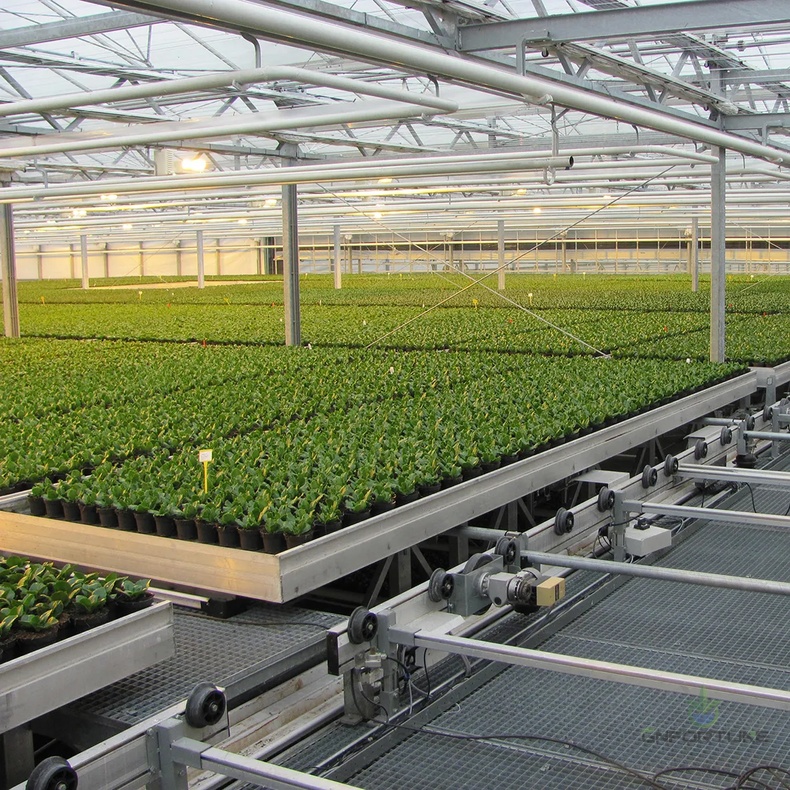
| Full-cycle container growing (potted herbs, strawberries, flowering crops) | Deeper trays, heavier frames, fixed benches, wider spacing | Crops stay 8–16 weeks; static, load-rated benches with clean drain runs beat flexibility |
| Mixed nursery | Modular tables with removable trays | Lets the same footprint serve propagation in spring and full-cycle pots in summer |
Full-cycle growing also changes irrigation: a propagation room can often share one pump and controller, while full-cycle bays usually want per-bay scheduling and root-zone monitoring. That is a controller and automation decision as much as a table decision — match the irrigation control to the longest cycle you run, not the shortest.
Budgeting a Flood Table System
Cost per square meter is the honest way to compare quotes, because quotes that differ in table size, frame spec, and included fittings otherwise cannot be compared. The realistic spread for a commercial flood table system — trays, frames, bulkheads and standpipes, drain lines, reservoir, and pump — is roughly the range between a light propagation setup and a full-cycle bench system with engineered drain runs. Within that range, the big cost drivers are frame material, tray depth, and how much drainage plumbing your layout needs.
Three budgeting rules from projects we have costed:
- Price the drain plumbing before you price the tables. On retrofits, drain work routinely costs more than the buyer expected and sometimes more than the tables.
- Buy the frame once. A galvanized frame at 10–15 years of life is cheaper per season than a “value” frame that needs replacing when the first crop cycle is over.
- Check spare-parts availability and lead time for bulkhead gaskets and standpipes before you commit to a supplier — downtime on a flood room is measured in lost batches.
To see how table investment pays back against crop revenue, work through the numbers in our hydroponic farm ROI guide — most buyers run it after costing tables and find the bottleneck is utilization, not price. And if a flood room is new to you, the ebb and flow system explainer covers how the flood-and-drain cycle works before you commit to hardware.
FAQ
What sizes do ebb and flow tables come in?
A: The standard flood tray is 4 × 8 ft, with 4 × 10 ft and longer custom sections common. Frames are made to match tray footprints, and multi-bay benches scale to a full greenhouse bay with shared drain lines.
How much weight can a flood tray hold?
A: It depends on the frame, not just the plastic. A tray full of saturated growing media is heavy — ask for the frame’s rated load per linear meter and the tray’s deflection spec under wet weight. Light trays on unsupported spans sag and stop draining in the middle.
What is the difference between a flood tray and an ebb and flow table?
A: A flood tray is the plastic basin; an ebb and flow table adds the frame, working height, and proper drain plumbing. For small trials a tray on any level bench works, but for repeated commercial cycles the framed table is the reliable configuration.
Can I buy flood tables for a whole greenhouse in one order?
A: Yes — this is a normal wholesale order for us. Send your greenhouse dimensions, crop plan, and pot sizes and we will return a table layout with drain runs and reservoir sizing through the quote form below, with per-square-meter pricing.
Get a Table Layout That Matches Your Crop Plan
Send your greenhouse dimensions and target plant count through the quote form, and our team will return a flood table layout with tray and frame spec, drain plumbing, reservoir sizing, and per-square-meter pricing — the same wholesale and shipping terms apply whether you need 5 tables or 200.