Main diameter between zones is not a comfort decision — it is set by pipe velocity on the upper side and friction losses on the practical side. Too fast, and the main erodes, hammers and hums. Too narrow, and the pressure the pump generates evaporates before it reaches the last zone. Both limits are predictable, which is what makes mains sizing a design step rather than a guess.
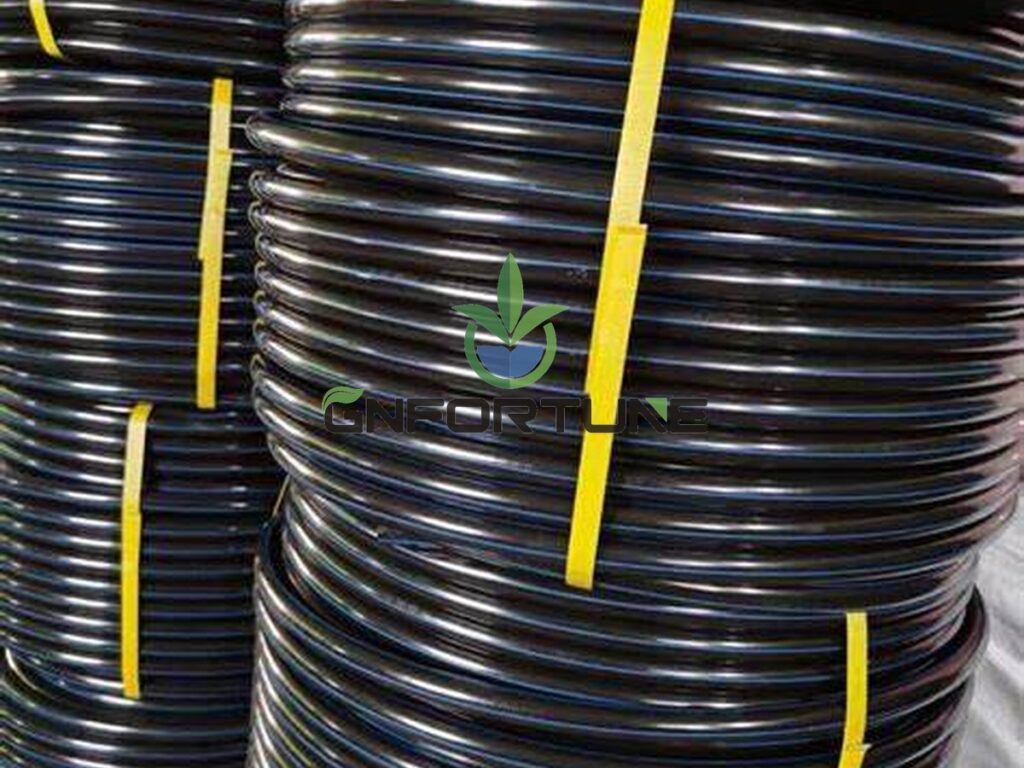
Pump and tank sizing live in their own articles; this piece covers only the pipe between them and the zones. The layout rules for runs and manifolds are set out separately in the farm pipework layout article, and the pipe material choice between PVC and PE is compared in the article on PVC versus PE for irrigation mains.
Two Limits on Velocity: Erosion and Water Hammer
As planning bands with the premises stated — standard PVC or PE mains carrying clean, filtered nutrient solution:
- Comfortable design range: roughly 1.0–2.0 m/s. In this band friction losses stay manageable and the system stays quiet.
- Approaching the limit: 2.0–2.5 m/s is workable on short runs but spends pressure and amplifies every downstream disturbance.
- Above about 2.5–3.0 m/s: erosion risk on fittings rises, noise becomes audible, and any valve closure or pump stop turns into a sharp pressure transient. The mechanics and remedies of that transient are covered in the article on water hammer in hydroponics — the sizing link is that velocity is the energy water hammer starts with.
Velocity is just flow divided by area, so the design check takes one minute: peak flow in the main, pipe internal diameter, compute. A main carrying 40 m³/h at 2.0 m/s needs an internal diameter of about 84 mm — a DN90 or DN100 pipe in practice. The same 40 m³/h pushed down a DN63 pipe runs near 4 m/s, which is a hammer event waiting for a solenoid to close.
Friction Loss: How It Accumulates Along the Main
Head loss per metre scales steeply with velocity — roughly with its square — which is why one pipe size up changes everything. The table gives planning-order figures for clean water in straight PVC mains; fittings add a percentage on top and actual losses vary with roughness and age, so treat these as estimation references.
| Pipe (internal approx.) | Flow 20 m³/h | Flow 40 m³/h | Velocity at 40 m³/h |
|---|---|---|---|
| DN63 (~56 mm) | ~2–3 m per 100 m | ~8–11 m per 100 m | ~4.0 m/s — reject |
| DN90 (~84 mm) | ~0.4–0.6 m per 100 m | ~1.5–2.0 m per 100 m | ~2.0 m/s — at the design edge |
| DN110 (~102 mm) | ~0.2 m per 100 m | ~0.6–0.8 m per 100 m | ~1.4 m/s — comfortable |
| DN160 (~148 mm) | negligible | ~0.15 m per 100 m | ~0.7 m/s — generous |
Read the table as a shape, not as gospel: dropping from DN63 to DN90 at 40 m³/h cuts the loss per 100 m roughly five-fold while the pipe’s price and footprint barely move. On a 60 m main, the DN63 choice burns 5–7 m of head — head the pump must produce and the last zone never sees.
Sizing a Main Between Zones: Four Steps
The procedure that keeps the decision honest:
- Set the design flow. Peak simultaneous demand — which zones actually run together — not the sum of all zone nameplates. Zone scheduling is the cheapest pipe-size reducer on the farm.
- Check velocity first. Pick the smallest standard diameter whose velocity sits inside the 1.0–2.0 m/s band at design flow. This sets the floor on pipe size.
- Then check friction. Compute head loss over the actual run length, including fittings, and confirm the total fits inside the pressure budget — pump head minus elevation minus what the worst zone needs at its inlet.
- Reserve margin deliberately. If expansion is plausible, take the next size up at installation rather than re-digging later; the incremental cost is small and the retrofit is not.
Where balancing between zones consumes the margin instead of serving the crop, the zone balancing logic in the article on zone balancing valves and flow setting shows what the commissioning data should look like — a main sized correctly leaves the balancing valves working in their normal range rather than wide open.
Symptoms of an Undersized Main
Undersized mains announce themselves through four recurring symptoms, and the pattern is worth memorising because it is often misread as a pump problem:
- The far zones collapse when near zones open. Opening one more valve steals the distant zone’s pressure — the signature of friction, not of pump capacity.
- Balancing valves sit wide open at the far end and heavily throttled at the near end: the main consumed the head that balance needed.
- The pump duty point sits wrong. With the system curve steeper than designed, the pump rides back on its curve and delivers less than its rating — the pump looks undersized and a larger impeller only papers over the pipe.
- Hammer and noise on every valve closure. High velocity stores the energy; every solenoid becomes a small impact event.
If two or more symptoms appear together, measure before spending: a pressure gauge at the pump and one at the farthest zone, both read at design flow, puts the actual loss on the table and confirms whether the pipe or the pump is the real deficit.
Pipe Material Note: Why Smoothness Matters Here
Friction arithmetic assumes a known interior roughness, and materials age differently: new PVC is smooth, older PVC and any pipe that has hosted scale or biofilm carries a rougher wall and higher real losses. That is one more reason the velocity band above is conservative rather than optimistic. Biofilm growth inside pipes is managed as a hygiene topic elsewhere; from the sizing view, the takeaway is to leave head margin for the pipe the farm will own in year five, not the pipe it installs in week one.
Pipe velocity and friction losses turn mains sizing into arithmetic a project team can defend: set the design flow, hold velocity in band, budget the head honestly, and the last zone gets the pressure the first zone does.
FAQs About Pipe Velocity and Friction Losses
What velocity should a hydroponic main run at?
Plan for roughly 1.0–2.0 m/s as the comfortable band on PVC or PE mains carrying filtered solution, with anything approaching 2.5–3.0 m/s treated as a hammer and erosion risk. Short runs tolerate the upper band better than long ones.
How much head does friction really cost?
It depends on diameter more than anything: at 40 m³/h, planning-order losses run about 8–11 m per 100 m in a DN63 pipe versus under 1 m per 100 m in a DN110. Compute for your own lengths and fittings rather than copying any table.
Why do far zones lose pressure when near zones open?
Because simultaneous demand raises velocity in the shared main, and friction loss rises roughly with the square of velocity. The deficit appears at the end of the line first; it is a pipe symptom, though farms often spend on the pump first.
Can we fix an undersized main without re-piping?
Partially: re-schedule zones to lower simultaneous flow, add a booster at the far end, or accept throttled near zones — all workarounds with costs. Where the deficit is structural, replacing the main is usually cheaper than years of operating around it.
Does pipe size affect nutrient dosing or EC?
Indirectly, yes: velocity affects mixing distance and dead-leg volumes, and very large, slow mains hold more standing solution that dilutes the buffer — the volume side of that trade is covered in the system water volume article. For most farms the sizing decision is driven by pressure and hammer, not chemistry.
Related Reading
- PVC vs PE Pipe for Irrigation Mains: Which Wins — The material choice behind the friction figures
- Water Hammer in Hydroponics: Pressure Spikes — What high velocity stores and releases
- Zone Balancing Valves and Flow Setting — The commissioning data a correct main makes possible
- Hydroponic Pump Sizing: Flow Rate, Head and Redundancy — The pressure budget the main spends
- Pipework Runs and Manifold Layout: Farm Rules — The routing rules around the sizing arithmetic
Next Step: What to Send for a Quotation
Mains diameter is quoted from the flow schedule and the pressure budget, both of which come from the zone plan. Send the zone schedule, run lengths and inlet requirements, and the pipework can be sized and priced with the velocity checks shown.
Sizing mains between zones or auditing an existing network? For RFQ or project consultation, send: the number of zones and their simultaneous-run schedule; design flow per zone and total; run lengths from pump room to the farthest zone; pipe material preference (PVC or PE); available pump head and elevation differences; expansion plans that affect margin; delivery schedule; and the budget band. G AND N FORTUNE LIMITED supplies pipework, manifolds, valve packages and complete NFT, DWC, Dutch bucket and substrate systems quoted to those parameters.