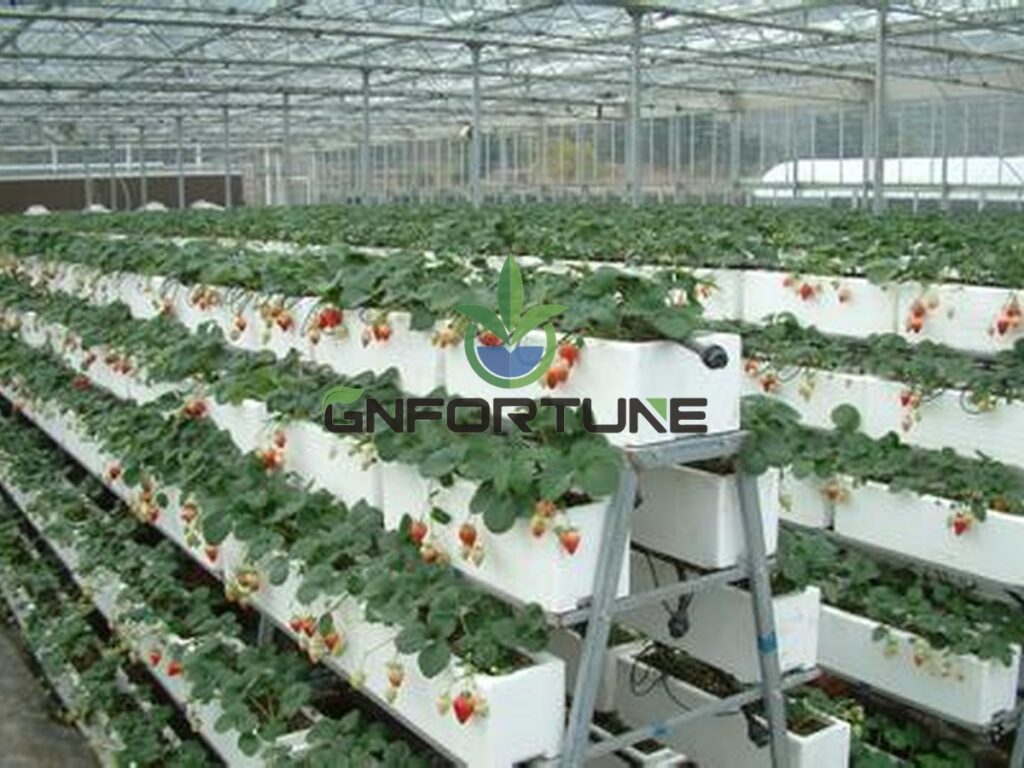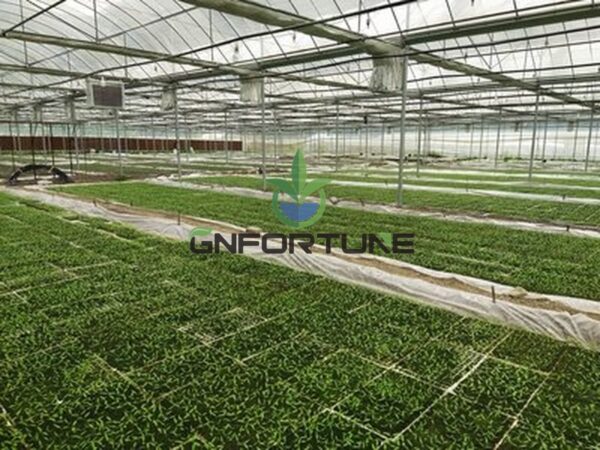
The control room says 19 °C; the canopy may be running at 15. The difference is heat stratification — warm air buoyantly collecting under the ridge while the crop sits in the coolest layer of the house. Every heated or screened greenhouse stratifies to some degree, and the size of the gradient, not the average, decides how uniform the crop grows and how honest the sensor readings are. Ventilation system configuration and deliberate day-night temperature steering are separate subjects; this article covers the stratification phenomenon itself: why the ridge wins, what the gradient costs, and what mixing fans genuinely change.
Why the Ridge Is Warmer
Warm air is lighter air, and nothing in an undisturbed greenhouse forces it back down. Heat sources near the top — sun-warmed cover, ridge-space pipes, screened light — load the upper air first; the thermal screen then closes and acts as a lid, trapping the warm layer above the fabric or, when the screen sits below the ridge, above the crop but below the film. Radiation through clear film adds to the effect: on a cold clear night the ridge air loses heat more slowly than the crop layer, which sits closest to the cold floor and the coldest inflows.
The result is a vertical gradient that forms within an hour of the house closing up and deepens through the night. As a planning observation, houses with closed screens and ridge heating commonly show ridge air 3–8 °C warmer than crop level on winter nights, assuming a screen-height of 3.5–4.5 m and no destratification. The number varies with screen position, heating type and weather, which is exactly why it should be measured on each site rather than assumed.
What a Vertical Gradient Costs
The gradient taxes the farm in four currencies:
- Uneven crop development: plants in the cold layer grow slower and stay wetter; anything near the ridge grows faster. Across one house the difference reads as uneven maturity at harvest and wider grading spread.
- Wasted energy: heat delivered to the ridge is heat the crop never uses. A thermostat at ridge height reads the warm layer, concludes the house is warm, and holds back heating while the crop shivers — the classic reason a house feels under-heated with normal energy bills.
- Deceiving sensors: a single sensor answers a question about its own height, not the crop. Ridge-level readings and crop-level readings can differ by more than the control dead-band, and the control system will faithfully serve the wrong one.
- Humidity and disease pockets: cool, still air at the canopy holds moisture longer, so the coldest layer is also the wettest — precisely where botrytis begins. The humidity and VPD guide covers the control side.
What Mixing Fans Change — and What They Do Not
Mixing fans attack the mechanism, not the heat budget. By circulating air continuously, they drag the warm ridge layer down and return cooled air upward, collapsing the vertical gradient so the whole house runs closer to one temperature. Three effects follow: crop-level temperature rises without new energy input — the warmth already paid for is finally delivered where the crop is; humidity evens out and wet pockets shorten; and the thermostat reading starts to mean something, because the volume it samples matches the volume the crop occupies.
What mixing does not do: raise the average temperature of the house, replace heating, or overcome a closed screen that traps air above the fabric. If the warm layer sits above a screen that stays closed, the fans below can only stir the layer they share with the crop. Screen design with adequate porosity, or screen-gap operation during the coldest hours, is part of the stratification answer whenever a near-airtight screen is installed — the guide to thermal screens covers that trade.
Fan Choice, Placement and Air Speed
Two fan families do this work, and they are often confused. Horizontal air flow (HAF) fans move air along the house in a loop, circulating the whole volume rather than pushing it downward; they are the standard tool in gutter houses and the usual meaning of “mixing fans” on a farm. Vertical destratification fans, common in taller structures and warehouses, point air straight down from the ridge and physically press the warm layer into the crop zone; they suit houses where the gradient is dominated by height rather than length.
Placement rules that hold across designs:
- Circulate in a loop, not across the crop: HAF fans mounted above canopy height and aimed horizontally along the bay set up the rolling circulation that reaches every plant. Aimed down at the crop, the same fans create cold draughts and dry spots.
- One direction per bay, staggered along the house: opposing fans at alternating positions keep the loop continuous through the length of the house.
- Size for gentle speed: a planning band of roughly 0.2–0.5 m/s air speed at canopy level suits most leafy and fruiting crops, assuming normal humidity targets; above that, transpiration stress and uneven drying appear, and the fans begin costing more than the gradient did.
- Run the fans whenever the house is closed: stratification forms as soon as vents close and screens shut, so the mixing schedule follows the closing schedule, not the daylight clock.
The guide to ventilation design and HAF fans covers fan sizing and mounting hardware in depth; here the design intent is the point — the fans’ job is uniformity, not wind.
Verifying the Result: Measure the Gradient
The honest test is a vertical temperature stack: three or four sensors at floor level, canopy height, just above the crop and at ridge height in the same bay, read together on a still winter night. Before mixing, the spread tells you the size of the problem; after fans are commissioned, the spread tells you whether they were placed and sized correctly. A pair of handheld meters carried through the bay at crop level adds the horizontal dimension — cold corners and end-wall zones are horizontal problems that vertical mixing cannot fully solve.
The table below is the field reading pattern worth keeping. It assumes a screen-height house with HAF fans, measured on a still winter night with the vents closed.
| Height in the bay | Typical pattern without mixing | What mixing fans change |
|---|---|---|
| Ridge, above the screen | Warmest layer, several degrees above crop level | Largely unchanged if the screen traps it; design screen porosity instead |
| Screen level, below the fabric | Warm pool forms here overnight | Pulled down into circulation and shared with the crop |
| Canopy height | Coolest occupied layer; wet air, slow growth | Rises toward the house mean; humidity evens out |
| Floor and channel level | Coldest zone; drafts at base gaps | Warmed by circulation; base sealing still required |
Heat stratification is not a defect to eliminate but a physics to manage. Measure the gradient once, install circulation that shares the warm layer with the crop, and verify the same way — the readings before and after are the whole business case, written in numbers the energy bill will confirm.
FAQs About Heat Stratification
How large can the ridge-to-crop temperature difference get?
On winter nights with a closed screen and no destratification, planning observations commonly show 3–8 °C between ridge air and crop level, assuming screen heights of 3.5–4.5 m. Measure the gradient in your own house, since screen position, heating layout and weather all move the number.
Why is our thermostat reading warm while the crop looks cold?
The sensor sits in the warm upper layer that stratification created, so the controller believes the heating target is met. Move the control reference to crop level in a mixed house, or add mixing so the sampled air matches the air the crop lives in.
Do mixing fans increase energy use?
Fan motors consume modest power, but mixing usually reduces total energy use: heat already delivered to the warm layer is reclaimed for the crop, thermostat overshoot falls, and heating setpoints can often be verified downward once the house runs to one temperature.
Should HAF fans run during the night as well as the day?
Yes whenever the house is closed, because the gradient forms as soon as vents and screens shut. The common exception is extreme cold with low airflow tolerance, where growers balance mixing against draught risk on the most exposed rows.
What air speed at the canopy is right?
A planning band of roughly 0.2–0.5 m/s at canopy level suits most crops, assuming normal humidity control. Gentle movement keeps leaves dry and temperature uniform; speeds beyond that stress transpiration and dry the crop unevenly.
Related Reading
- Greenhouse Ventilation Design: Vents and HAF Fans — Fan sizing, mounting and circulation layout in depth
- Thermal Screens for Hydroponic Greenhouses — The lid over the warm layer and its porosity trade
- Greenhouse Heating for Hydroponics — Where heating energy goes and how the targets are set
- Sensor Placement: Where Readings Go Wrong — The height problem behind the deceiving thermostat
- Greenhouse Humidity Control and VPD for Hydroponics — Why the coldest layer is also the wettest
Next Step: What to Send for a Quotation
Fans, screens and sensors are quoted separately, and uniformity is exactly the outcome that falls between them. Specifying circulation together with screen design and sensor layout is what makes one-temperature houses achievable.
Planning circulation for a stratified house? For RFQ or project consultation, send: greenhouse dimensions, ridge height and screen position; heating system type and layout; measured vertical temperature spread if available; crop and target canopy air speed; whether vertical destratification or horizontal circulation is preferred; automation and sensor level wanted; spares ratio; delivery schedule; and the budget band. G AND N FORTUNE LIMITED supplies channels, gutters and matched structure and circulation hardware quoted to those parameters.