Two covering films can carry the same thickness, the same nominal light transmission and a similar price, then behave completely differently over a season. The difference sits in the additive package: agents that move condensed water off the inner surface, particles that scatter incoming light, and layers that slow radiant heat loss at night. Greenhouse film additives are usually sold as a list of features, and buyers are rarely told which one addresses their actual problem. This guide takes the three functions separately and covers the failure patterns that appear in the second or third season.
The scope is functional layers in polyethylene covering film; see the covering materials comparison for the wider material choice.
What Film Additives Change, and What They Do Not
Additives change how the film handles water, light and radiant heat. They do not make the film mechanically stronger, and they will not rescue a house that cannot ventilate or cannot remove humidity.
Additives are either compounded into the resin or a co-extruded layer during production, or applied to the surface afterwards. That distinction decides how the function ages: a compounded layer loses performance as the material weathers, while a surface treatment can be stripped by cleaning or chemical drift. Confirm which construction is being quoted.
The families that matter in a hydroponic house:
- UV stabilisation — a prerequisite, not an upgrade; ask the rated dose and warranty period.
- Anti-drip surfactant — changes how condensation behaves on the inner surface.
- Diffusing agents — particles that scatter transmitted light.
- IR / NIR layers — reflecting near-infrared to cut day heat gain, or blocking long-wave loss at night.
Anti-drip and anti-fog are not the same claim: anti-fog concerns fine droplets, anti-drip concerns condensate that runs or falls.
Anti-Drip: Film Condensation Control Comes First
Anti-drip agents lower surface tension so condensed water spreads into a continuous sheet and runs down the inside of the film instead of hanging as droplets. The benefit is fewer drops falling onto the canopy and less light scattering — not lower humidity, because the water stays in the house.
Humidity is managed by ventilation, dehumidification and screen management; the film only decides where condensate goes. The value shows up in two places:
- Disease pressure. Water dropping onto a dense canopy keeps leaves wet overnight, which is the condition botrytis and downy mildew need.
- Light and leaf damage. Droplet cover reduces transmission and can focus light onto individual leaves; scorching is often blamed on the sun when the cause is an anti-drip greenhouse film that has stopped shedding water as a sheet.
The benefit is largest where the inner surface regularly falls below dew point: cold-climate houses, poorly sealed structures, and houses where the screen leaves the film cold at the edges. Where a well-sealed energy screen is fitted, condensate above the screen matters far less to the crop — the humidity problem then belongs to the thermal screen side.
Anti-drip is a finite reservoir. The surfactant migrates to the surface and is gradually depleted, so performance falls progressively rather than suddenly. Ask for a stated duration and the test method behind it.
How Greenhouse Film Additives Change Light: Diffusing Film
Diffusing agents scatter direct sunlight so a larger share of it reaches the middle and lower canopy. In a tall or dense crop this usually improves uniformity; in a low-light winter climate it can cost total transmission, so the trade-off should be quantified before ordering.
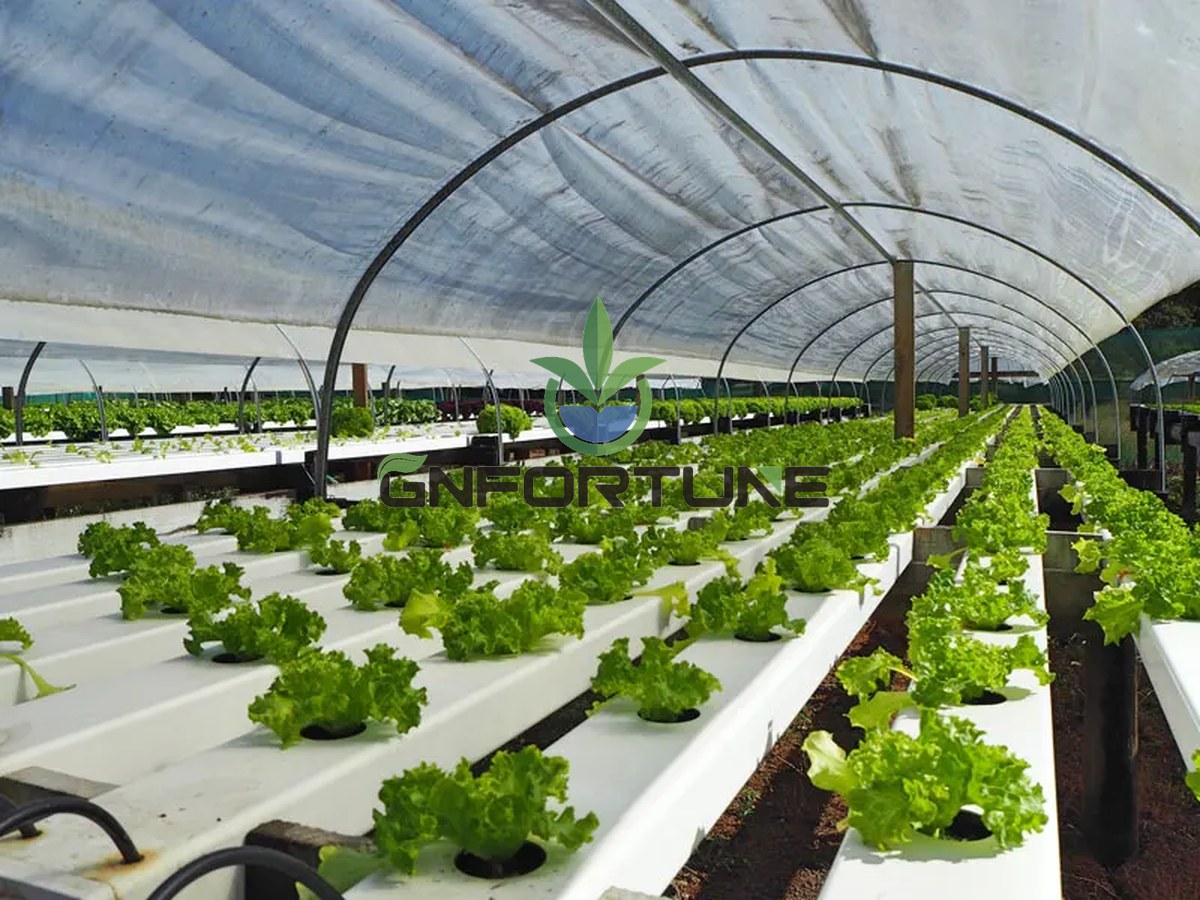
Direct sun saturates the top leaves while lower leaves work in shade. Scattering evens that out, lowers peak leaf temperature under strong sun, and softens the hard shadow edges that make lower trusses ripen unevenly. The light diffusion crop effect on a lettuce canopy is smaller, because that canopy is short and already evenly lit.
Two numbers matter: total light transmission and haze, the share of transmitted light that is scattered. A film described only by total transmission hides its diffusion behaviour. Ask for both, and note that a higher haze value is not automatically better — under low winter light, total transmission usually limits production more than distribution does. Hot climates are where diffusion earns its cost, where it complements the options in the guide to pads, fog and shade rather than replacing them.
Diffusing particles are dispersed through the material, so diffusion does not migrate away the way anti-drip does. What changes is clarity: soiling and weathering reduce total transmission.
IR-Blocking Layers and Night Temperature
IR-blocking additives slow the loss of long-wave radiation from plants and soil back out through the film. The measurable result is a warmer canopy on clear, still nights; on overcast or windy nights the difference narrows considerably.
There are two directions, and they are frequently confused. Near-infrared reflecting films are specified in hot regions to cut daytime heat gain; thermal barrier films are specified in cold regions and heated houses to hold heat at night. A film optimised for one is not optimised for the other, so state which problem you are solving.
Where a house runs an energy screen that closes properly, the increment from an IR-blocking film is smaller, because the screen already interrupts most of the radiant path. Where there is no screen, or it closes with gaps, the film carries more of that load.
An IR layer also changes the film’s own temperature and therefore its condensation behaviour, so the two functions belong in one evaluation rather than two separate purchases.
Service Life: How Additive Functions Fail
UV stabiliser depletion ends a film’s structural life. The functional additives usually fade earlier, and their symptoms are often mistaken for dirt.
- Dripping returns — from around the second or third season, condensate forms droplets again.
- Streaking — water running in fixed channels leaves deposits that cut transmission.
- Chemical haze — sulphur and certain sanitisers cloud the film permanently.
- Chalking and embrittlement — usually first at the fixing profile and gutter corners.
A planning range of three to five seasons is commonly used for a mid-thickness UV-stabilised film in a temperate climate with no sulphur use, assuming correct tension and no aggressive cleaning. Tropical UV loads, sanitisers and loose film shorten that range. Treat it as a planning assumption to test against the supplier’s written warranty.
Installation quality decides how the film ages. A sheet held firmly in its profile weathers evenly; one that flaps fails at the fixing line years earlier.
Choosing by Climate and Crop
Match the package to the limiting factor in the house: condensate in cold climates, peak leaf temperature in hot ones, night heat loss where energy is expensive.
| Context | Priority function | What to ask the supplier |
|---|---|---|
| Cold temperate, unheated | Anti-drip, then IR barrier | Anti-drip duration and test method |
| Hot arid | NIR reflection, moderate diffusion | NIR rejection figure and haze value |
| Humid tropical | Anti-drip, high UV package | UV dose rating; sanitiser compatibility |
| House with a sealed screen | Anti-drip only | Whether the IR layer adds anything |
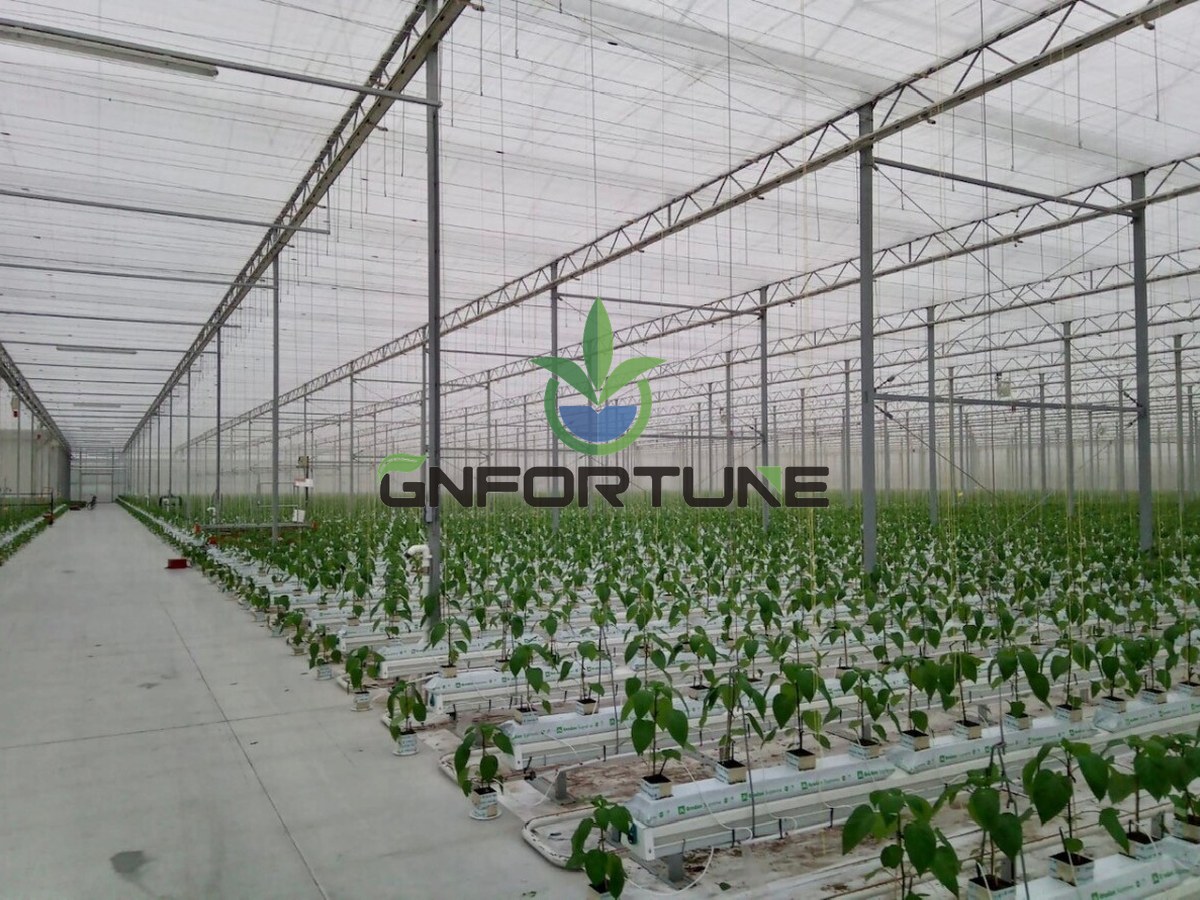
Crop shape matters as much as climate. Short canopies — lettuce, herbs, young plugs — gain more from anti-drip, because a drop landing on a low canopy lands on a saleable leaf. Tall vine canopies gain most from diffusion, since upper leaves shade everything below. Where one structure carries different crops, moderate haze with a long-rated anti-drip is the compromise.
What to Put in the Film Specification
Specify measurable quantities and the test method behind them. Feature names are not comparable between suppliers; numbers are.
- Thickness in microns with a tolerance, plus whether the functional layer is co-extruded or coated.
- Total light transmission and haze, both measured and stated.
- Anti-drip duration in months or seasons, with the test standard named.
- UV stabiliser package and warranty terms, including what voids them.
- Chemical compatibility with the sanitisers used on site.
The ordering that works in practice is to fix condensation first, decide light distribution second, and treat radiant heat third. Greenhouse film additives are worth specifying carefully for exactly that reason: the first protects saleable yield, the second changes uniformity, and the third is an energy decision that only pays under particular conditions.
FAQs About Greenhouse Film Additives
Do anti-drip and anti-fog mean the same thing?
No. Anti-fog deals with fine droplets that obscure transmission; anti-drip deals with condensate that runs off or falls onto the crop. Only anti-drip affects leaf wetness and disease pressure.
Does diffusing film reduce total yield?
It can, where light is the limiting factor rather than distribution. Under low winter light, total transmission usually matters more than scattering, so a high-haze film may cost more than it returns.
Can an IR-blocking film replace a thermal screen?
No. A screen interrupts convective and radiant loss together and opens by day; a film is a fixed barrier. IR layers are an increment on top of a screen, not a substitute.
How long do the additive functions actually last?
Shorter than the film. Anti-drip commonly declines before the sheet reaches the end of its structural life, while diffusion persists because the particles are dispersed in the material. Get the stated duration in writing.
Can anti-drip be restored on a film that has stopped working?
Not permanently. Spray-on treatments work briefly and need reapplication, rarely matching original performance. Replacement at the end of the planned cycle is usually cheaper.
Related Reading
- Glass vs Polycarbonate vs Film: Greenhouse Covering Materials — How the covering materials compare before you choose an additive package
- Thermal Screens: Night Heat Retention and Energy Saving — Where the screen does the work an IR film layer is sometimes bought to do
- Greenhouse Cooling in Hot Climates: Pads vs Fog vs Shade — The cooling options that sit alongside NIR-reflecting and diffusing film
- Greenhouse Ventilation Design: Vents and HAF Fans — Why ventilation and air movement still decide humidity after the film is chosen
- Technical Specification: Writing Hydroponic Equipment Specs — How to write specifications suppliers can price against each other
Next Step: What to Send for a Quotation
Covering packages are quoted against the structure and the climate, so the details below decide whether a quote is usable.
Planning a covering order or a full greenhouse package? For RFQ or project consultation, send: greenhouse dimensions and roof form; crop and canopy height; local climate range including night lows and peak summer radiation; whether a thermal screen is installed or planned; the sanitation products used on site; target film life in seasons; existing fixing hardware type if re-covering; delivery schedule; and the budget band. G AND N FORTUNE LIMITED supplies covering film packages and matching fixing hardware quoted to those parameters.