
Perlite for Hydroponics: Grades, Bags and Dust
Perlite for hydroponics is ordered by bag count and used by particle size, and the gap between those two units is where most media trouble starts. Expanded perlite is an inert, sterile, near-neutral granule that holds water on its surface while draining freely, which is why it appears in almost every commercial soilless blend. What changes root-zone behaviour is the grade: fine, medium and coarse cuts hold different air-to-water ratios, and a bag labelled only “horticultural perlite” can be any of them.
How Perlite Is Made and Why Grade Matters
Perlite starts as volcanic glass containing 2 to 5 percent bound water. The ore is crushed, screened to a feed fraction around 0.1 to 1 mm, then passed through a furnace at roughly 760 to 1,100 °C, where the bound water flashes to steam and the particle expands to four to twenty times its original volume.
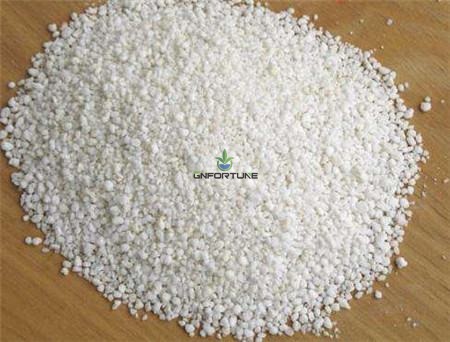
Two consequences matter on site. The product is sterile and chemically inert: pH sits near neutral, its contribution to EC is effectively zero, and it adds no buffer or nutrition. And the grade is set by the screen cut applied after expansion, not by the ore, which decides how much water the granule holds against gravity and how much air stays in the container. Buyers who specify only “perlite, 100 L bag” hand that decision to the supplier.
Particle Size and Air-to-Water Ratio
Particle size sets the air-to-water ratio. Small granules hold water in the narrow gaps between particles and drain slowly; large granules leave wide gaps that drain fast and refill with air. Figures below are indicative ranges, not guarantees.
| Grade | Particle size | Water at container capacity | Air-filled porosity | Where it is used |
|---|---|---|---|---|
| Fine | 0 to 1.5 mm | 35 to 45 percent | 15 to 22 percent | Germination covers, plug mixes |
| Medium | 1.5 to 3 mm | 28 to 38 percent | 22 to 30 percent | Bagged blends, bucket mixes |
| Coarse | 3 to 6 mm | 20 to 30 percent | 30 to 40 percent | Straight-fill bags, drainage layers |
Read the table as an irrigation decision: short, frequent pulses suit a coarse or de-dusted cut; a shallow tray watered once a day needs the moisture reserve of a fine cut. Note that a bagged “all-purpose” cut behaves like the finest fraction present, because fines settle into the gaps between coarse granules.
Bulk Density, Bag Weights and Container Loading
Bulk density for horticultural perlite commonly falls between 60 and 130 kg per cubic metre depending on grade and fines content. That number converts a bag count into a volume, and it is the number most quotes leave out.
| Format | Nominal volume | Typical weight | Handling note |
|---|---|---|---|
| 100 L bag | 0.10 m³ | 6 to 13 kg | Standard unit, staged by hand |
| Large bag, 8 ft³ class | About 0.22 m³ | 14 to 29 kg | Two-person lift, common export pack |
| 1 m³ big bag (FIBC) | 1.0 m³ | 60 to 130 kg | Forklift needed, lowest packing cost |
| 40 ft high-cube container | 55 to 70 m³ loose | 3.5 to 9 t | Loads by volume, under the payload limit |
Freight on perlite is a volume problem, not a weight problem: a 40 ft high-cube fills long before it reaches its payload, so landed cost per usable cubic metre tracks packing density and inland haulage. Compressed or baled packs cut volume but generate extra fines, so ask for a dust figure on the baled option first. Storage moves the weight too, since perlite staged outdoors picks up rain and a wet 100 L bag carries several extra kilograms of water.
Dust: Handling, Clogging and Health
Dust is the specification buyers skip and later pay for. Fines are the fraction below about 0.5 mm, and they cause three problems: airborne dust during handling, downward migration that blinds the drainage path, and loading of filters, emitter screens and return-line strainers.
A workable purchase spec asks for the percentage passing a stated sieve, in the low single digits by weight for most commercial buyers, and asks for the sieve analysis of the batch rather than a typical figure from a brochure.
Where it goes wrong on site: the dust does not stay where you put it. It washes down through the media in the first two weeks of irrigation, collects at the base of the container or slab, and turns the drainage layer into a paste. The crop looks fine for a month, then the root zone goes anaerobic and the plant collapses quickly.
Pre-wetting is the cheapest control. Wetting perlite to 30 to 40 percent moisture before it is tipped or mixed cuts airborne dust sharply; crews working dry material need eye protection and a fitted dust mask, and mixing belongs outside the house. Expect fines to show up as maintenance too, since return-main strainers need cleaning more often after a refill.
Mixing Perlite with Coir or Peat
Perlite is almost always a component rather than the whole media. Coir and perlite blends at 70:30 to 50:50 by volume are standard for bucket and bag crops, and peat and perlite mixes commonly run 3:1 to 4:1. Straight perlite suits sites where drainage matters more than water reserve and demands shorter, more frequent irrigation events. Filtration in the 120 to 200 mesh range is typical for recirculating systems, as the guide to soilless substrates explains.
Mixing practice decides how much of the grade survives to planting. Pre-wet before mixing, since damp material produces less dust and less breakage, and keep the mixing short: two to three minutes in a paddle or drum mixer is enough, because over-mixing fractures granules into fines. Fill containers loose and settle them with water rather than tamping, and blend by volume.
Nutritionally, all of the buffering and cation exchange in a coir and perlite mix comes from the coir, so unbuffered coir means calcium and magnesium have to be handled in the recipe. The cleaning and refill routine in reusing growing media applies to blends as much as to straight fills.
Perlite Substitute Media: What Changes When You Switch
A perlite substitute is chosen for freight cost per litre, local availability, or a different air-to-water balance. None is a drop-in swap.
| Substitute | Bulk density | Water versus air behaviour | Trade-off |
|---|---|---|---|
| Vermiculite | 90 to 150 kg/m³ | More water, less air | Soft, breaks down; heavy when wet |
| Expanded clay | 350 to 700 kg/m³ | More air, less water | Heaviest to ship; reusable |
| Pumice | 400 to 800 kg/m³ | Airy, stable | Freight cost; regional supply |
| Coarse coir chips | 70 to 110 kg/m³ | High water, moderate air | Batch EC; needs buffering |
Before switching, run the substitute through one crop cycle on a single zone and log irrigation events, run-off percentage and root-zone EC, because a cheaper price per litre can raise water and labour cost enough to erase the saving. Expanded clay pellets are the usual comparison when growers want an airier substitute.
Reuse, Sterilising and Disposal
Perlite can be reused for two to three cycles before the structure breaks down and fines accumulate. The sequence that works is to screen out roots, flush to bring EC down, disinfect, then top up with 20 to 30 percent new material. Heat treatment means steam or hot water at roughly 70 to 80 °C held for 30 minutes; the chemical alternative is hydrogen peroxide or peracetic acid at supplier rates followed by a clean-water rinse. Test run-off EC before refilling.
Disposal is a budget line: perlite is inert and does not break down, so spent media leaves the site as solid waste unless a local outlet accepts it as a soil conditioner or lightweight aggregate, and volume drives the cost. The checklist in the hydroponic supplier factory audit covers what to confirm before a bulk media order ships.
Frequently Asked Questions
Which perlite grade suits Dutch buckets?
A: A coarse or de-dusted cut in the 3 to 6 mm range, because finer grades hold water around the emitter and cut root-zone oxygen.
How much perlite does a 1,000 m² house use per cycle?
A: Roughly 8 to 10 m³ per cycle for a bucket house at about 2.5 plants per m² with 10 to 12 L of media per plant and a 70:30 blend, which is around 80 to 110 bags of 100 L; figures vary by region and season.
Does perlite need buffering before planting?
A: No. Perlite is inert with effectively no exchange capacity, so buffering and calcium or magnesium supply come from the coir or peat fraction and the nutrient recipe.
Can perlite be reused between crops?
A: Two to three cycles is realistic after root screening and disinfection, with 20 to 30 percent new material added at each refill.
How should two perlite quotes be compared?
A: Normalise to cost per usable cubic metre at a declared bulk density and fines limit, then add freight.
Grade, bulk density and fines decide whether perlite for hydroponics performs as the crop plan assumes, so get those three numbers into the enquiry before comparing prices.
Specify Perlite by Grade Before You Order
Send the crop, container volume, blend ratio and irrigation frequency, and ask for grade, bulk density and fines in writing. Request a perlite grade and packing quote with those three numbers declared, so the price you compare is the price you plant.


