
“Tower kit” is not a standard specification, and that is the first thing a buyer should accept. One supplier’s kit is a column with a cap; another’s includes reservoir, pump, timer, net pots, plugs and a spare nozzle set. Comparing two quotations on price per tower therefore compares different things. The reliable approach is to break the kit into component groups, cost-weight each group, and ask the supplier to fill the same table. Aeroponic tower system components fall into six groups, and four of them are where quotations quietly differ.
Aeroponic Tower System Components: The Standard Kit
A complete commercial tower kit covers the column, the misting assembly, the reservoir base, the planting hardware, the pump and controller, and a spares pack. The first five are equipment; the sixth is the line most often missing, and the one a first-time buyer needs most in month one.
| Component group | Contents | Indicative share of kit value | Often omitted |
|---|---|---|---|
| Column | Moulded or extruded tube, port faces, base collar | 25 to 40 percent | Base collar and joining sleeve |
| Misting assembly | Riser tube, nozzles, top cap, anti-drip valves | 10 to 20 percent | Spare nozzles and seals |
| Reservoir base | Base tank, lid, drain and fill access | 10 to 20 percent | Drain fitting and level mark |
| Planting hardware | Net pots, collars or lids, plugs | 5 to 15 percent | Spare pots and plugs |
| Pump and control | Pump, interval controller, tubing, strainer | 15 to 30 percent | Spare pump or seal kit |
| Spares pack | Nozzles, seals, pots, plugs, strainer | Under 5 percent | Usually omitted entirely |
The shares are indicative and move with configuration: a kit with a moulded column and a high-pressure pump sits at the top of the column and pump ranges, while a basic gravity-fed column with a low-pressure pump sits at the bottom. Actual figures vary by region and season, so use the table to check that a quotation is complete rather than to predict a price.
Columns: Moulded vs Extruded
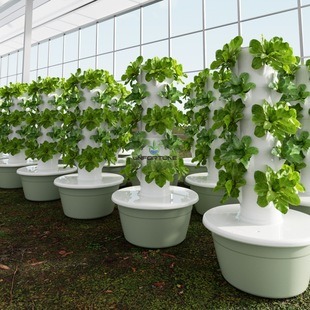
Column construction sets port accuracy, freight, and tooling cost, and it is the group with the widest quality spread between suppliers. Moulded columns arrive with ports formed in, so port geometry and spacing are repeatable. Extruded columns are cut to length and drilled, which allows any height but puts accuracy in the hands of a jig.
| Attribute | Moulded column | Extruded column |
|---|---|---|
| Port accuracy | Formed in the tool, repeatable | Depends on drilling jig and operator |
| Height flexibility | Fixed by tooling | Any length from the extrusion |
| Tooling cost | High, amortised over volume | Low; jigs only |
| Freight efficiency | Poor; a column is mostly air | Better; nests or ships as lengths |
| Wall thickness and UV | Stated per tool, easy to verify | Varies by extrusion batch |
| Best fit | Repeat orders at fixed specification | Pilot runs and custom heights |
Whichever construction is quoted, four material facts belong on the specification: polymer type, UV stabiliser package, wall thickness in millimetres, and a food-contact declaration for the material in contact with nutrient solution. A white exterior is standard on purpose, since it reduces heat gain on columns standing in direct sun.
Ports, Net Pots and Spacing
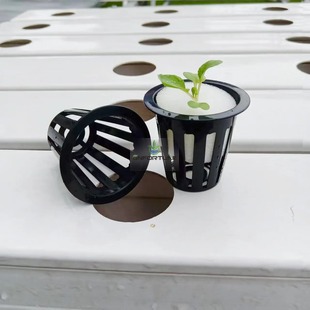
Port count and net pot size set what the tower can grow. Common configurations run 20 to 40 ports per column at roughly 100 to 150 mm vertical spacing, with net pots in the 50 to 65 mm range for leafy crops. Wider spacing suits larger plants and longer cycles; tighter spacing suits short-cycle leaf and raises plants per square metre.
Two compatibility details cause most re-ordering. Port diameter and net pot diameter are nominal, so a pot that fits one column may drop through another; and collar or lid geometry varies, so a lid bought separately rarely matches. Net pot specification is worth reading before the column order is finalised — see the wholesale net pot guide and the net pot size comparison.
Misting Manifold and Top Cap
The misting group is small in value and large in consequence. Confirm nozzle count per column, nozzle type and orifice, how the riser seals into the top cap, and whether the assembly can be withdrawn for cleaning without dismantling the column. Anti-drip valves belong on the specification, because a weeping nozzle changes root-zone moisture between cycles.
Ask whether the manifold is pressure-rated for the pump supplied with the kit. A top cap that holds at low pressure will mist unevenly or weep at the seal if the pump is later upgraded, and a cap without a serviceable seal becomes a replacement part rather than a maintainable one.
Reservoir Base and Pump
The base is a reservoir, a structural foot, and a hygiene surface at the same time. Confirm volume, which on commercial columns is commonly in the tens of litres; drain and fill access; whether the lid seals against light; and whether the pump sits inside the base or externally. An internal pump is quieter and simpler to ship, but harder to service; an external pump is easier to swap and easier to hear when it fails.
Pump specification should state pressure at the nozzle, duty cycle, and start-stops per hour, since tower pumps run in short bursts. The mist hardware side of that decision is covered in the aeroponic equipment buying guide, and the duty pattern in service in the tower mist pump and uptime guide.
Spares, Warranty and Selling Unit
Selling unit is a commercial question that changes the landed number: kits may be quoted per column, per complete tower, per pallet, or per container, and the packing count should appear on the quotation. Confirm minimum order quantity, whether mixed configurations are allowed within one container, and what the warranty covers in months and in parts.
The question that separates a real kit quotation from a column quotation: ask what is not included. A supplier who lists the exclusions — plugs, spare nozzles, spare pump, strainer, collar seals — has usually costed the kit properly. A supplier who answers “everything is included” has usually not, and the missing parts arrive as a second order at air freight cost.
The spares first-time buyers forget are consistent across suppliers: spare nozzles and seals, at least 10 percent extra net pots and collars, a spare pump or seal kit, a spare interval controller, and plugs for the first planting. Ordering them with the kit costs little in freight and removes the first-season emergency. For layout and density planning around the columns, the vertical growing systems guide sets out how towers sit alongside racks and walls, and vertical system packages show the standard configurations.
FAQ
What does a standard aeroponic tower kit include?
A: Column, misting assembly with top cap, reservoir base, net pots with collars, pump and interval controller, and ideally a spares pack. Confirm each group by name, since kit definitions vary by supplier.
How many ports does a commercial tower have?
A: Commonly 20 to 40 ports per column at roughly 100 to 150 mm spacing, with net pots in the 50 to 65 mm range for leafy crops.
Is a moulded or extruded column better?
A: Moulded gives repeatable port geometry and stated wall thickness, and suits repeat orders. Extruded allows any height with low tooling cost, and suits pilots and custom runs.
Does the kit need a spare pump?
A: Yes on any installation where a pump trip would dry the root zone before staff respond. One spare pump or seal kit per site is the usual starting point.
What is usually missing from a first order?
A: Plugs, spare nozzles and seals, extra net pots and collars, and a spare controller. Add them to the kit order rather than shipping them separately later.
Request a Tower Kit Quotation
Send column count, port configuration, crop and cycle length, and whether pumps and controls are required, then compare suppliers on the same six-group breakdown. Aeroponic tower system components are easy to buy individually and expensive to buy twice, so ask for the kit contents as a table with omissions stated. Use the request a tower kit quotation form to send those inputs.


